

Last Updated on April 21, 2024 by George Pavlopoulos
Folegandros is one of the most beautiful Greek islands, and shooting polaroids there was one of the most joyful things to do. The main settlement, Chora, is stunning, and the landscape is breathtaking. So, even though it’s tempting to shoot thousands of digital photos, I decided to keep it analog for 48 hours. That said, for the Polaroid Diaries: Folegandros, I decided to skip both my camera and smartphone for two days and see what would attract me.
It was not an easy task. I had two SX-70 films with me, and I wanted to have some keepers. Moreover, I had to keep in mind the limitations of instant cameras. Sure, the SX-70 is much sharper than other instant cameras, but this doesn’t mean you can shoot everything. However, since the landscape was so beautiful, I wanted to push my Polaroid SX-70 to its limits.
Could I produce some fine photos full of detail for the Polaroid Diaries: Folegandros? And, the most important thing: how would the SX-70 handle the extremely intense light of Folegandros? I won’t lie: I thought that everything would be overexposed. But as you can see below, the SX-70 didn’t let me down.
*Some links are affiliate links. It means that if you buy something, I might earn a small commission at no additional cost to you.
What you’ll see in the Polaroid Diaries: Folegandros with the SX-70
I won’t present all the 16 polaroids I took. The reason is that some of them are duplicates, while others didn’t work as I expected. So in this edition, you will actually see 10 polaroids from Folegandros. In the Polaroid Diaries: Folegandros, you will see some of my photos while strolling or hiking around the island. I wanted to have a variety of pictures, and that’s why you won’t see a constant motif. Sometimes it’s all about the landscape; other times, you will see details.
At the bottom of this post, I will also share the settings I used. And, if you want to learn more about the island, you can check my Folegandros travelogue and also my travel guide.
Let’s start.
*This post belongs to my #PolaroidAugust project.
Polaroid Diaries: Folegandros with the SX-70
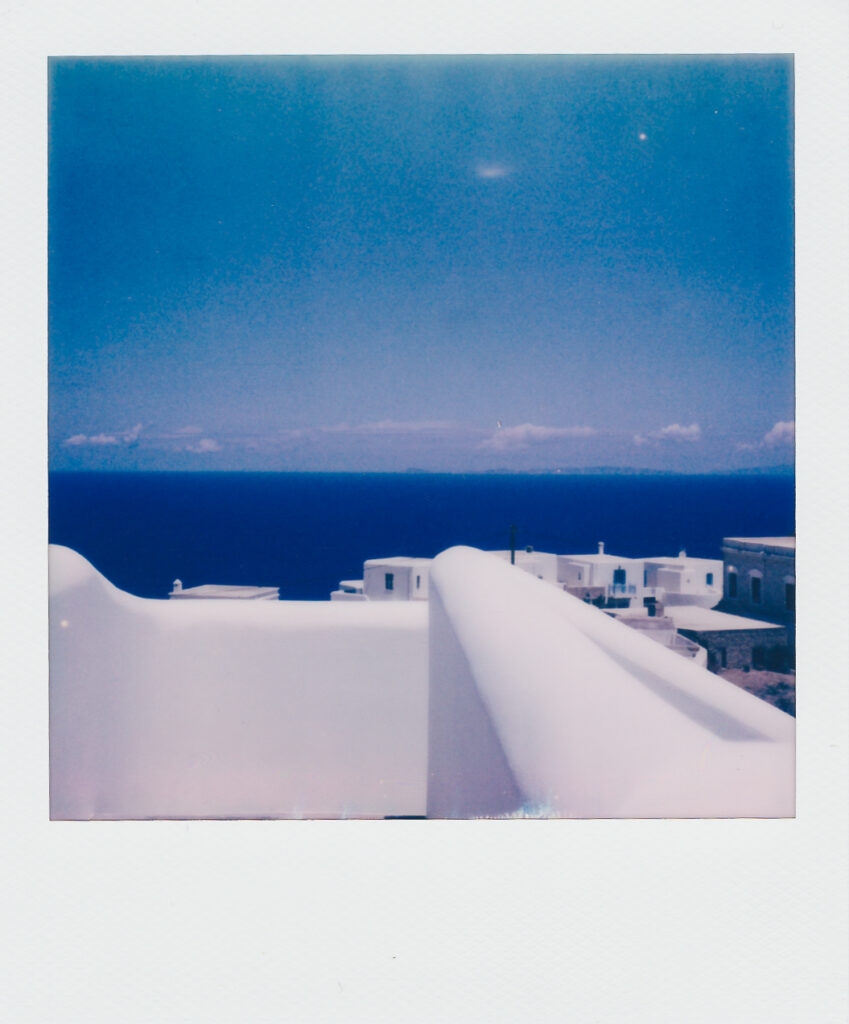
The first polaroid I shot in Folegandros was from my hotel room. The upper floors of Hotel Horizon enjoyed wonderful views of both the sea and the Chora. You could also see the monastery on the top of the rock, one of the most photographed spots on the island. I always have a thing for negative space, and it is even more challenging to capture it in polaroid photography. So, here’s the view from my hotel room.

Well, whenever we hear about the Greek islands, I guess we all think of the blue sea and white walls. So I found a nice motif, combining the two elements, actually. The sunlight was intense, but I kept the exposure wheel in the middle. The result satisfied me: for a polaroid photo, both the highlights and shadows looked nice.
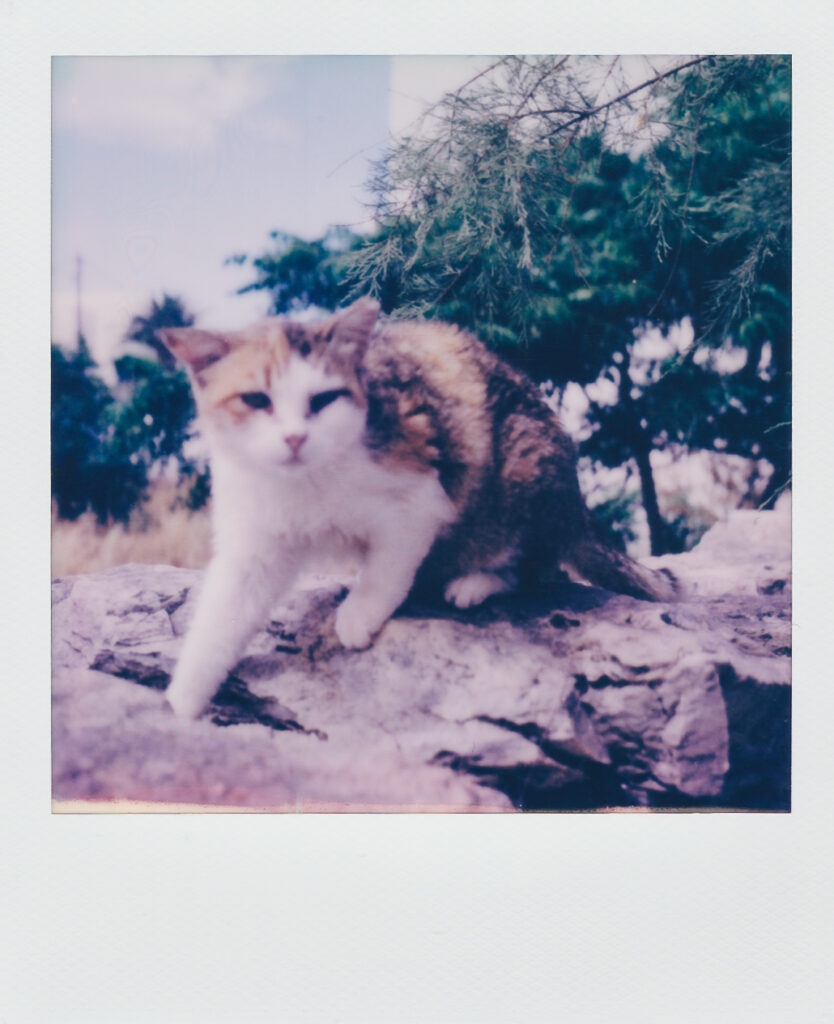
The next photo didn’t work as I expected it to. Apart from missing a bit of the focus, it seems that there was a problem with the film. The cat moved quickly on the stones, but as you can see, there’s something like a layer splitting the image into two. However, Polaroid photography is not about perfect results. Instead, it’s all about the moment and the sweet nostalgia you feel after years. Plus, the cat was beautiful even though a bit bored.
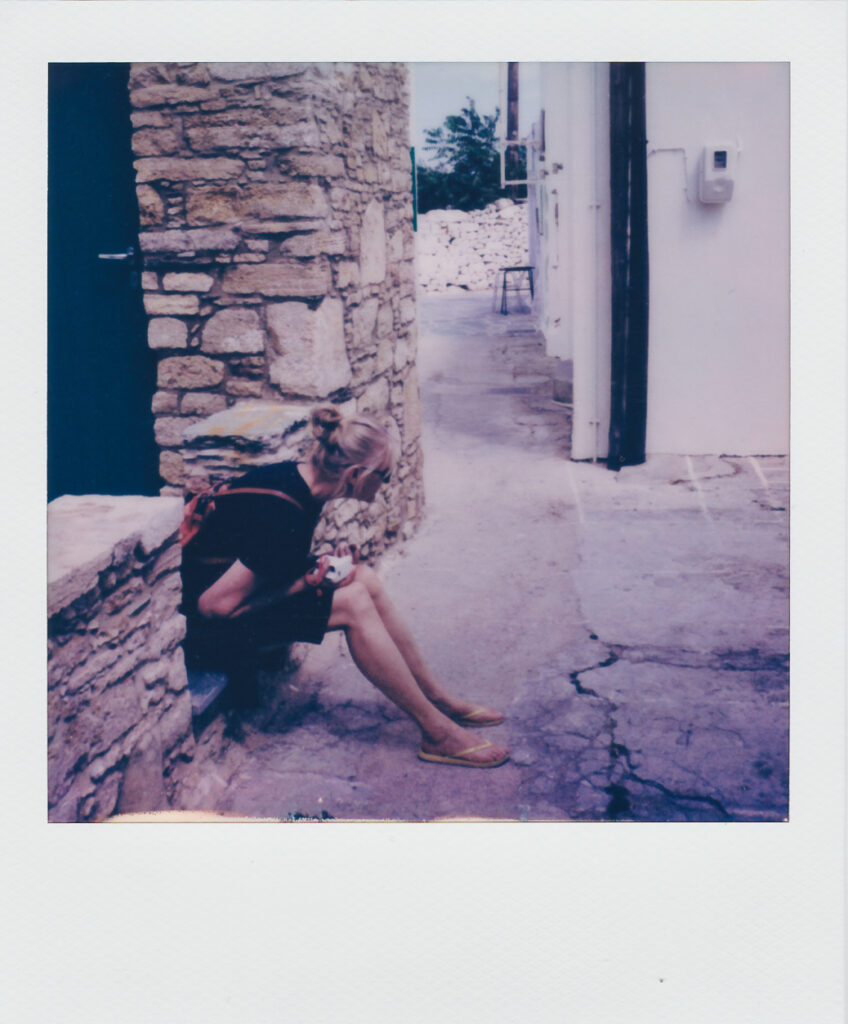
I took two more photos from the Chora before hiking towards the beaches. In the first one, you can see Barbara taking a break while trying to bring another cat towards her. The light was not that strong at the moment, hence the darker touch on the image.
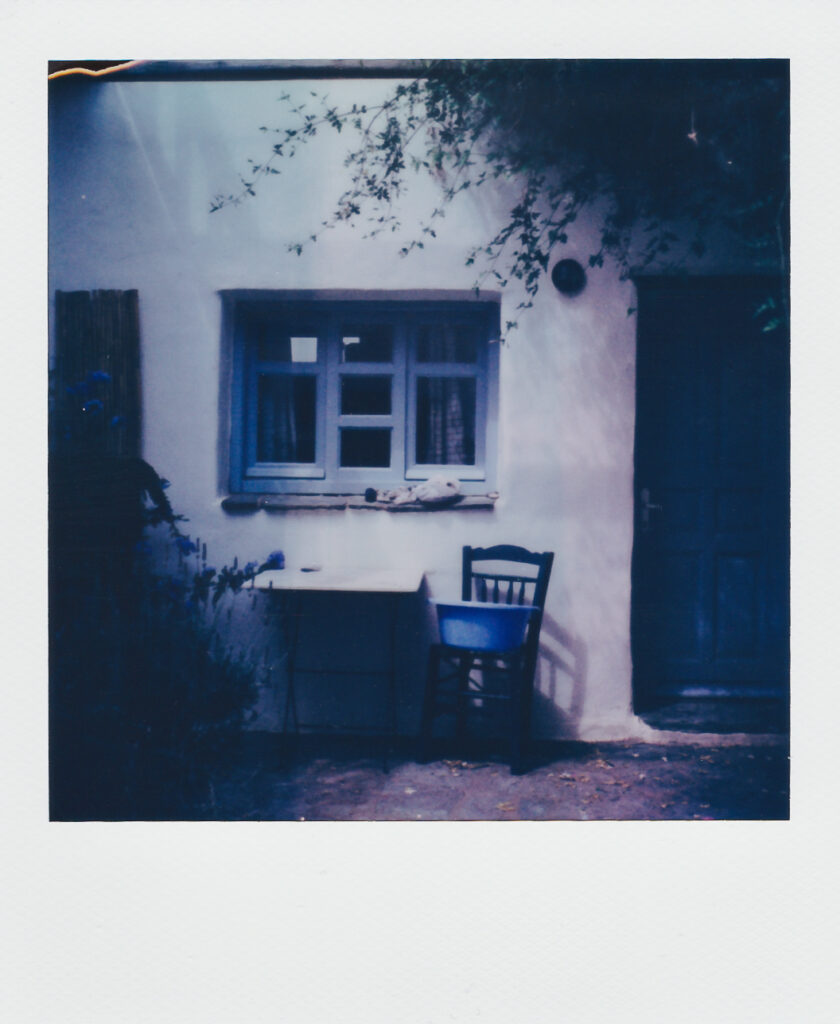
Close to where Barbara was sitting, a passing cloud created some interesting shadows. I often like to shoot banal polaroids and see how they look. Here you can see the facade of a typical Cycladic house. It’s in the Chora of Folegandros.
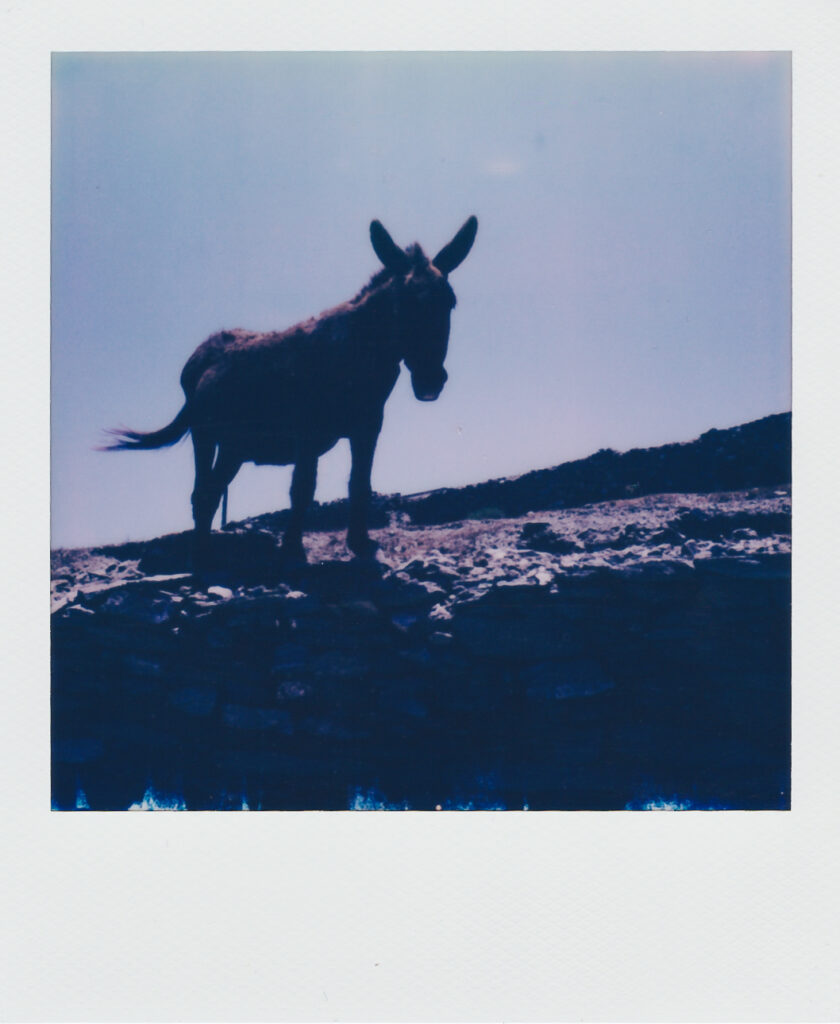
Later the same day, I saw a lonesome donkey. In the settings section below, you will see what I tried to do and why the photo turned out like this. I like the photo, however, and I find it typical for the landscape of Folegandros. If you decide to hike, you will actually see plenty of donkeys everywhere on the island.
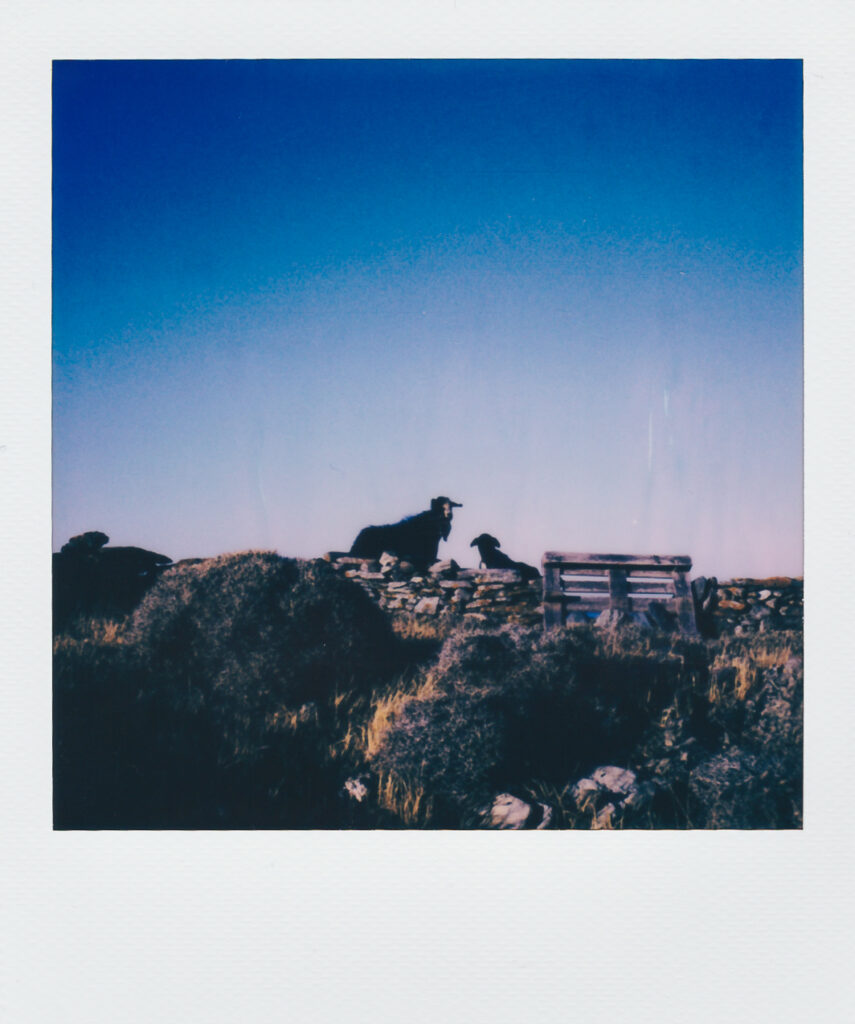
Talking about the animals of Folegandros, apart from donkeys, you will also come across goats and sheep. They are really everywhere on the cliffs, and they won’t harm you. Sure, they will be curious about your presence, but soon they will lose interest. Since the Polaroid SX-70 doesn’t have a zoom, it’s hard to take a close-up shot. The moment you start approaching them, they’ll run away. Here you can see two of them.
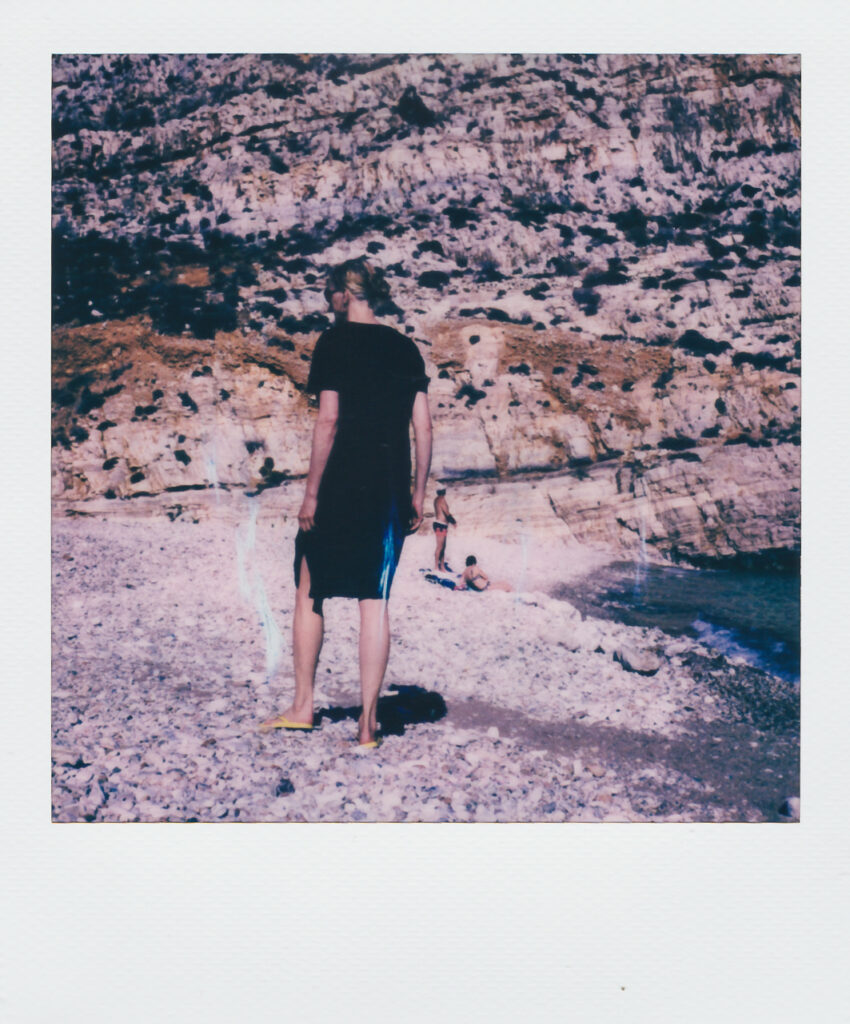
After an hour of hiking, I arrived at the beautiful Livadaki beach in Folegandros. The sun was very intense. I took a candid photo of Barbara while she was walking around. While this photo doesn’t portray the beauty of Livadaki, I add it here as a reminder to both you and me to clean your rollers. I didn’t clean them, and some of the next photos have these strong marks on them.
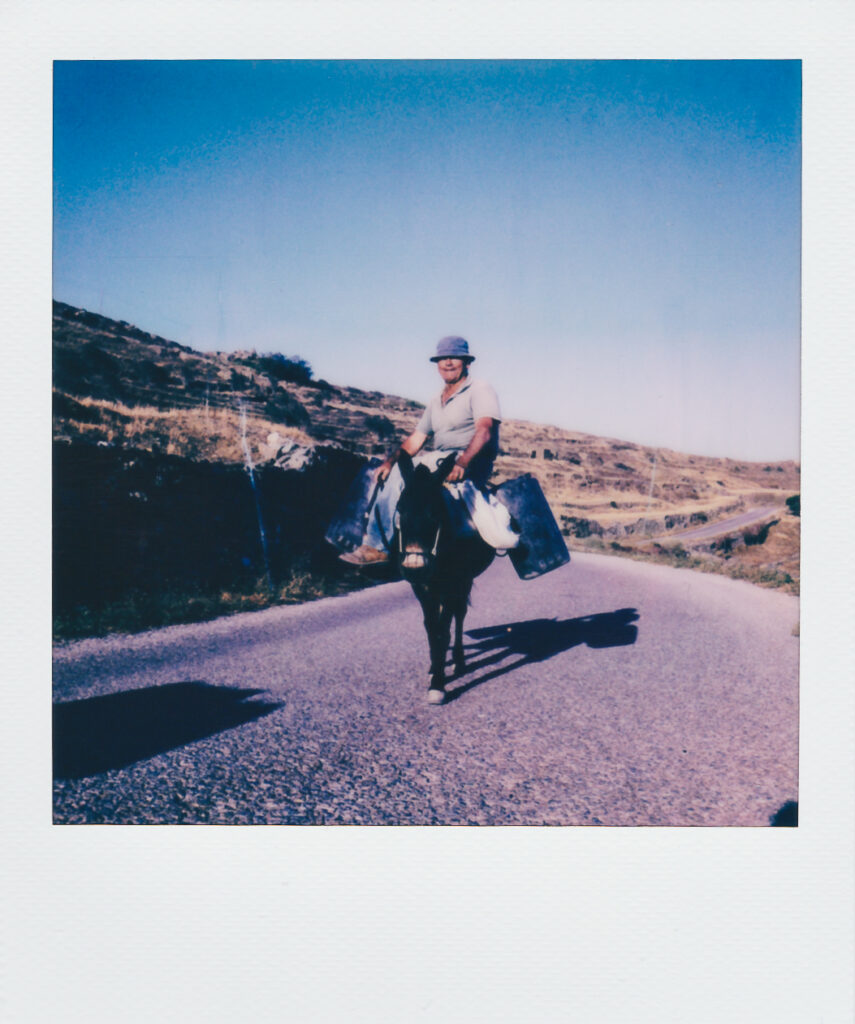
The last photo of the Polaroid Diaries: Folegandros with the SX-70 is probably one of my all-time favorite polaroids. Late in the afternoon, after returning from Livadaki, I saw a man on a donkey. It might sound like a total Greek cliche, but it portrays life in the Greek islands. As he was approaching, I asked him if I could get a Polaroid of him. Here’s the result.

My SX-70 settings for this series
Since the Polaroid Diaries: Folegandros with the SX-70 has a similar approach to the previous editions of my Greek polaroids, the settings I used were identical. However, the harsh sunlight made everything a bit more complicated.
For every photo you see here, I decided to keep the exposure wheel in the middle. Even though most of the photos were taken in the early afternoon, I decided to keep the exposure balanced. The reason is that when I underexposed, some of the polaroids I took looked rather dark. Polaroid cameras have a mind of their own, which means that you have to obey their rules. I don’t know if this is a general issue with the SX-70s or if it is just with mine -I suspect the latter.
The only photo that I actually overexposed was the one with the donkey. The sun was behind the donkey, and I thought I wouldn’t just get a silhouette if I overexposed slightly. However, I was wrong. Even though the sky seemed to have a lighter blue color, it didn’t work as expected. Needless to say, for every other photo you saw in the Polaroid Diaries: Folegandros, the sun was always behind me.
So, that’s it with another edition of Polaroid photography. Most of the photos look really nice, and I’m looking forward to shooting more with the SX-70. So, stay tuned for more Polaroid photography, and feel free to subscribe to my Polaroid mailing list for reviews, Polaroid photos, and updates.
More Polaroids: The full Polaroid diaries
My Polaroid Reviews: SX-70 review, My OneStep+ review & My Polaroid GO review

Get my Polaroid Camera on Amazon | Buy the film on Amazon
Pin it for later

Feel free to share on FB or Twitter the Polaroid Diaries: Folegandros with the SX-70.
Nice pics George. You are taking better and better polaroids with your SX-70 as time goes on. I’m at the doesn’t have a clue stage, so hopefully I can only go up from here. This is my link to my very first post: Using the Polaroid SX-70 camera for the first time
Also, I thought you were going to mention the Instagram #PolaroidAugust in this post as well. I’m going to post that photo of Eros one day on Instagram, so I’ll try and use any polaroid hashtags of yours. Also, looking forward to a future post on tips to best use the SX-70. I need it, but it may not help too much if I have a busted camera.
John! Your post is fantastic (and hilarious)! I loved it. It’s very nice to see that you started using the SX-70. I think that you should be ready to lose some film: in the beginning, everything seems complicated. Polaroid photography is often fabulous and nerve-breaking at the same time. I’m writing a long SX-70 review; I’ll post it next week. But I can give you some quick SX-70 tips:
First of all, check when your film is produced. If it’s older than 12 months, it might not work correctly. Also, it means that the colors might be a bit washed off. If the film is younger than 12 months, try to get a film produced later. Once I had a film from 03/20, it seemed bad; the ones I got later, dated 05/20, were much better.
Second, avoid using it in low light. You need clear skies with adequate light because the film is slow (ISO 160). Add on top that the SX-70 is an f/8 camera, and you see what it’s better not to use it indoors or in cloudy days.
Third, make sure always to have the light source on your back.
Four, if you can’t get usable results even under optimal conditions, consider sending back the camera. It might be defective.
Last but not least, be patient. It takes a lot of time to understand the mind of the SX-70. As a rule of thumb, add 1/3 of exposure. But avoid shooting when the light is either too intense or too weak; in general, a couple of hours after sunshine or before sunset work the best.
The Eros photo turned out really well! Keep on shooting!
George