

Last Updated on December 9, 2021 by George Pavlopoulos
Dear Barbara,
I know that you are wondering why I chose Minsk as a destination. The comparison is inevitable: from the sunny and sandy Greek islands to the darkness of Minsk. That’s exactly the reason, though: the city’s darkness. I know you’re smiling while reading this statement. But I am attracted to dark cities, and this habit worsens as time goes by.
The truth is that I’m here for a story. Or for a story within a story. I’m not going to write anything more about it right now. But, I’m going to tell you this: Minsk is not as dark as you might think.
Arriving in Minsk: “Taxi, taxi.”
My flight with Belavia, the country’s national airline, is smooth. A small Embraer 175 flies over Poland for one and a half hours before landing in Belarus. The country seems green, and despite talking about a certain degree of darkness, it’s a sunny afternoon here in Minsk. The horizon is clear, the sky is blue, and I’m surprised to find 18 degrees in Belarus in the middle of October.
The capital’s airport is big and grey. It looks like a remnant of the Soviet past (or shall I say present?), but to be honest, I find it somehow charming. I heard stories about ill-tempered airport employees, but these stories are untrue. Instead, everybody is polite to me. The non-smiling attitude seems to be a cultural thing and not a collective temperament.
Straight after arrival, I have to buy health insurance. This is obligatory for everybody visiting Belarus. The cost is low (one euro per day), but it’s still an odd regulation. Then, I have my passport stamped, and I hear a word in repeat: taxi. A hive of men approaches me, screaming “Taxi! Taxi!” straight into my ear. For a moment, I believe that I am the taxi driver. I reject the offers and order an Uber: it’s prime time, and I’m afraid I’ll have to pay a fortune for the cab.
The car goes first through forests and later finds its way to the motorway. We are driving towards the sunset of Minsk, but we don’t say a word: the driver doesn’t speak a word of English, and I don’t speak Russian at all. Sometimes you spend one hour with somebody, and the only memory is the silence.
And then, on the way to the city, the radio plays that beloved song by Elton John, Rocket Man. Shortly before visiting Belarus, I read on a travel guide that a Russian astronomer had discovered a minor planet in 1979 and named it 3012 Minsk as a tribute to the city. I listen to Rocket Man, and I see a country that seems to be a planet of its own. I feel like a Rocket Man as the car drives through the Belarussian landscape: I’m far away from home and unable to speak a word of Russian.
The Island of Tears in Minsk
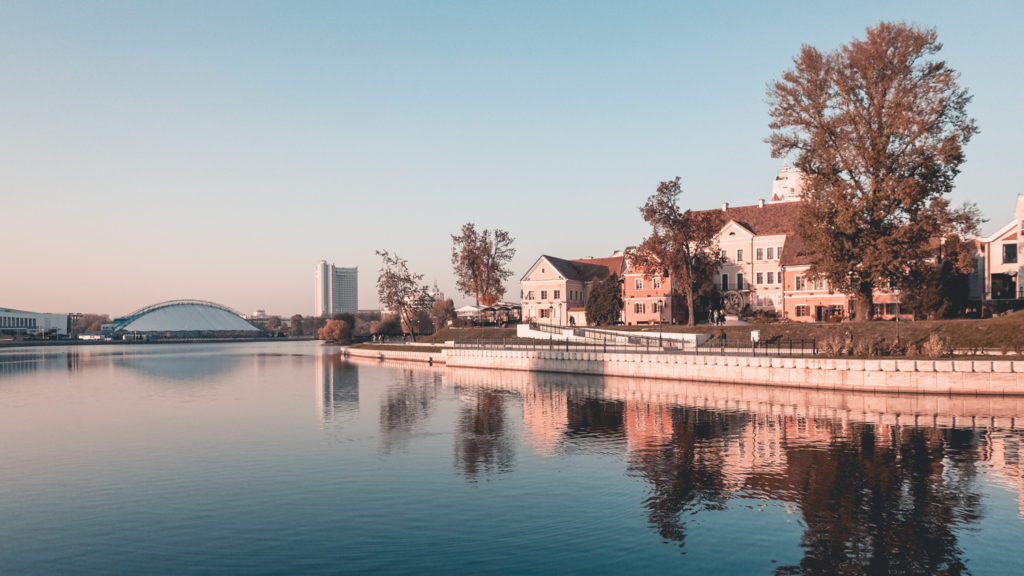
The river Svislach flows through Minsk. Exactly opposite of the Old Town, there is a small island. I cross the footbridge and find myself on the Island of Tears. This is a highly lyrical name with a political background. The tiny island serves as a memorial to the unsuccessful USSR campaign in Afghanistan (1979-1988). Lost combat and thousands of dead soldiers: this war was Russia’s Vietnam.
For several years the veterans didn’t receive recognition, but since 1996 Minsk has paid tribute to the dead soldiers. There is a small chapel at the island entrance, and on the walls, the figures of mothers and widows are sculpted. In the middle of a busy city, this is a peaceful spot. Only a couple of people visit the Island of Tears this morning, a young girl among them. She starts running up and down the small island, and she’s probably unaware of the symbolic meaning of the place.
A moment later, her parents shout at her. I find their reaction extreme. The girl’s unawareness is some statement: it’s proof that innocence can flourish even in places of collective grief.
Minsk is a city like you
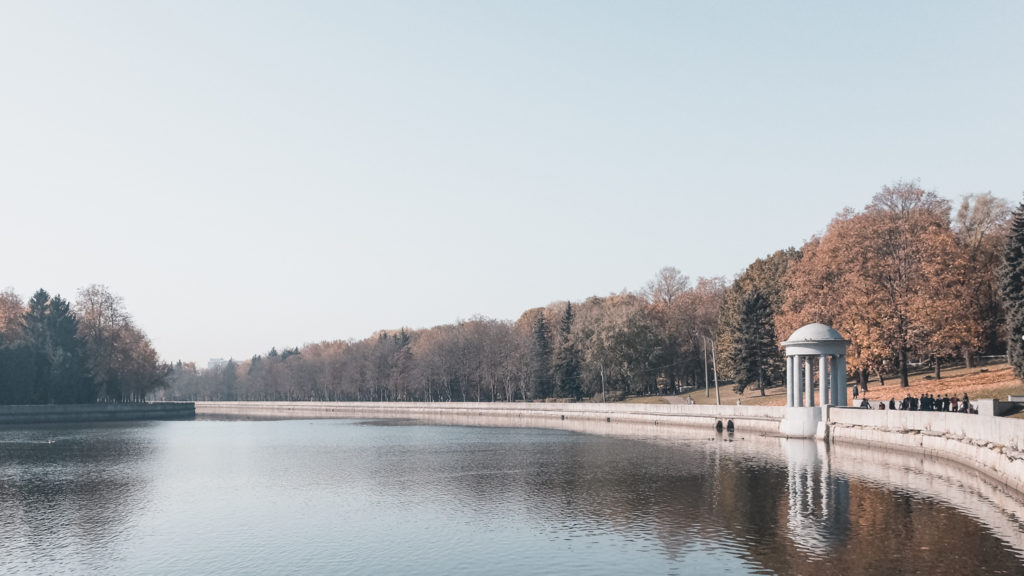
All of a sudden, I find myself in a trance. I expect Minsk to be dark and joyless and what I see is an energetic city. And also, it’s very green. After leaving the Island of Tears, I think that I won’t see any more greenery. But, to my surprise, now and then, a park crops up.
After walking along the Janki Kupali street, I enter the Friendship Alley and walk through yellow autumn leaves. The Svislach River is visible, and it flows slowly. A young couple is canoeing; an old lady sits on a bench, and many youngsters talk loud. Then, I see briefly the Victory Monument, an obelisk in the middle of a big square, and that’s the last image before starting to wander around Gorky Park.
It is hands down one of the nicest parks I’ve seen lately, and I’m sure you’d love to walk here. However, it’s only at Gorky Park that I realize the twofold abilities of Minsk: it’s lively and quiet at all times. I have no idea how this can even be possible. There are motion and stillness, voices and silence, hot in the sun and cold in the shadow, there is past, and there is future, there is grief, and there is hope.
I sit on a bench for a while, and I smoke. Minsk can be described with the words that we use for humans, not for cities. I repeat to myself: “both lively and quiet.” And then, I think of you, Barbara, that you are exactly like this, lively and yet quiet.
Risking a KGB interrogation
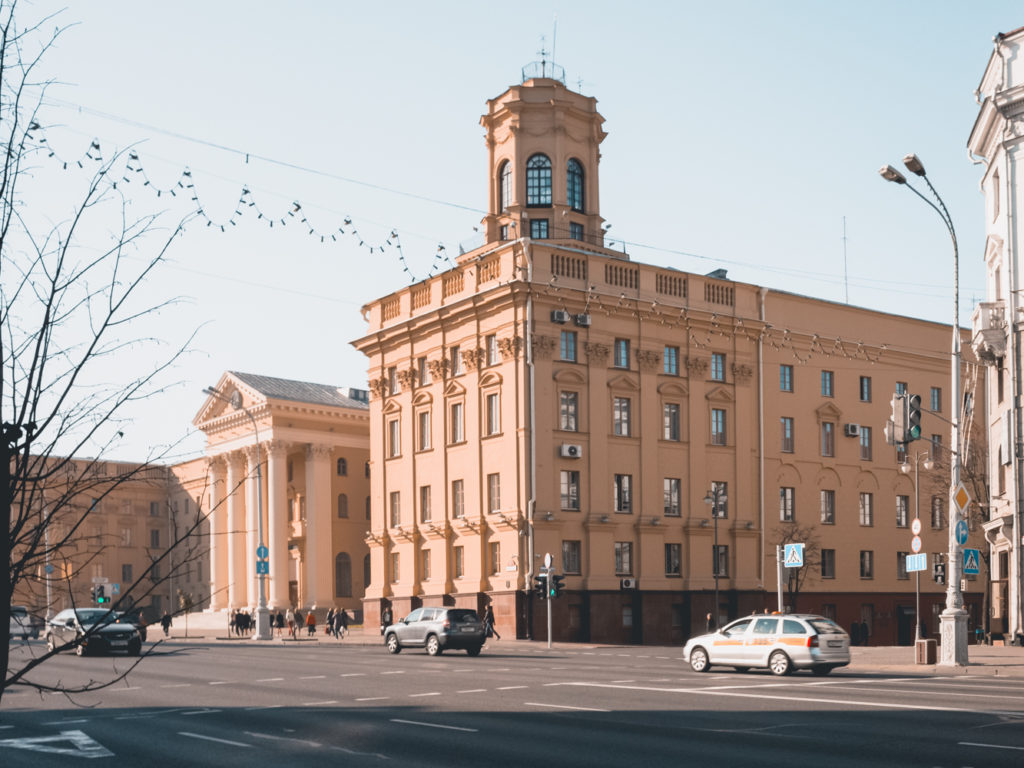
After the fall of the Berlin Wall and the collapse of the USSR, most intelligence services changed their names. This is not the case in Minsk, where the state security committee still uses the KGB name. Their pale yellow Headquarters are located in Nyezalyezhnastsi Avenue, one of the city’s longest and most beautiful avenues.
I read and heard loads of stories about the KGB: about the interrogations there; that you should not take a photo of the building. The truth is that I have everything in mind as I walk along the beautiful avenue, and I wait for the building to appear. It seems that this is a movie set and not a road anymore.
I first cross the Palace of Republic, then the two metro stations located on the avenue, and I’m trying to study the light. That’s right, to study the light. I decided to take my chances and take a photo of the KGB building.
I don’t carry fancy equipment with me. All I have with me is my small Ricoh. Scattered clouds flow the sky, and the light changes every one or two minutes. I try to manually set everything on the camera: the aperture, the shutter speed, the focus. I know that I will only have one second to take the photo. If I stay there for too long, I might indeed have troubles: from deleting the photos to spending a couple of hours inside the pale yellow building.
I finally arrive at the corner, and I see the building. I wait for the traffic light to be green. The camera is ready. Then, I bring it to eyesight level and hit the shutter. Three clicks. I have three shots, and I hope one of them is good enough to make it here. I keep on walking, pretending that I never took the shots. And then, it happens.
Then, a car stops next to me, and from the other side of the street, I see an officer coming quickly towards me. I’m about to freeze, but oddly enough, I carry on walking. The officer is a meter away from me, and only then do I realize that he is not paying any attention to me. The man has an envelope in hand. He goes to the car, gives the envelope, and life goes on.
Being deep in the internet stories paranoia is never a good thing. I just took a photo with a non-zoom camera, after all.
At the Cat Museum in Minsk
Ewa is an energetic woman that runs the Cat Museum in the heart of Minsk. When I enter the door on the third floor, Ewa welcomes me while a bunch of cats is spinning around. “The first rule,” she says, “is to wash your hands with this antiseptic liquid.” This offers apparently extra protection for the cats.
She then shows me around. It is an old flat that has been transformed into a place for cats. There are four big rooms decorated with paintings about -what else?- cats, plus an extra room, which remains at all times closed and there you can have coffee or tea.
“Where do you come from?” she asks me. When she hears that I come from Greece, she shines. “Ah, Greece. I have never been there, but I want to go. You see”, she continues, “my great-great-grandfather comes from Greece. I hear so many things about him from my grandma. His name was Metaxas”. I tell her that she should visit Greece and find her roots. She nods, although she has no idea from which area her ancestor comes.
The cats are still running. The oldest is almost ten years old; the youngest was born just two months ago. The whole project was an idea of her mom, and both women work now in the museum. Ewa keeps talking about the museum’s contribution to the local community. “Now and then,” she says, “we organize tours for people with disabilities.” Today, they have kids that use sign language visiting, and they play with the cats endlessly. They seem to be happy here.
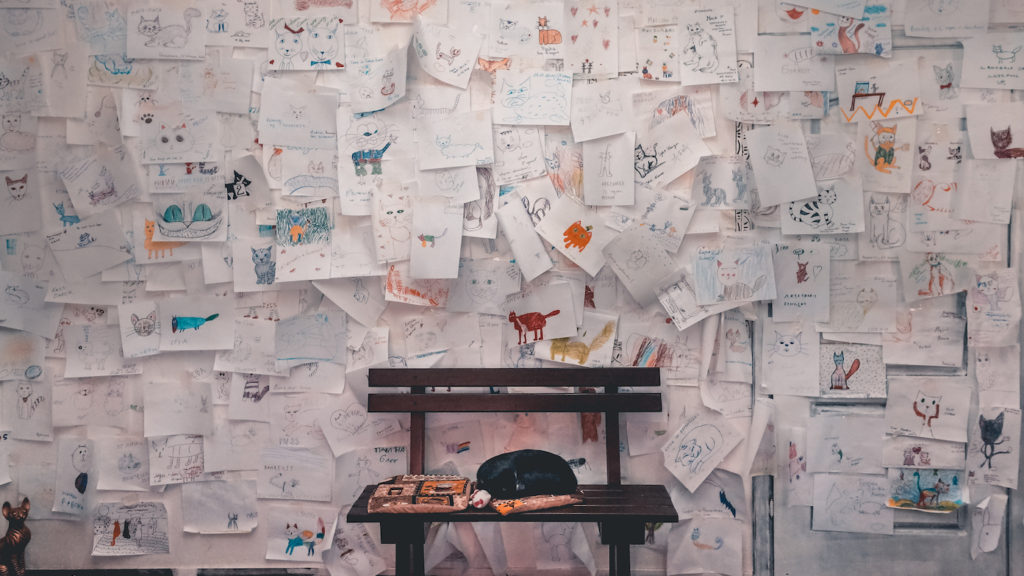
The nicest room, located on the very edge of the corridor, is covered by paintings on plain paper. The visitors are eager to draw cats -or their version of cats anyway- and pin them on the walls. There are hundreds of these paintings. Beneath them, on a cat-sofa, a black kitten takes a nap.
I have a quick tea because, unfortunately, my time is limited, and I thank Ewa for her time. As I walk down the stairs, I find it normal that such a museum exists in Belarus. This is the country where Marc Chagall was born, the painter who often included cats in his paintings. Chagall was born in Vitebsk, a city in Belarus that I won’t be able to visit this time.
A diamond in the outskirts of Minsk
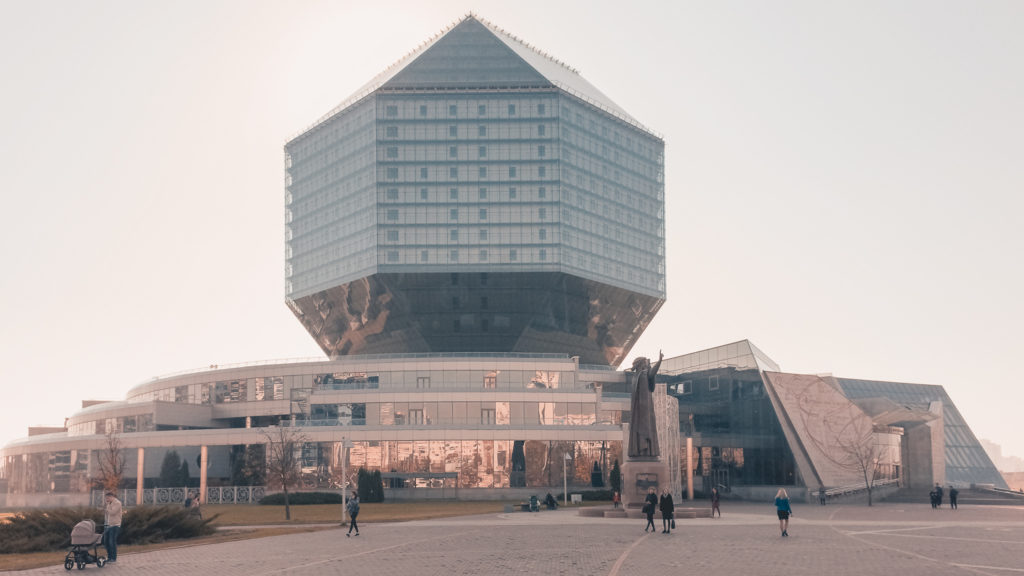
I know that you spend a big part of your life in libraries, Barbara. On the other hand, as a writer, I have found myself quite often in libraries, too. Nowadays I don’t visit them that often though. I prefer to be outside, to places where life happens. I feel that my batteries are empty after spending way too many years reading tons of books.
In the last couple of years, as you know, I have kept myself away from heavy reading; I only read specific things. You see, some voices are so loud that they can cover your inner voice and, in the end, kill your creativity. It’s just a phase, I know; that’s what you think about it, too. But right now, I need to see things, write about places and be perpetually on the road.
This, of course, doesn’t change the fact that you are visiting libraries all the time. And that’s why I thought of visiting the National Library of Belarus, on the outskirts of Minsk. I take the metro for six stops, and the first thing I see when exiting is a huge shopping mall. A couple of meters later, though, the library appears.
It’s a beautiful building. I doubt if other Eastern European countries have such a contemporary architectural gem. It has the shape of a diamond, but please don’t underestimate its size: it’s so big that it hosts the third largest collection of Russian books in the world. It is almost 75 meters high, can host two thousand readers, and has twenty-three floors.
Writers love new words, and here is one that I learned today due to the shape of the library: rhombicuboctahedron. According to Geometry, this means that it’s an Archimedean solid with eight triangular and eighteen square faces. But, to be pretty honest, I’d instead call it diamond-shaped, exactly like the locals do.
Don’t be upset
I promised to write to you about the story that brought me to Minsk in the first place. But it’s getting late, and this letter is already too long. I know it’s something you don’t like, but I will have to postpone the story. Trust me, you will love it. But, as I said, it’s already very late (3 a.m.), and I have to wake up in five hours to catch a train to Brest, a city close to the border with Poland.
I’ll write to you again soon.
Take care,
George
More about Minsk: The days of Lee Harvey Oswald in Minsk & Things to do in the capital of Belarus
*Tip: Nigel Roberts wrote a fantastic travel guide that I read before visiting Belarus. You can find it here.
Pin it for later
Sharing is caring. Share A rocket man in Minsk with your friends.
Beautiful essay, that you for sharing ❤️✌?
Thank you very much, Norma! Minsk is a wonderful city and I highly recommend a visit. I think that Belarus will change rapidly.
If you would like to receive occasional updates, please consider subscribing to the mailing list here: my.letterstobarbara.com/newsletter.
Cheers!
George
Beautiful essay, that you for sharing ❤️✌?
Thank you very much, Norma! Minsk is a wonderful city and I highly recommend a visit. I think that Belarus will change rapidly.
If you would like to receive occasional updates, please consider subscribing to the mailing list here: my.letterstobarbara.com/newsletter.
Cheers!
George