

Last Updated on June 20, 2025 by George Pavlopoulos
Riga, the capital of Latvia, is a paradise for architecture lovers. Despite its compact size, the Latvian capital boasts an impressive number of Art Nouveau buildings: almost a third of Riga’s downtown buildings belong to the architectural movement that sealed the beginning of the 20th century. Therefore, as you can easily imagine, the Art Nouveau architecture in Riga is an integral element of the city’s identity.
It was actually Riga’s architecture that made me want to visit it. Despite the insanely low winter temperatures, the walks around the Art Nouveau district and beyond were mindblowing. The beautiful ornaments and motifs decorating the facades made me feel like I was visiting an open-air architecture museum. This long walk was definitely one of my favorite things to do in Riga.
So, in this article, you’ll find lots of photos and information about Art Nouveau architecture in Riga. Moreover, I’ll share the reasons that drove this impressive development of the so-called Jugendstil architecture in the capital of Latvia. Last but not least, if you have a genuine interest in architecture, at the bottom of this post, you’ll find the best Art Nouveau tours in Riga and how you can join them.
So, let’s start with our architectural photo walk in Riga, Latvia.
*Some of the links are affiliate links. It means that if you buy something, I might earn a small commission at no additional cost to you.
Art Nouveau architecture in Riga
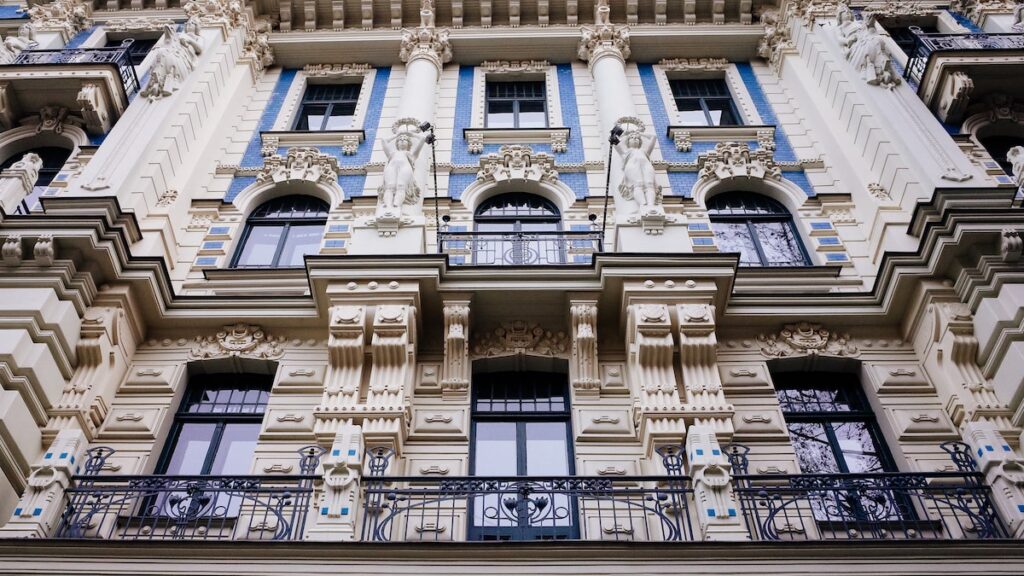
With a population of slightly more than 600,000, Riga is the economic center of Latvia and the home of a third of its inhabitants. However, one may wonder how Riga became the city with the highest concentration of Art Nouveau architecture in the world.
To understand Riga’s architectural miracle, we must delve into the historical context of the era. In brief, the city owes its development to a variety of sociopolitical factors. But let’s be more specific and see how this was possible.
The background story of Riga’s Art Nouveau architecture
Although contemporary Riga doesn’t rank among the biggest European capitals, things were different at the end of the 19th century. Riga was one of the most notable cities of the Russian Empire due to its port, and it enjoyed a period of rapid economic development.
In less than twenty years, between 1896 and 1914, Riga’s population almost doubled to more than 530,000 inhabitants before the outbreak of World War I. Compared to contemporary Riga, with its 600,000 people, the growth was massive. It was actually the biggest population rise that Riga has seen to this day.
A few decades later, around the 1860s, the city started expanding outside its medieval Old Town. It was a time when many European capitals began to redesign their city centers, and the Latvian capital followed suit. Urban planning took a different approach, and the city’s expansion was performed in a grid pattern. In addition, open spaces (like parks) started playing a significant role in urban development, and it’s not an exaggeration to say that the Latvian capital aligned with the era’s architectural trends.
Therefore, rapid economic growth, population increase, and the expansion of the city center were the decisive factors that led to the implementation of Riga’s Art Nouveau architecture. At the peak of the city’s development, between 1910 and 1914, up to 500 buildings were erected every year.
So, what exactly is Art Nouveau?
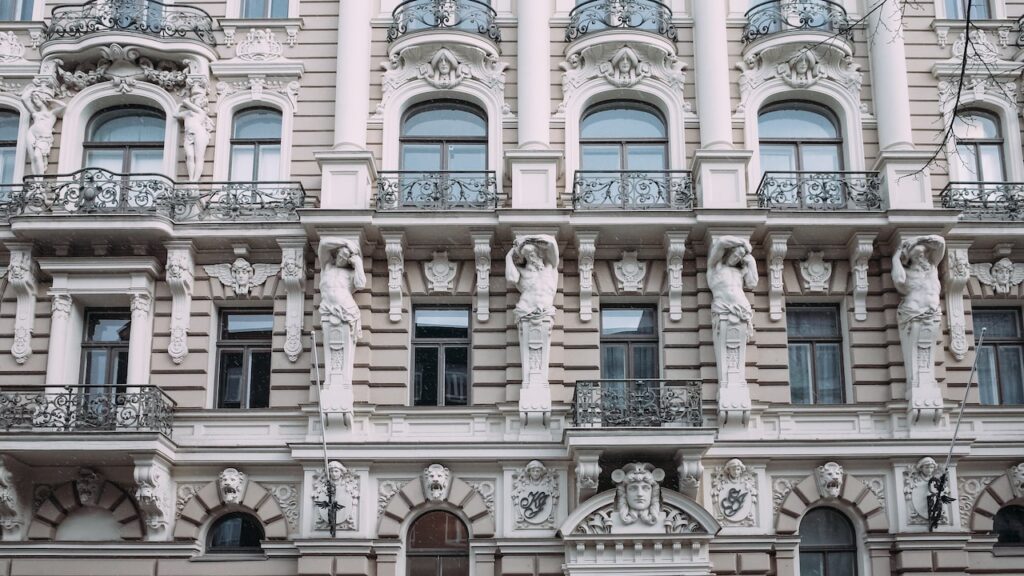
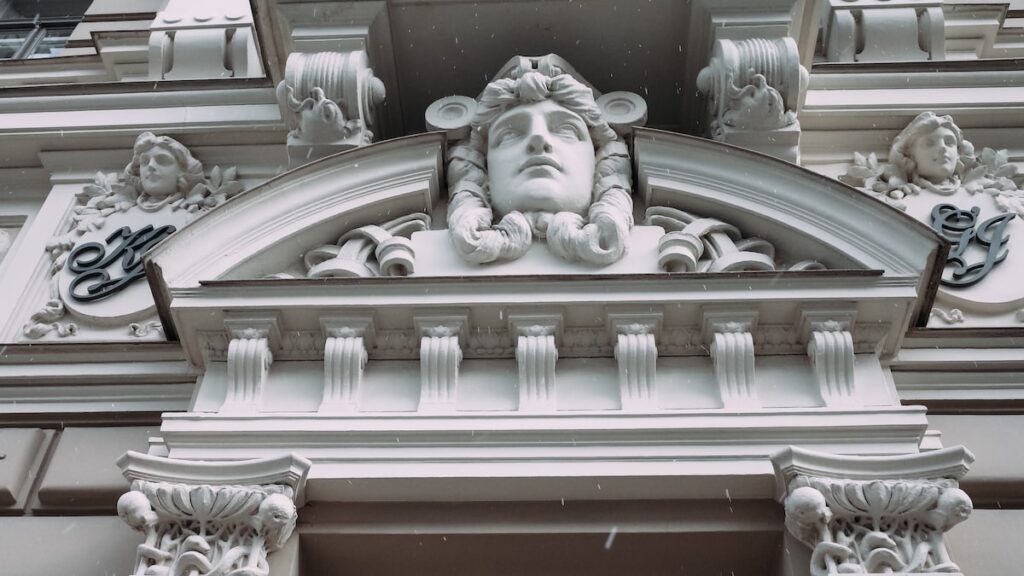
Art Nouveau is an architectural style that flourished in the late 19th and early 20th centuries. It draws inspiration from natural elements, such as flowers and plants, and often uses asymmetrical lines to decorate facades and expand inner spaces. As time passed, Art Nouveau introduced a variety of motifs, like faces, mythological elements, and animals.
When was the first Art Nouveau building in Riga erected?
Shortly before the turn of the 19th century, in 1899, Riga’s first Art Nouveau building was erected. Designed by architects Max Scherwinsky and Alfred Aschenkampff, the beautiful building stands on Audeju Street 7 (Latvian: Audēju iela 7), and you can still admire it today.
How many categories of Art Nouveau architecture exist in Riga?
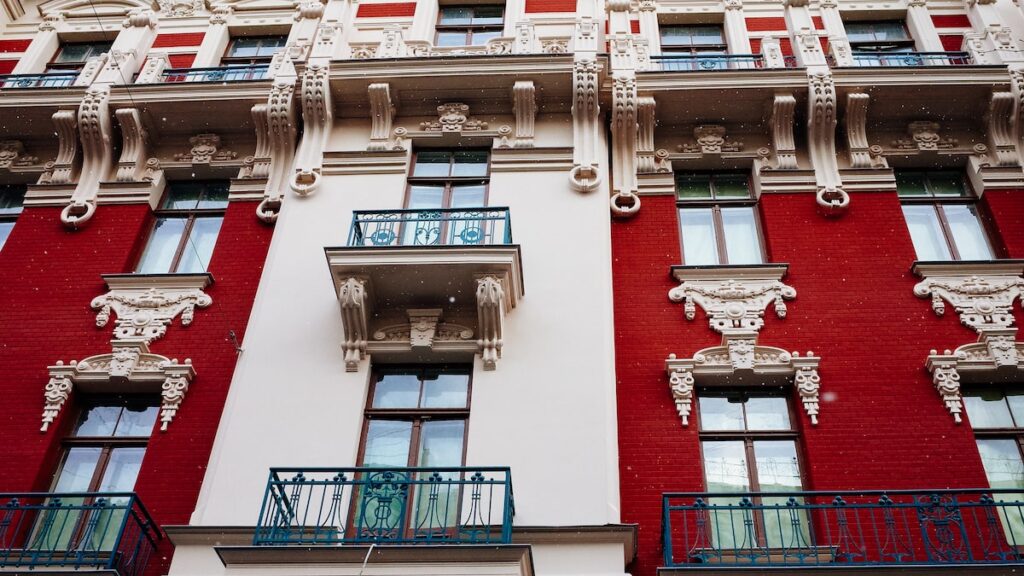
Judged by the buildings’ style, one can identify four categories of Art Nouveau architecture in Riga. These are:
Eclectic. To this category belong the city’s early buildings, and the influence of German Art Nouveau is visible. Although this style produced some of the most iconic buildings in Riga, such as those on Alberta iela, it’s not really representative of the city’s Art Nouveau architecture.
Perpendicular. This style is definitely more representative of Riga’s Art Nouveau architecture. Apart from the ornamented exterior, the buildings begin to exhibit major Art Nouveau influences in their interiors as well. Approximately one out of three Art Nouveau buildings in Riga follows the perpendicular style.
National Romantic. A quarter of Art Nouveau’s buildings in the Latvian capital were built according to National Romantic Art Nouveau. This style is renowned for its elements that reflect Latvian identity, and folk art characterizes its decorative elements.
Neo-Classical. Finally, the Neo-classical style emerged as the last stage of Riga’s Art Nouveau architecture development. However, it was short-lived and is not as thoroughly represented in the city nowadays. It is a more “raw” Art Nouveau style, distancing itself from the highly ornamented facades of the earlier stages. Neo-classical Art Nouveau feels much closer to classical architecture.
Where can you see Art Nouveau architecture in Riga?
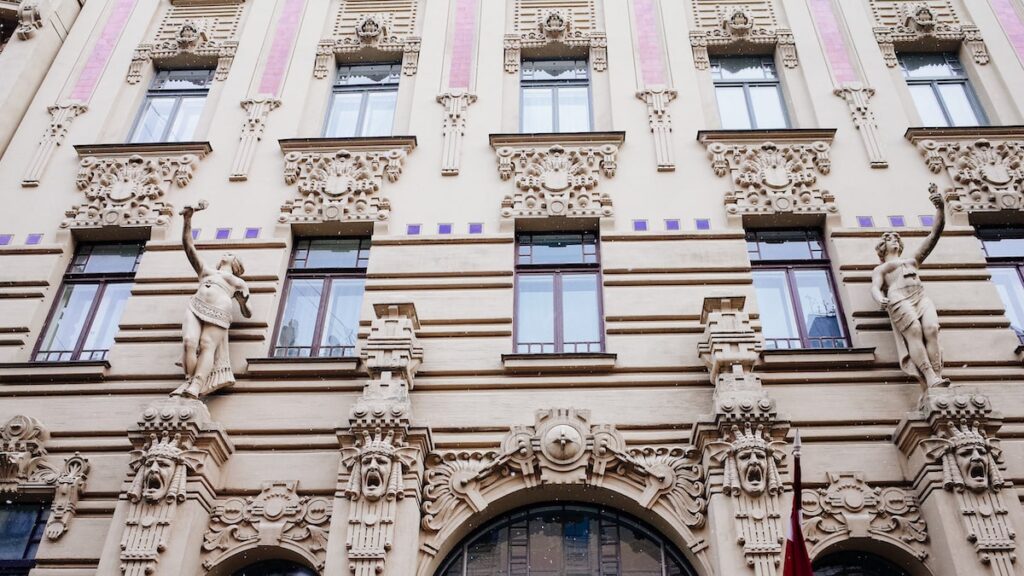
Glorious Art Nouveau buildings are spread throughout Riga. According to residents, the city is home to more than 800 Art Nouveau buildings. Therefore, a list containing every single building would be exhaustive. However, some streets have a larger Art Nouveau concentration, and in this section of the article, you’ll find some places where you can see several buildings. In addition, there’s also a museum about the famous architectural style, and you can learn more about Art Nouveau.
So, let’s start with the best places to see Art Nouveau architecture in Riga.
Alberta iela (Alberta Street)
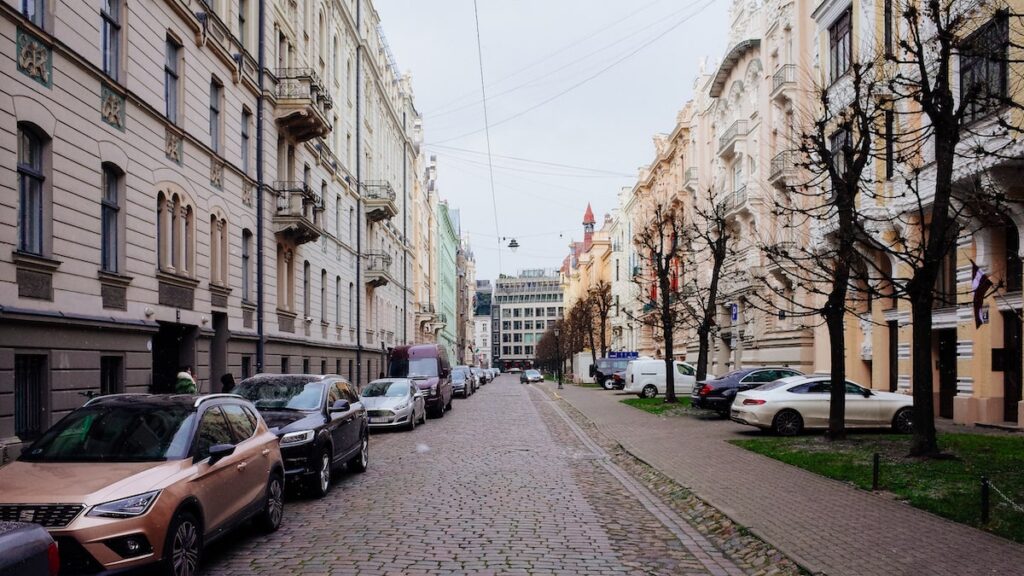
Located approximately one kilometer north of Old Town, Alberta iela is arguably one of the best places to see Art Nouveau architecture in Riga. Stunning facades dominate the whole street, and the impressive figures decorating the walls will show you some of the best examples of the style. The majority of buildings belong to the Eclectic Art Nouveau style, and many of them are designed by Mikhail Eisenstein.
Eisenstein was one of the most prolific architects of Latvia and is the person behind many notable buildings. If the name rings a bell, it is probably because of his son, Sergey Eisenstein; the latter directed the movie Battleship Potemkin, featuring a memorable scene set in Odesa. The Art Nouveau buildings on Alberta Street are among the most impressive you can see in Riga. Therefore, if you want to admire stunning architecture, be sure not to miss it.
You can see Alberta street on Google Maps and save its location for your visit.
Elizabetes iela (Elizabetes Street)
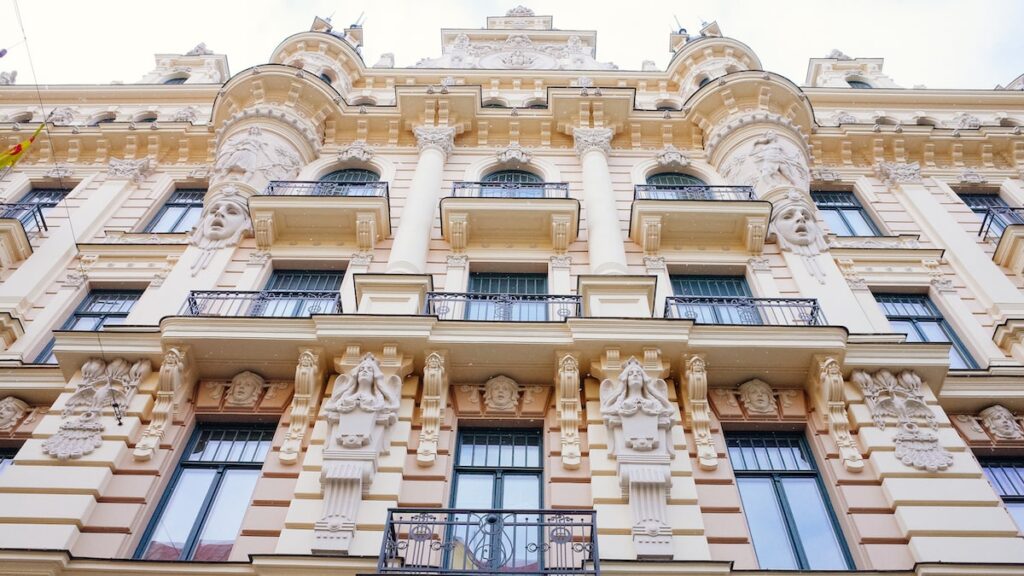
Adjacent to Alberta Street, you will also find the Elizabetes iela. Known also for its Art Nouveau masterpieces, Elizabetes iela is dominated by the creations of Riga’s most prolific architects: Konstantīns Pēkšēns and, of course, Mikhail Eisenstein. It’s actually at 10b Elizabetes iela where you can find one of Riga’s masterpieces. The iconic building features a colorful façade with blue tiles on its upper part and a variety of sculptures adorning it, including faces and peacocks.
Riga Art Nouveau Center
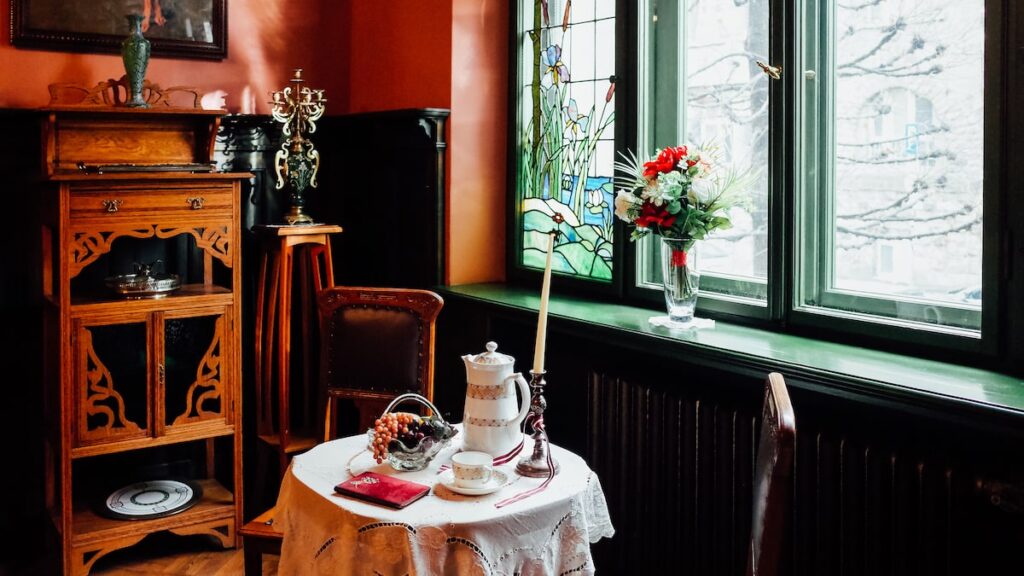
The Riga Art Nouveau Center is the museum I mentioned earlier in the article. It is definitely the best place to learn more about the architectural style that makes Riga famous. Conveniently located at Alberta iela 12, the building dates back to 1903 and was the home of Konstantīns Pēkšēns, the renowned architect who designed almost two hundred buildings in Riga.
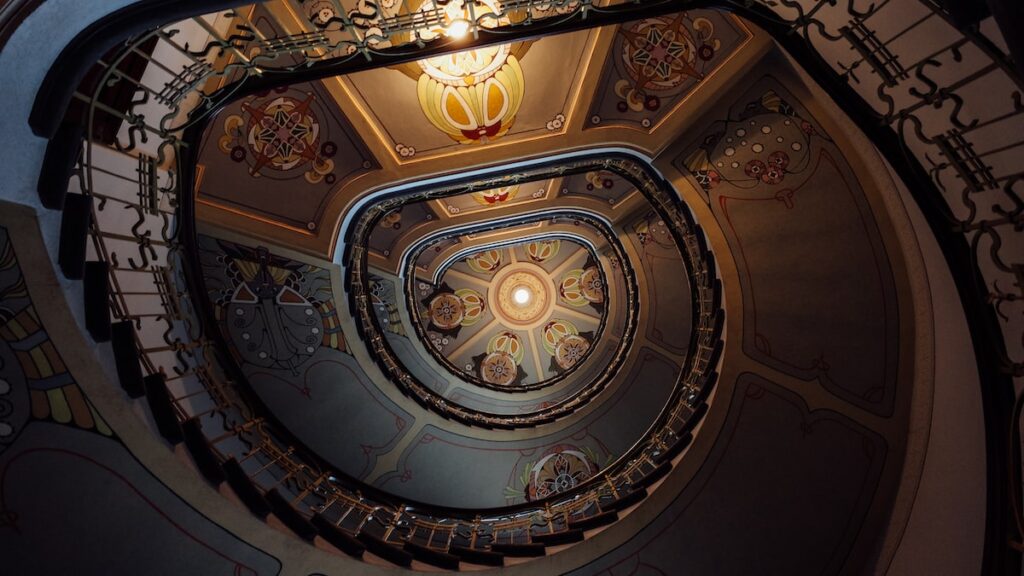
Shortly before entering the museum, you will see a stunning spiral staircase. As for the Riga Art Nouveau Center itself, it features an apartment following the principles of Art Nouveau and hosts various exhibitions. Wandering around the apartment feels like walking inside a time capsule dating back to the early 20th century. You can visit every room and admire the paintings and the decorations.
Apart from the impressive apartment and its collection of objects, the Art Nouveau center in Riga has a great website. There you can find info about every Art Nouveau building in Riga and read its background story. You can visit the museum’s website here.
Other streets featuring Art Nouveau buildings
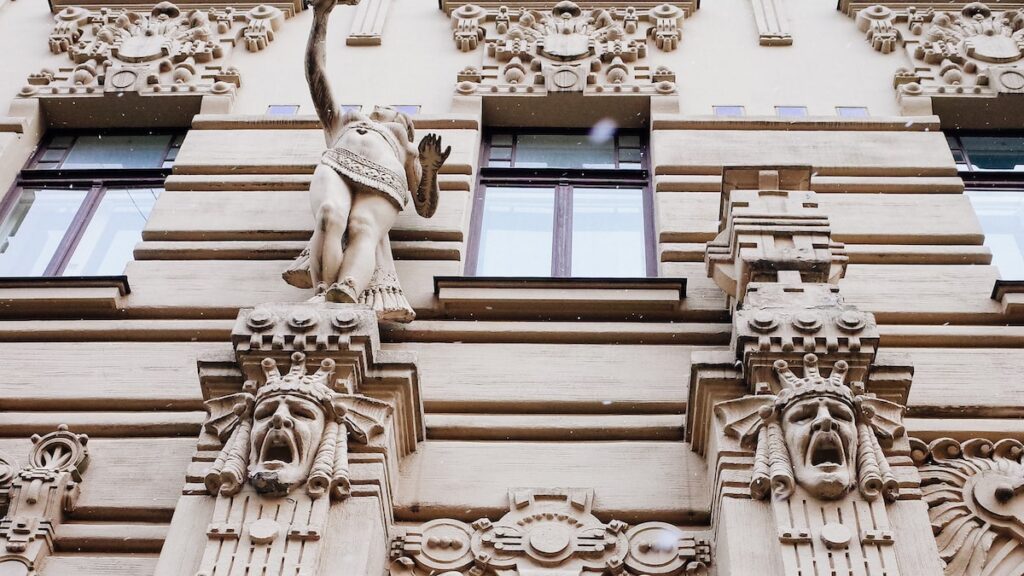
As I already wrote, Riga is home to more than 800 Art Nouveau buildings. As you can imagine, it is nearly impossible to visit them all. However, close to the places mentioned in the previous sections, you can also find various streets featuring beautiful architecture. Some of them are:
- Kronvalda Boulevard
- Rūpniecības Street
- Vīlandes Street
- Antonijas Street
- Strēlnieku Street
If you want to gain insights into the architecture from a local tour guide, check the following section, which contains the best Art Nouveau tours in Riga.
*I also have to mention an Art Nouveau building that didn’t become famous for its architecture. The so-called Corner House is yet another building that represents the architectural style, but its history is darker. The building at Brīvības iela 61 hosted the KGB Headquarters in Riga for more than 40 years. Although this place is haunted by torture and punishment, it’s a must-see if you visit Riga.
I wrote a separate article, and you can read about the KGB Museum here.
The best Art Nouveau tours in Riga
Due to its increasing popularity as a travel destination, Riga has developed a wide range of walking tours. Among the best you can book right now are the so-called Art Nouveau tours: a local guide will take you to every Art Nouveau location in downtown Riga and share stories and insights about the buildings.
If simply seeing the buildings isn’t enough for you, I encourage you to join an Art Nouveau tour. The guides are fluent in English and share various facts about the style that dominates Riga’s cityscape. Therefore, in the following lines, you’ll find the best Art Nouveau tours in Riga, together with info and their prices.
Walking tour of Riga’s beautiful Art Nouveau Architecture. As its title describes, this Riga walking tour focuses exclusively on the city’s stunning Art Nouveau architecture. The tour lasts two hours, and you’ll discover the most beautiful buildings in town while learning fun facts and historical aspects. Available in English and German. You can book this architectural walking tour here.
Art Nouveau walking tour. That’s another great option for discovering the most impressive Art Nouveau buildings in the Latvian capital. It also lasts two hours and will take you (among other places) to Alberta Street. Moreover, there will be an extra focus on the life and work of Eisenstein, the iconic Riga architect. You can book this 2-hour walking tour here.
Riga’s Old Center and Art Nouveau tour. Finally, if you’d like to combine a walk in Old Riga with a glimpse of the city’s Art Nouveau buildings, this excellent tour will show you both. The Dome, the Old Guild House, and the Riga Castle are part of this guided walk in Riga. Afterward, you’ll visit some of the most beautiful Jugendstil buildings while learning about their history. The tour lasts 3 hours and offers pick-up from your hotel. You can book the Riga walk here.
Art Nouveau architecture in Riga: Conclusion
The rise of Art Nouveau architecture in the late 19th century coincided with the city’s most vibrant period. In just a matter of years, Riga became one of the epicenters of Art Nouveau architecture in Europe. Today, it hosts the largest concentration of Jugendstil buildings in Europe, making it an ideal place to admire an architectural style that the modern world has largely abandoned.
If you happen to visit Riga, wander through the city’s streets and enjoy some of the best examples of European Art Nouveau. The facades are impressive, and observing the decorative elements will definitely be a memory to take back home. It’s a unique experience, and you shouldn’t miss the chance to enjoy it.
More about Riga: The House of Black Heads, KGB Museum Riga, Riga Airport guide

Pin it for later
Sharing is caring. Share this article about Art Nouveau architecture in Riga, Latvia, with your friends.