

Last Updated on May 16, 2026 by George Pavlopoulos
As a first-time visitor to New York, you can feel overwhelmed and disoriented, especially if you are more used to the urban planning of European cities. However, I truly believe that when you understand a few simple rules, the city begins to make sense, and you can navigate it even without a map. Additionally, due to its layout, NYC is very intuitive and easy to explore without constantly checking directions on your phone.
The reason I’m sharing these 10 Manhattan facts is dual: on one side, I want to share some background information about New York’s most known island that fascinated me; on the other hand, it’s because beneath the noise and the crowds, Manhattan has such a clear structure that it’s fairly easy to navigate.
So, here are 10 Manhattan facts that appear in a certain order, because they have a clear goal: to help you find your way through New York and enjoy the city without constantly checking your smartphone’s screen.
*Some links are affiliate links. This means that if you make a purchase, I might earn a small commission at no additional cost to you.
10 Manhattan facts for easier navigation in New York

After walking and visiting locations in New York for several weeks, here are the tips that I want to share with you for a smoother NYC visit.
In Manhattan, 20 blocks are roughly one mile

I believe that this is one of the most useful rules of thumb in Manhattan, and it’s easy to memorize. Twenty north-south blocks equal approximately one mile. Apparently, this is not a scientific formula for every part of the island, but it is definitely something to keep in mind when planning your day or walks.
And here’s a second handy estimate: walking one of the north-south blocks takes about 1 minute.
These two facts, paired, can serve as a great shortcut when planning, letting you quickly calculate distances without checking a map. For example, you know already how long it will take approximately to walk from (let’s say) the 14th to the 34th Street. Yes, the distance is about a mile, and it will roughly take 20 minutes.
So, if you are up for a little homework, feel free to calculate now how long it will take to walk from the 34th to the 59th Street.
The Street numbers rise as you go north

While this might sound too obvious, it’s a handy piece of information to keep in mind while strolling or commuting in Manhattan. If you are on 23rd Street and you want to visit a restaurant on 42nd, you already know that you have to head north. Subsequently, if you want to go from the 54th Street to the 41st, you need to move south.
This simple rule can help address many of the navigation issues first-time visitors might encounter in New York. Unlike other cities, where street names don’t betray much about the location, in New York, you can already navigate without a map. Especially in Manhattan, even a number is a useful clue to where an address is located.
Fifth Avenue is the line that divides East from West

The previous two Manhattan facts I shared are interconnected with this one. The NYC addresses that you will see will make even more sense if you memorize this simple fact: in the biggest part of Manhattan, the iconic Fifth Avenue is the dividing line between East (right side of the map) and West (left side of the map).
That being said, every address with an East Street lies on the right side of Fifth Avenue, while addresses with a West Street are on its left. Therefore, East 24th Street is on the right of Fifth Avenue, while West 24th Street is on the left.
That’s one of the Manhattan facts that feel small but are truly helpful for finding your way across NYC.
However, south of 8th Street, the logic reverses, and Broadway Avenue serves as the divider. I will write more about it in one of the following sections, but for now, keep the division between East and West Streets based on Fifth Avenue.
Avenues and streets do different jobs

One more easy Manhattan fact to keep in mind is that the majority of streets run east-west, while most avenues run north-south. This is a very plain rule of thumb, but, paired with the first three Manhattan facts I shared, it concludes the basic navigation in the city.
In New York, I felt that whenever I saw an address, it was more like reading coordinates. This helped me walk around with ease, without having to check my phone for maps. For example, a location on West 23rd Street near 8th Avenue already tells me a lot about where I should walk.
Broadway is the rule breaker and the reason for open spaces

While the Manhattan grid is an excellent example of urban planning, not the entire city of New York is based on it. The famous Broadway Avenue predates the grid and cuts diagonally across it.
Broadway is also the reason why you will often see strange angles and squares that you don’t expect to be there, and, of course, some iconic triangular buildings like the famous Flatiron. Other such spaces you’ll come across sooner or later are Times Square and Herald Square.
There’s a navigational practicality based on the presence of Broadway: whenever you feel that Manhattan becomes less rectangular and less neatly organized, Broadway can often be the reason. Therefore, keep an eye out if an intersection suddenly looks confusing: it may well be that Broadway did its thing again.
Yes, Times Square is named after The New York Times

This is one of those Manhattan facts that sound too obvious to be true, and one feels there’s something else behind it. But, it is true: the area is named after The New York Times moved there in 1904.
Times Square was the first place I ever saw in Manhattan: I exited Port Authority, and all of a sudden I was outside the NY Times building, among the crowds, the characters, the screens, and the city’s noise. Despite its abstract and chaotic look, it was good to know that even such visually powerful locations have their own solid history.
“Uptown” means north, and “Downtown” means south

In Europe, whenever we visit a location in the city center, we often use the word downtown. But in New York, the word means something different.
Whenever you want to go north, you are going Uptown. And, subsequently, whenever you want to go south, you are going Downtown (and in between, there’s also the Midtown).
The Uptown-Downtown distinction is particularly useful when you use the subway. Whenever inside a subway station, you will see signs pointing to either Uptown or Downtown. Therefore, if you memorized the first four Manhattan facts I shared about the addresses, you can easily determine which direction to move.
The subway lines are secondary, because you have to find the direction you are headed first. And this is important because you can save lots of time: you might pick the right line, but in the wrong direction.
Here’s another quick homework for you: if you’re going from 18th Street to 55th, are you headed Uptown or Downtown?
Some subway lines follow avenue corridors
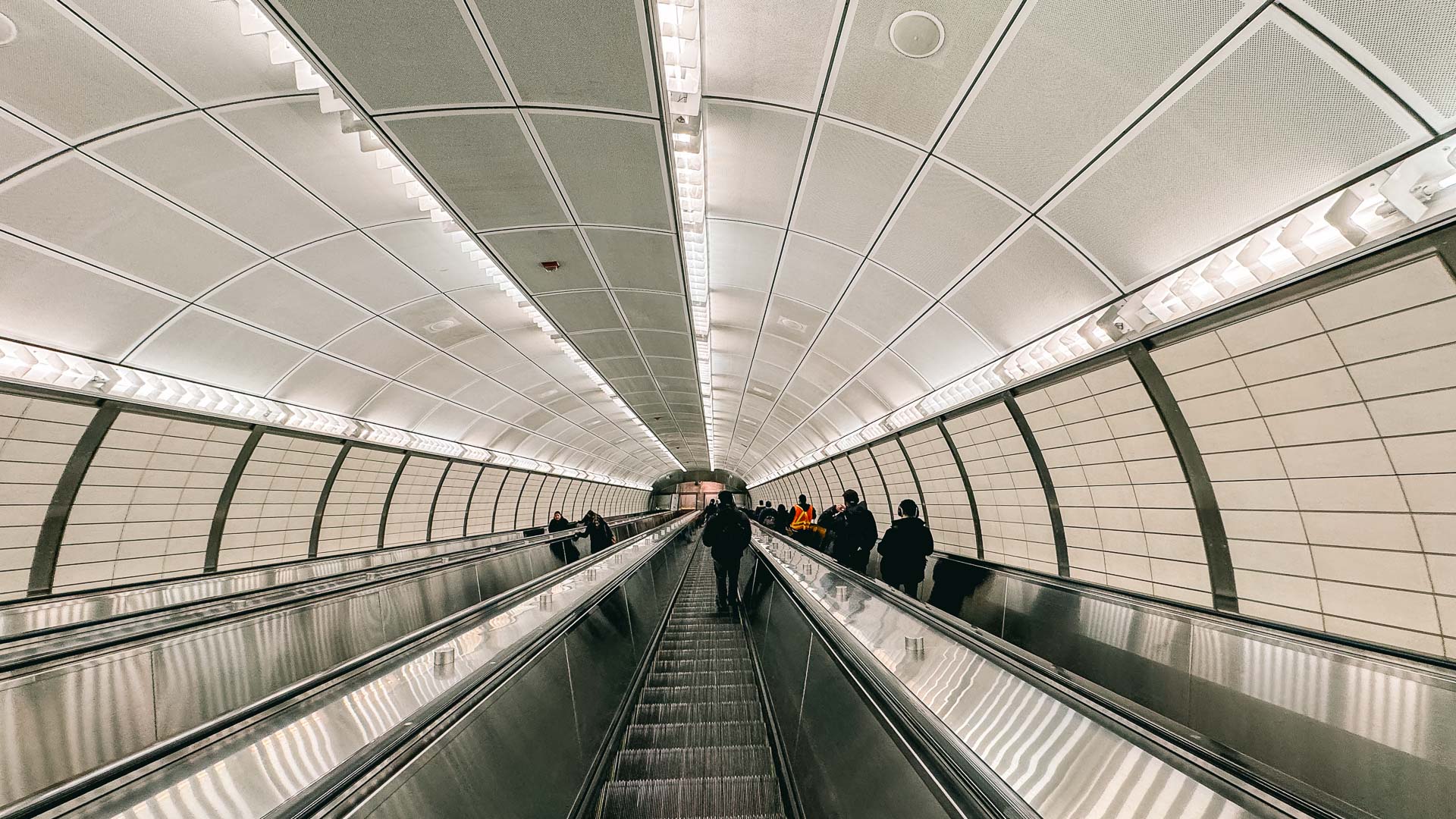
This is not something you’ll notice right away, but it is helpful and will make you feel a bit like a local. Some subway lines roughly follow certain Manhattan avenue routes. To me, it felt like underground avenues mirroring those above ground.
For example, the 4/5/6 subway lines run along Lexington Avenue, the A/C/E along Eighth Avenue, the B/D/F/M along Sixth Avenue, and the 1/2/3 along Seventh Avenue.
It is impossible to memorize the New York subway map overnight, and honestly, there’s no reason to do so. But if you know on which side of Manhattan you are, you can already visualize how and why you’ll choose the train to your destination.
Lower Manhattan plays by different rules and feels more European
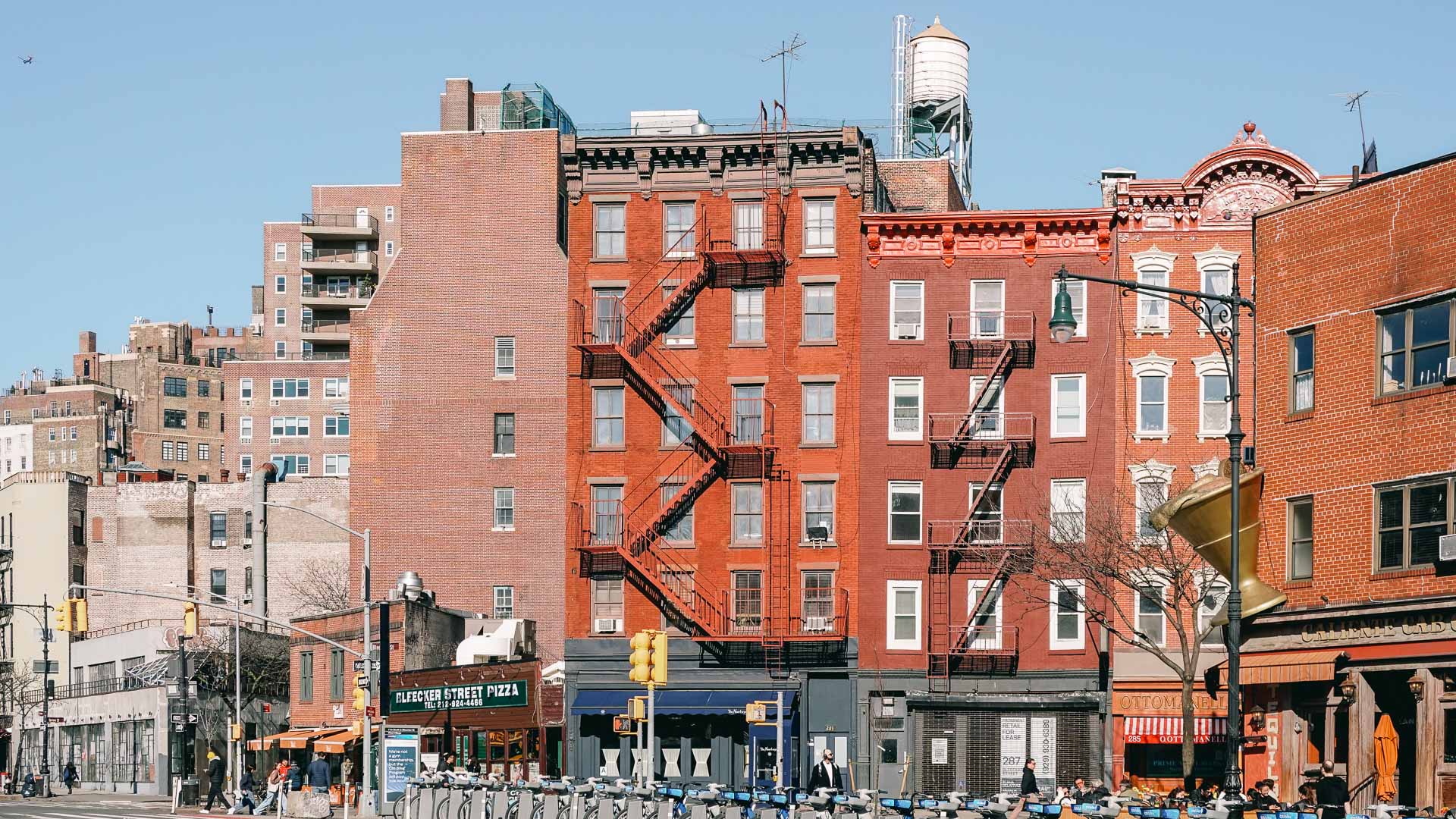
The moment you think you have grasped the essence of navigating New York City, Lower Manhattan will take some of that comfort away. The reason is that Lower Manhattan doesn’t follow the numbered grid logic: the streets feel less rectangular, there are more turns and twists, and the city feels older, almost European.
And here’s why. Lower Manhattan is older than the Manhattan grid. The numbered street system comes from the Commissioners’ Plan of 1811, which affected the northern parts of the island. However, since the Downtown area was developed much earlier, most streets remain intact and still follow their original logic.
This is part of the charm of Lower Manhattan, which was the first area that was inhabited in NY, and that’s why you might feel it’s less easy to navigate compared to the rest of the island. Therefore, here you will have to get back to memorizing and let go of the geometry of Midtown.
In Manhattan, an address is usually some kind of direction

This is the last of my Manhattan facts to help you explore the city smarter. And this is actually more of a roundup than a solo piece of advice.
Once you understand the basic grid, you’ll visualize every address in your mind before even checking the map. An address in Manhattan can already provide a lot of background information. Specifically, it can tell you whether the place is Uptown or Downtown, East or West of Fifth Avenue, which underground corridor it’s in, and whether you can walk there or you’d be better off using public transport.
And this was exactly what I truly appreciated in Manhattan. Despite its size and chaotic rhythms that might feel intimidating at first, once you understand the grid, the city becomes totally intuitive. It is as if the more you walk, the more the city explains itself.
New York will still surprise you, of course. It should, actually. But in Manhattan, confusion often gives way to recognition way faster than you expect. And that, perhaps, is one of the reasons so many people fall for it: not just because it is fairly easy, but mainly because it gradually teaches you how to read it.
After strolling around Manhattan, it is strangely satisfying to see the whole island open up from above. Top of the Rock is one of the best spots to see the grid in front of you and get a sense of New York’s stunning scale. You can book your ticket to Top of the Rock below.
10 Manhattan Facts for easier navigation: Final thoughts

Manhattan might overwhelm you at first with size and dynamics. It is a place that never sleeps and can easily intimidate first-time visitors to NYC. However, it doesn’t stay unreadable for long, and the more you walk (or cycle it), the more it becomes transparent, as a layer that once unfolded remains in your mind.
And maybe that’s part of its beauty and the pleasure of being there as a traveler. For me, seeing New York and unlocking its secret passages was a true joy. Apart from the undeniable beauty and the impact that it had on me, I enjoyed seeing the address and understanding where I had to head. A street number is not as abstract as in Europe and serves more as a proper direction.
By memorizing those Manhattan facts, I felt strangely familiar in New York after a few days. The energy is there, and so is the scale, the noise, and the characters. But in between this happy chaos, the city became navigable and, therefore, a bit more mine. What started as a shy immersion ended in an oddly confident familiarity with the city’s impressive architecture. And of all the things I loved in New York, exploring it after a few days with ease was the one thing I appreciated the most.
More about New York: A visit to the MoMA, Ellis Island, The New York Easter Parade
Pin it for later

Sharing is caring. Share these 10 Manhattan facts with your friends.