

Last Updated on February 24, 2026 by George Pavlopoulos
Dear Barbara,
I’m leaving Zambujeira do Mar behind and heading towards the mainland, known as Central Alentejo. I know: it’s tough to leave the coast behind, it’s tough to say goodbye to the Atlantic Ocean. But somehow, if I stay near the sea all the time, I think I won’t have a clear overview of what Alentejo really looks like. I’ve written to you in the past about a rabbit in the hinterland and why I adore Endochora, the Greek word for the mainland. Now, I want to see the mainland of Alentejo too.
Rodrigo and Louis greet me goodbye, and as the car moves along the dirt road, I feel that I already miss their little barn. It’s a warm summer morning, and I’m heading again towards Vila Nova de Milfontes. But there, shortly after crossing the bridge above the lagoon, the car takes a right turn. This is somehow the spot that I must leave the sea behind. And that’s where I’m starting to explore the mainland of Alentejo.
I first cross Cercal, a small settlement, and then I go through Alvalade. I expected the scenery to be rougher, but I’m wrong. As if this is a promise of eternal summer, Alentejo keeps the same pace at all times. There are no major changes as I drive through Central Alentejo. Once again, I see a yellow landscape and scattered green trees on the top of the hills. Sometimes, though, the light is so harsh that I can only see dancing silhouettes: are these trees or people?
And then, of course, I see cows. The cows are everywhere, and the intense sun makes them look ginger. They lie on the fields indolently, like tired workers. One should never forget that this is one of the poorest regions in Europe.
Of course, this doesn’t mean that the people here are lazy. On the contrary, whenever I hear that an area is poor, I always imagine hard-working people. Such regions don’t represent laziness; they represent underpaid work.
Central Alentejo is a place to fall in love
The road after Ferreira do Alentejo touches a couple of barragem. These are big water barriers that appear behind clusters of trees. They remind me of artificial lakes, and as the car moves, I can see these watery surfaces receding into the distance.
The landscape of Central Alentejo repeats itself, but it somehow never becomes monotonous. The traveler will always long for the next village, which has whitewashed walls and sunburned inhabitants. It’s also the same traveler who, sooner or later, will take the camera in hand and will try to immortalize, once again, a lonely tree in a yellowish background.
Life is slow in Central Alentejo. I can tell that by the rhythms of little cafes and restaurants, and I can tell that by judging from the talks in gas stations. The people in the rural areas of Alentejo are still sweet, but they are also shyer. They probably don’t meet strangers that often, as the inhabitants of the coastline do. It’s a tougher life, consisting of fewer words and more work in the fields.
Even in Alvito in the region of Beja, which looks like a proper town, the people are shy. One should never underestimate the importance of such places in the Mediterranean: Alvito has been inhabited since the Neolithic age. Its highlight is a castle, built between 1494 and 1504. In places like Alvito, or like the Viana do Alentejo that follows shortly afterward, there is so much history and light that one can instantly fall in love. Finding the right person to fall in love with seems somehow easier in Central Alentejo.
The stray dogs of Estremoz
Aguiar is the last town before reaching Évora, the definite pearl of Central Alentejo. I expected a prelude to Évora, but the truth is that Aguiar is a sleepy little town. Hence, I move forward, and I’m heading towards Évora. I won’t see it today, though; I’m saving a visit to Évora for the next few days. Today I plan to spend the night in Elvas, a town close to the Spanish border.
But after three and a half hours of the journey, I need a pause. Road trips are always awesome, but they can make you feel tired quickly. Soon, I reach Estremoz, and I decide that I had better find a place to sit. Unfortunately, though, it seems that it’s siesta time here. The town seems shut, with only one tapas bar open. But I don’t sit there: some guy is using a hammer exactly next to the door.
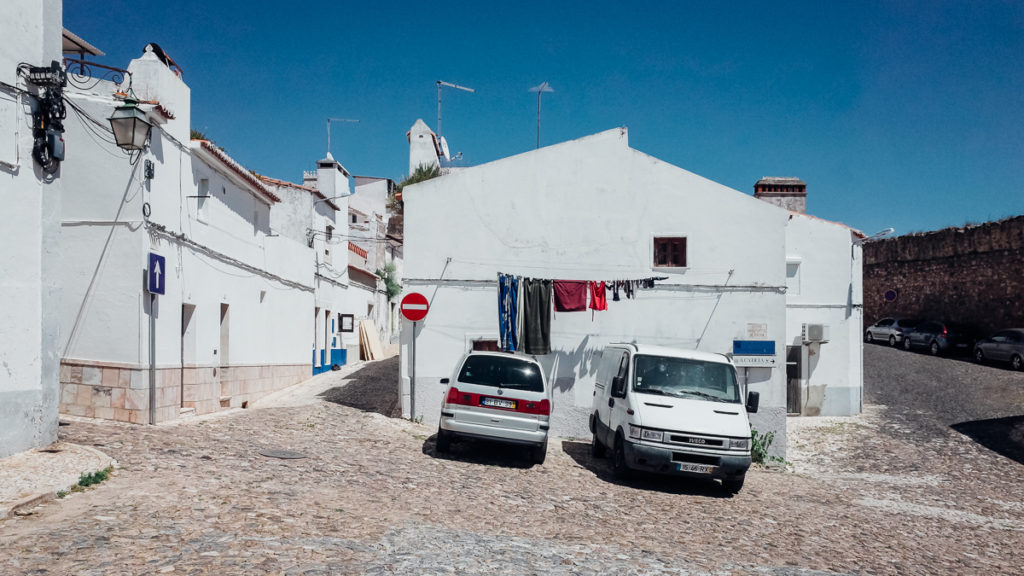
I walk around instead. Estremoz is all white, and literally, every surface is covered with marble. This is not a surprise, because Estremoz has a vast marble production – the locals use it even in their doorsteps. It’s not hard to assume that the excessive marble production is also used to make whitewash, which covers every wall of this sleepy town.
No matter how long I walk, there is no place to sit. And then I set my Plan B in motion. I follow this plan quite often in such cases, and it actually consists of one simple rule: follow the youngsters. In every big and small city, teenagers seem to know the places that stay open all day. When I spot two of them -school bags, fast pace, smartphones in hand- I start following their steps. Soon they end up in a tiny cafe, close to the big fountain. The cafe has red plastic chairs, and other teenagers occupy it.
Estremoz sleeps under a temperature of 34 degrees this afternoon, and the only voices in the town are here, in this little cafe. In the interior, some regulars are eating a light meal beneath the scarves of a local team hanging on the walls. I order a coffee and a local sandwich, and I sit outside. Rich in flavor and cheap, the sandwich is exactly what I needed after a long day on the road. I let the afternoon go by.
Shortly before leaving town, I visit the castle of Estremoz. It stands slightly off the town, on top of a hill, of course. This is a small town within the town, picturesque and whitewashed. There seems to be no life there, just empty streets and laundry hanging on the ropes. It’s as if the people left all of a sudden, and they didn’t take anything with them.
The only proof of life is two stray dogs that give me a hard time. They bark, they attack me, and the impolite conversation we share is probably the only chat that takes place today, inside the walls of Estremoz’s castle.
Flamboyant Elvas
There are still 30 kilometers to cover from Estremoz to Elvas. The sun becomes more tender now, but the heat sits like a thick blanket on the valleys of Alentejo.
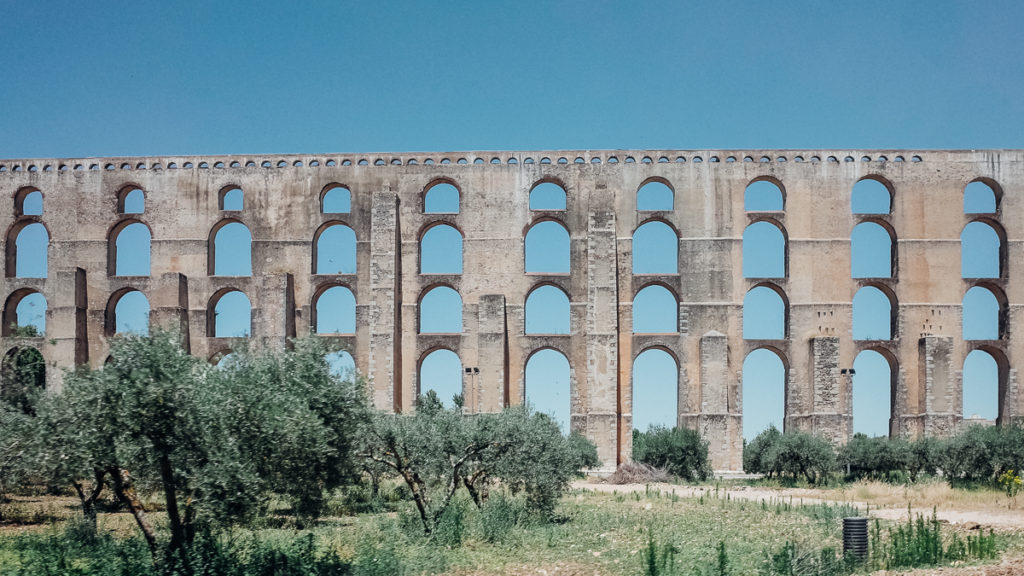
Entering Elvas is quite a spectacle. About a kilometer before reaching the town, I see the impressive Amoreira Aqueduct. Five centuries ago, in the 1500s, Elvas was running low on water. To solve the problem, the city decided to bring water from Amoreira, which lies eight kilometers away. They used a fairly ambitious aqueduct. It took almost a century to build, and as you enter from the southern gates, you can see the mind-blowing piece of architecture, which runs through the valley with four tiers of arches.
But that’s not the only thing about the town. Elvas is a UNESCO World Heritage Site, located entirely within its walls. The fortification of Elvas is really extensive, and if you think about it, that’s an impressive fact for a town of approximately 16,000 inhabitants. There is also a star-shaped fort, the Forte de Nossa Senhora da Graça. It’s one of the finest examples of trace italienne, which means star fort.
Everything seems maximalist in Elvas. The streets are in excellent condition (I can assure you that the roads of Central Alentejo are not very pleasant to drive on), the facades are clean, and the cobblestone streets are shiny. Even the people seem larger than life here, like Paul, for example, the man for whom I rented his place for a couple of nights. He is a very nice guy, full of information about the city, the fortification, and the best things to do in Elvas.
His place has a beautiful veranda overlooking the castle, and that’s where I spend my evenings at Elvas: drinking red wine, chewing chips, staring at the orange stripes of the late evening sky, and writing.
A visit to Évora

No road trip to Central Alentejo is complete without a visit to Évora. Shortly after exiting the highway, Évora starts to unfold. This is not a tiny town like the ones I’ve seen before. Évora is a proper city, with more than 55,000 inhabitants. There is both cultural and economic life here -Évora is the biggest city in the region.
When I start walking down the streets of Évora, I realize that typical elements of Alentejo remain intact: whitewashed houses, vibrant colors, and azulejos covering some walls. And, above all, polite people. This is also the first time that I have seen tourists in Alentejo. Sure, there are not masses of them like in Taormina, but there is some tourist industry here.
I somehow expect to see more life in Évora, but the truth is that the city remains faithful in the sweet sleepiness of the region. This is not something to disregard: it’s not so easy for a city to keep intact, contain, and narrate the feel of a whole region.
It’s not high season yet, not even summer, but the day I visit Évora, it’s extremely hot. At 3 pm, the temperature is 36 degrees, and I’m trying to walk in the shade. Exactly like Bologna, Évora has porticos and roof-supported walkways supported by columns. On warm summer days, one can easily walk some distances in the shadow, and that’s what I do all day long in Évora.
I stop for a cup of coffee at Giraldo Square (Praça do Giraldo), which has seen several violent events through time, among them the execution of the Duke of Braganza.
And then, I walk towards one of the weirdest things I’ve seen in Europe.
The Chapel of Bones in Évora (Capella dos Ossos)


The Chapel of Bones in Évora is a small church like no other. What the name betrays is actually what you get: there are thousands of human bones and skulls embedded in the walls of this morbid chapel. How would you really feel if you knew that all the walls of a church were decorated with bodies exhumed from a city’s graveyards? That’s exactly what happened here, in the 16th century. The entrance of the Chapel of Bones is precisely next to the church of St Francis.
When you enter the Chapel of Bones, there is a creepy inscription in Portuguese. It reads: “Our bones are waiting for yours.” And then, the interior is ready to haunt you. More than 5,000 bones and skulls dress the walls. This little chapel might sound like an oddity, but it has a historical background.
Back in the 16th century, Évora’s graveyards were full and had to be emptied to make space for new corpses. It was also a period of Reformation, and one of its basic principles was that bodies should come closer to God. So, if you sum everything up, there is an explanation about this odd chapel in Évora.
That horror-movie interior reaches its climax with two final details. The first one is on the right-hand side: there are two desiccated corpses, one of which is a child. Both are in glass display cases. Last but not least, at the roof of the chapel, the visitor reads the phrase: “Melior est die mortis die nativitatis.” Which means: “Better is the day of death than the day of birth.”
One can only leave the Chapel of Bones full of optimism, I guess…
Evoramonte is the most amazing place in Alentejo
Approximately half an hour outside of Évora and after thirty kilometers on a rural road, I reach Evoramonte. A few years ago, I saw a photo of Evoramonte and have wanted to visit it ever since.
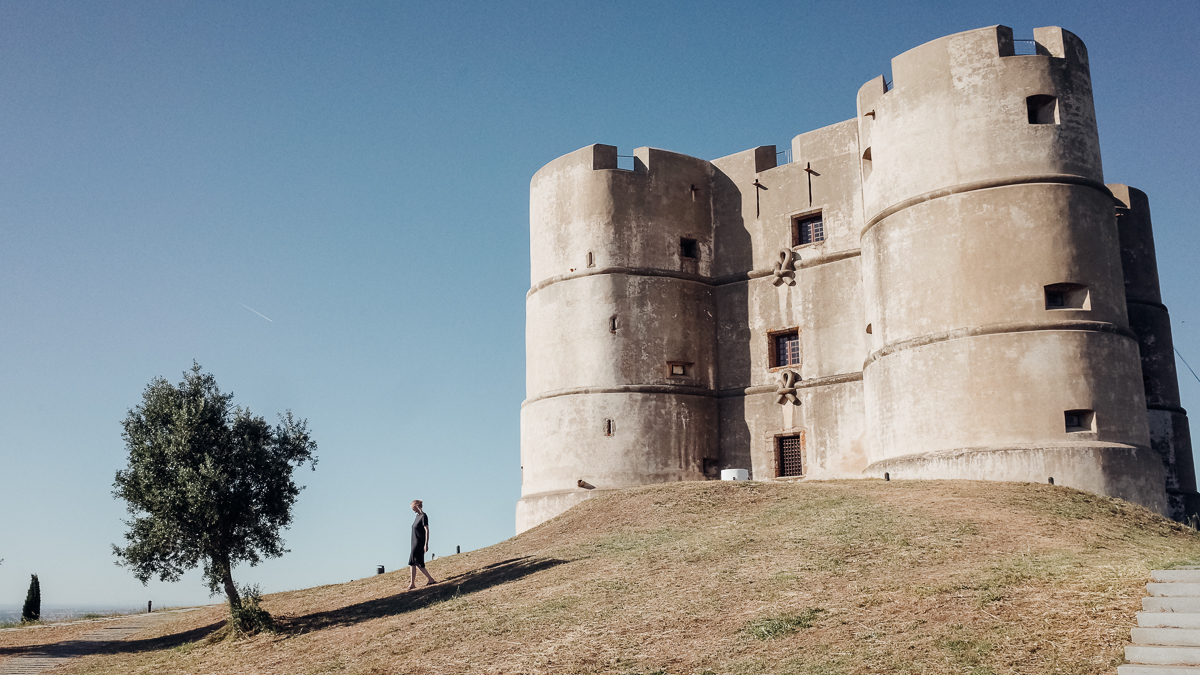
There is a castle on top that looks eerie, and it’s visible for several kilometers before you reach Evoramonte. The settlement itself is small (less than 600 inhabitants), but it has the most significant portion of Alentejo’s charm. There is a small square when you enter the village, with a couple of cafes and some parked cars. Then, the road takes a left turn, and you start driving towards the castle of Evoramonte. After crossing the walls, the Castle of Evoramonte will magnetize your eyes.
It stands at the highest point of the surrounding area. The Castle of Evoramonte is a typical example of 12th-century Gothic architecture, and it’s also an important building in Portuguese history. It was here that the Concession of Evoramonte was signed, on May 26, 1834. This concession marked the end of the Liberal Wars between the Liberal forces of Queen Maria II of Portugal and the Absolutist armies of Miguel of Portugal. The Liberal Wars are also known as the Portuguese Civil War.
I walk around the castle several times, checking the light and trying to imagine what the ideal photo should look like. Behind the castle, the view is endless: I feel that I can see the whole territory of Portugal -not true- as well as the entire Atlantic Ocean -definitely not true. As I circle around the Castle of Evoramonte, I try to decide if I find it romantic or not. The fact that it sits on a hill with a fantastic view is probably blurring my judgment. I can’t decide.
And then, the ideal photo appears. The light is weaker now, and all of a sudden, a visitor appears. It’s a woman standing between the two trees and the castle of Evoramonte. Her silhouette is perfectly in sync with the setting. I take a couple of photos, and then I decide to walk away and have a coffee. Yes, there is a cafe straight beneath the castle. I sit there, I drink espresso, and I space out.
I returned to Elvas for a gin tonic

The Aqueduct of Elvas is bathed in orange light. Even though I’ve seen this marvelous structure a couple of times, I still admire it every time. It needs self-denial and an eye to the future to create such an edifice.
It’s my last night in Elvas, and I walk around the town. I’m trying to find a bar to relax. The days are warm in Central Alentejo and, like in Palma, I try to save the nights for light food and drinks. I end up in a bar-café-restaurant called O Gremio at Praça da República. There is plenty of open space in the square, and in front of the Our Lady of the Assumption Cathedral, a bunch of kids is playing football. I sit at O Gremio, and I watch them running behind the ball.
An older guy, most likely the owner, asks me what I’d like. I need a cocktail, but the only thing that he can make is a Gin Tonic. I ordered one. And then I hear some noise from the kitchen: he is breaking a thick piece of ice. Five minutes later, he serves me one of the biggest Gin Tonics I have ever seen. I sip the drink slowly, and I’m thinking of tomorrow’s journey: I will return to the coast of Alentejo, but this time on its northern part.
The night falls, and the kids disappear in the narrow streets of Elvas. I can only hear the chatter of two older ladies and the noise of the owner talking to the TV: he’s watching a football match. A couple of voices, fresh wind, and the best drinks you can imagine. So generous Central Alentejo is.
I’ll write to you from the sea,
George
More travelogues about Alentejo: The first part of the travelogue & The third part
Read my guide for a road trip to Alentejo
Pin it for later

Please share, tweet, and pin if you enjoyed reading Central Alentejo: from Évora to Elvas. Your support keeps this website running and all the info up-to-date. 🙂