

Last Updated on July 3, 2025 by George Pavlopoulos
If you visit the eastern part of Sicily (where Catania, Taormina, and Syracuse are), you should try to take a tour to Mount Etna. The volcano has a significant impact on Sicily’s history, and visiting it is a unique experience. You won’t only see the dark soil and the craters; you’ll also understand Italy’s nature, and you’ll discover how fertile the area around Etna is.
While several operators offer day trips to Mount Etna (here’s the one I booked), it’s also possible to visit it independently. However, I recommend using one of the guided tours: it will save you time, and you will always have an expert with you. Please note that this is an active volcano and a challenging mountain to ascend.
What you are about to read here is my first-hand experience from my tour to Mount Etna. Although I’m always fond of traveling solo, this time, I also used a tour operator. In this post, I’d like to provide information about my Mount Etna tour and offer an honest review. Below, you will also find some selected tours to Etna and the surrounding area.
*Some links are affiliate links. This means that if you make a purchase, I may earn a small commission at no additional cost to you.
Where is Mount Etna
Mount Etna is located in Sicily, in southern Italy. The closest cities are Catania and Messina. Etna is one of the world’s most active volcanoes. It’s 3,326 meters high, but this can change after summit eruptions. The day I visited Etna, there was even some smoke coming up. To be more precise, Mount Etna is a stratovolcano: it has a conical shape, and many layers of lava and ash build it up.
Natural phenomena can alter the course of history, affecting civilizations or reshaping cities. For example, Catania’s history changed after Etna’s eruption in 1669 and the earthquake of 1693. We owe Catania’s Baroque architecture to these events, as this was the dominant architectural style of the late 17th century. I’m not writing this information as part of a history class; I write it because I want to highlight the fact that, under certain circumstances, a volcano can also be hazardous.
On the other hand, it’s hard to imagine that the disaster that lava leaves behind creates fertile soil. But it’s true. Around Mount Etna, you can see agriculture, orchards, and vineyards. If you take a tour of Mount Etna, you will actually have the chance to try these products. The guided tours usually include stops at local shops, and there you’ll taste such products (and buy them if you want).
How to visit Mount Etna: selected tours

As I mentioned in the introduction, several tour operators offer day trips to Etna. Most of these tours start from Catania, but it’s totally possible to take one from Taormina or Messina. Etna is a highlight of the region, and there will always be somebody to guide you there.
You also have the chance to visit Mount Etna on your own. If you don’t have a car, there is a bus from Catania (currently at 8 am) that reaches the Rifugio Sapienza almost one and a half hours later. The Rifugio Sapienza is the guardhouse at the base of Mount Etna. This is the starting point of several trips to the volcano.
The bus returns at 3 p.m. from Etna. During the day, there are no other public services back to Catania. Make sure not to miss it.
Selected Mount Etna tours
So, here you can find some of the best day trips for your tour to Mount Etna:
- Etna in the morning: half-day excursion from Catania. This tour to Etna starts from Catania early in the morning. The guides running the tour will take you to the craters and show you Valle del Bove, the most important valley on the eastern slope of Etna. Find out more about this tour here.
- Mount Etna: Cable Car, Jeep, and Hiking Excursion to the Summit. This is an all-inclusive excursion to Mount Etna. You’ll hike to the summit of Etna at 3,340 meters with a professional alpinist. The scenery is stunning, and if you’re up for mountain hiking, this guided tour is a must. Read more about the hiking excursion to the summit here.
- Catania: Etna hiking tour. This is a pretty standard tour to Mount Etna from Catania. It has great recommendations, and you’ll see all the significant places of interest. More info about this tour here.
- Etna tour from Taormina. A similar tour for your day trip to Etna, but this time it starts from Taormina. So, if you happen to be in Taormina and you don’t plan to visit Catania, that’s your best option for seeing Mount Etna. See more info about the tour from Taormina here.
My tour to Mount Etna
When I arrived in Catania, I asked the owner of my hotel (which, by the way, is a fantastic option for your stay in Catania) for any recommendations. She mentioned that pretty much every tour offered the same standard route, so, in the end, it was just a matter of preference. I checked the reviews and chose this one from GetYourGuide.
It was a good idea. I decided on a more “amateur” day trip to Etna because I didn’t know what I’d experience. By amateur, I mean tours that won’t require extreme physical activity, as I didn’t have proper hiking shoes. Such tours are also a good option for people who want to enjoy the experience without too much effort. The day I visited Etna, a couple of schools were exploring the mountain. You can easily take this tour if you are relatively fit and you don’t have severe health issues.
However, if you don’t feel adequately fit or if you’re not interested in this kind of experience but still want to see Mount Etna up close, the Rifugio Sapienza offers several cafes and restaurants. That said, you can visit Etna and spend time in one of the establishments, enjoying the view. It’s also quite something.
The second tour on my list above (where you can reach the summit) is probably the best option for a memorable Etna experience for hiking lovers.
A review of my day trip to Mount Etna
Now, back to my Etna tour. The guys picked me up from my hotel in Catania. In general, they will pick you up from any accommodation in Catania. The meeting time was from 8:30 to 8:45 am. Slightly cruel, I know, but that’s the only way to do it.
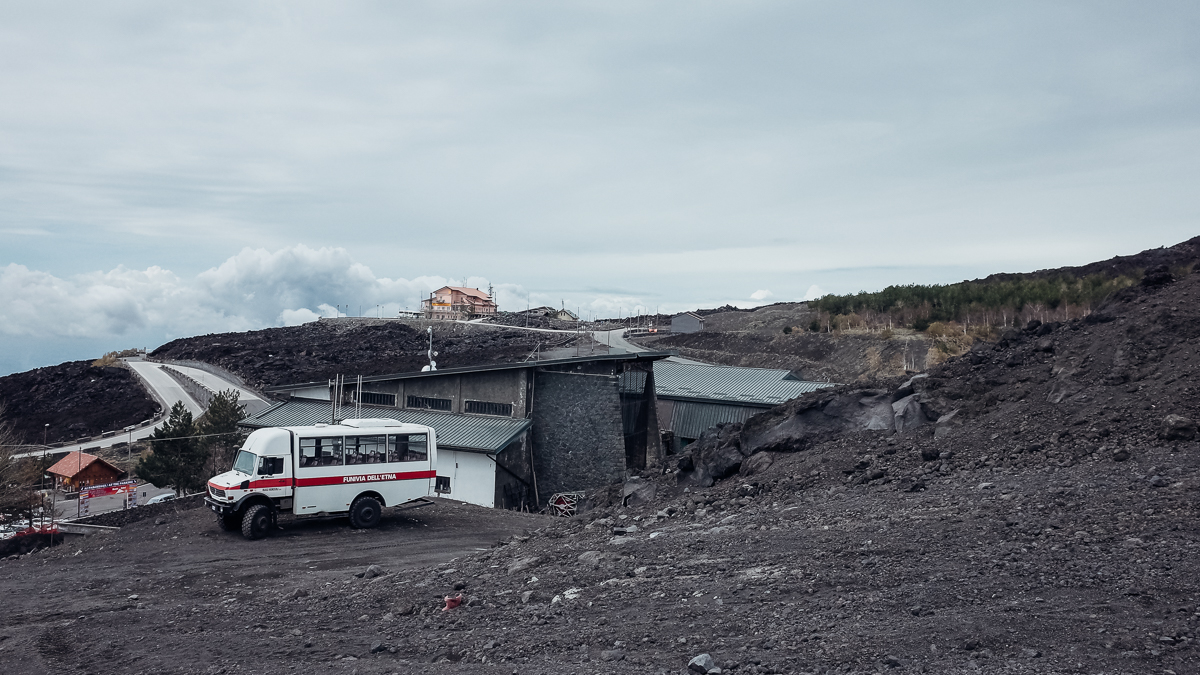
They arrived with a nice minivan, and I was the second one to be picked up. We made two more stops in Catania. All in all, there were seven people in the minivan, plus two tour guides. I believe that a capacity of nine people, including the guides, is the maximum for a minivan of this size.
Both guides were very friendly and helpful. They both spoke English and provided us with a wealth of information about the volcano. The ride was smooth, and I didn’t experience any uncomfortable moments during the tour to Mount Etna. After the tour concluded, they took each of us to the hotel. This was around 3:30-4:00 p.m.
The guys took good care of everyone. They ensured that group members stayed together and that we moved safely from one place to another. Since I stopped frequently for photos, there was always one of the guys waiting for me to make sure I followed the others. It might be a detail, yes, but when you visit an active volcano, it’s worth mentioning.
The cost of my Etna tour was 60 euros.
What is usually included in the tours to Mount Etna?
Most tours offer similar itineraries because there is probably too much demand for them. Here, I’ll write about the tour I took. It’s probably one of the easiest ones, and it serves as an introduction to Mount Etna. Next time I’m in Sicily, I’ll make sure to take a more difficult one. So, here is what my Etna day trip looked like.
First stop: The Lava Cave at Nicolosi
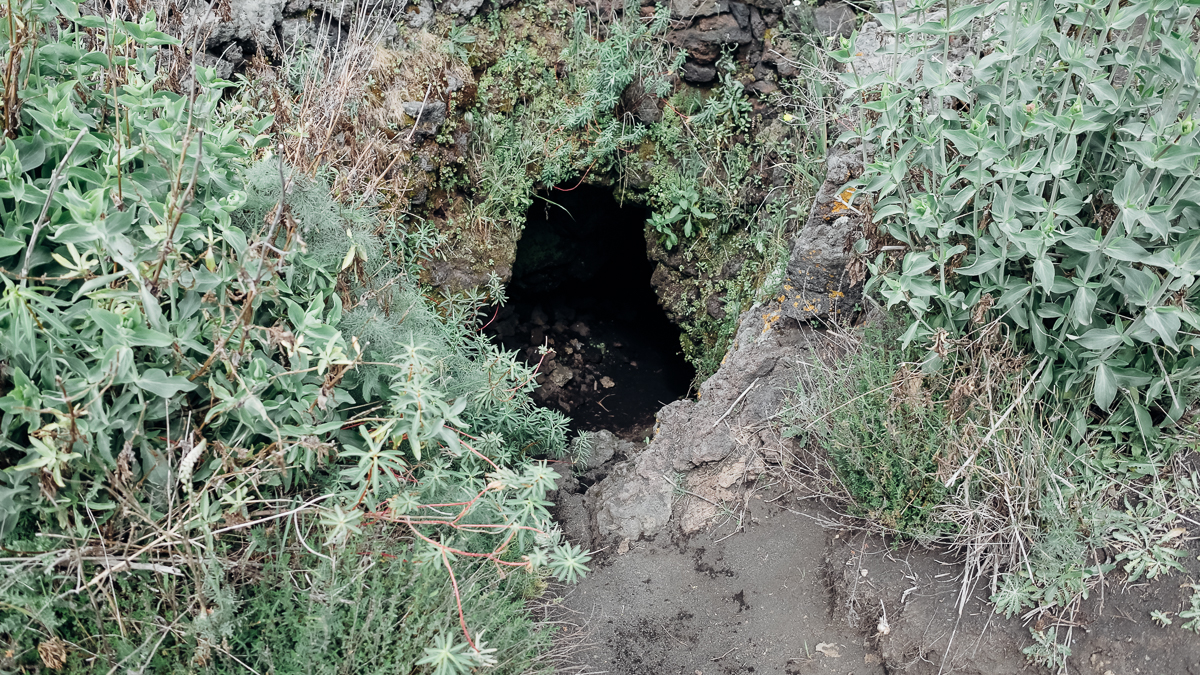
After almost one hour of driving, we reached the foothills of Etna. More precisely, we arrived at Nicolosi, where a small lava cave exists. The guides provided us with helmets and torches, and then we began walking.
The cave is almost in the middle of nowhere, and you can reach it after a 2-minute walk from the main street. The entrance to the cave is narrow, but it’s not difficult to enter. If you (like me) feel claustrophobic in small places, you have two options: a) to wait outside, and b) to enter but not to go to the very end of it. It’s a very small cave, not longer than fifty meters long. Apparently, it’s very dark inside there, and that’s where the torches come in handy.
It’s an interesting place to see. Despite my slight claustrophobia, I entered the cave. I wanted to experience it, and I don’t regret it. I didn’t go to the very end of it, though; actually, I preferred to stay 6-8 meters away from the exit instead.
Second stop: the Rifugio Sapienza & the craters of Mount Etna
So, that’s the main reason why you want to take a tour of Mount Etna.
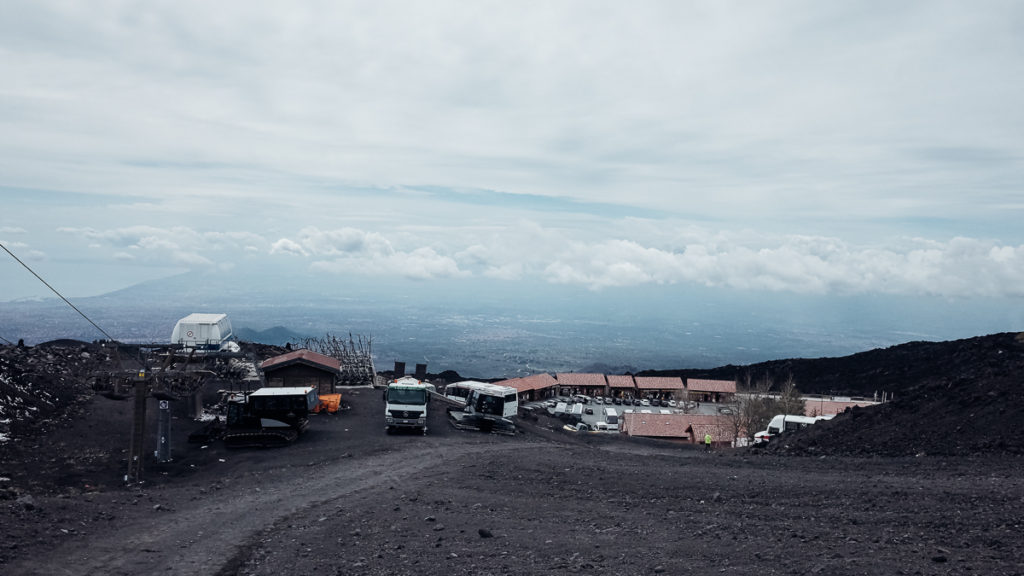
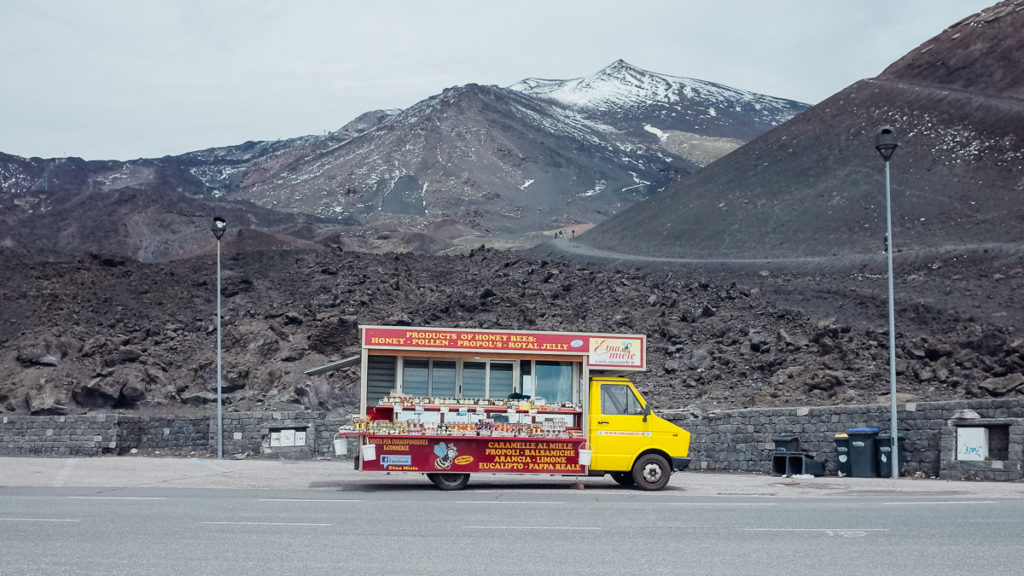
It took us another thirty minutes to reach the base of Mount Etna, which, as I wrote earlier, is also where most visitors gather. There are cafes, souvenir shops, and restaurants. You will also find small trucks selling local products from the fertile soil of Etna.
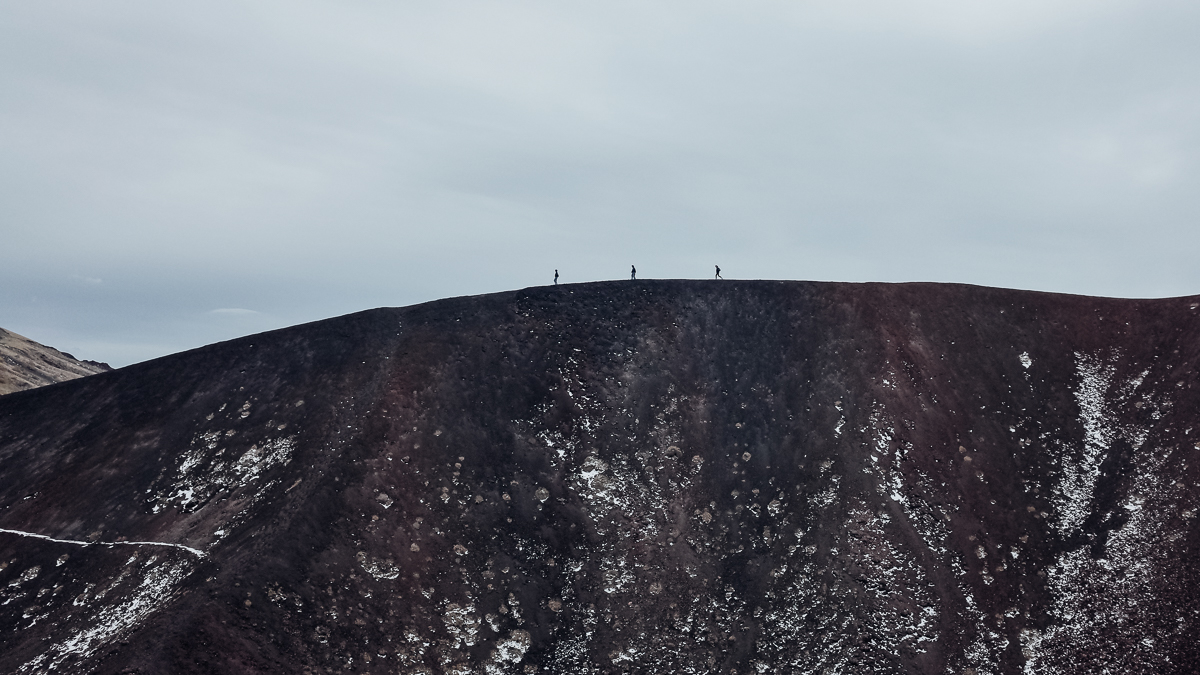
The tour I chose included some trekking in the Parco dell’Etna. This practically means that we would walk for one and a half hours around the Rifugio Sapienza. More precisely, we visited two big craters and wandered a bit more around. It was a fascinating experience. I felt like I was on the moon: dark soil and two huge craters with a bunch of people walking around them.
The wind was very strong, and it was really cold. The first part of the trek was steep, but soon everything became easier. After that first part, we had to walk on a rocky surface covered with volcanic ash. Then, we started climbing the craters.
That’s nothing to scare you. It’s just a short, steep way to the top of each crater, and then you’ll circumnavigate it. It’s also relatively narrow, measuring no more than 3-4 meters, and when the wind is strong, it can be a bit unpleasant. But as I already said, nothing to scare you.
After a bit more than one and a half hours, we returned to the minivan. We have reached an altitude of 2,000 meters, and that’s not something you do every day. Actually, the last time I did it was in Armenia, at Lake Sevan.
The experience was wonderful, and I would revisit Etna with pleasure (I’ll just have to bring proper shoes and a jacket next time).
Other options at Rifugio Sapienza
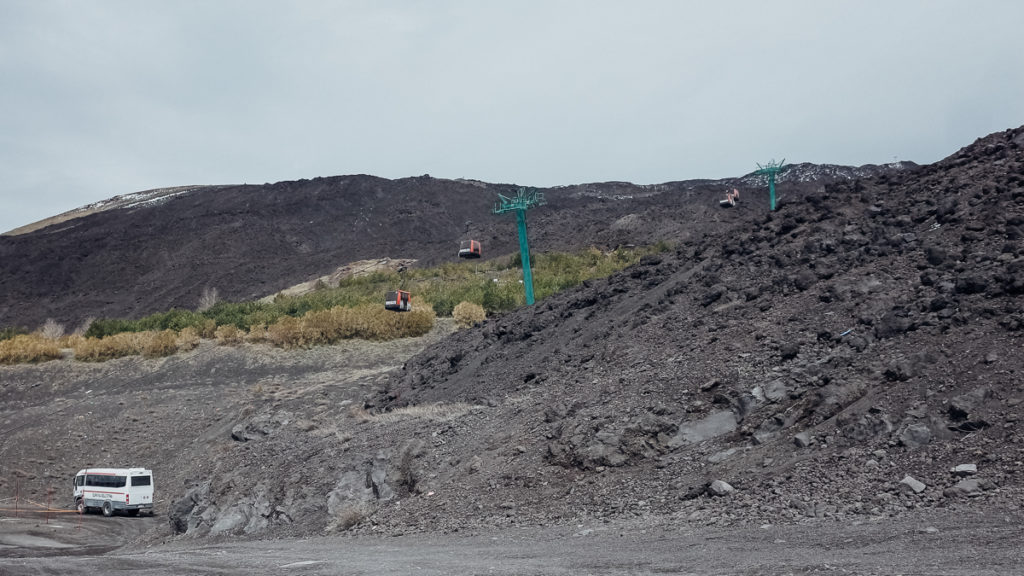
1. After reaching the Rifugio Sapienza, your guides will inform you that you have a few more options here. If you wish, you can purchase the high-altitude option. This means that you will embark on the cable cars (don’t worry, they are not like the ones in Chiatura), and after 15 minutes, you’ll find yourself at an altitude of 2,500 meters.
From there, you will continue further up, up to 2,900 meters, using a 4×4 minivan. It takes approximately 20 minutes to reach this spot, named Torre del Filosofo. What you’ll see there is the great crater, as well as the historical lava flows.
Professional alpinists will wait for you there, and you’ll have the opportunity to see the real Etna up close. On the way down, you’ll take first the 4×4 minivan and, once again, the cable car.
The day I visited Mount Etna (mid-April), this option was not available due to bad weather. It was snowing on the top of the volcano, and it was impossible to reach the Torre del Filosofo. The only option would have been to take the cable car to 2,500 meters, but the guides advised us that there weren’t many things to do there. Hence, I skipped the option.
The high-altitude option (cable car plus 4×4 mini-van) costs 65 euros more per person. It’s slightly pricey, to be honest, even though this is a lifetime experience. The cable car, up to 2,500 meters, costs 30 euros.
2. From Torre del Filosofo, you also have the option to reach the summit of Mount Etna. This requires special preparation and is heavily dependent on the weather. You might think that it’s just 400 meters more, but it’s probably not that easy. You should consider consulting a dedicated alpinist to help you with your plan, and never attempt it alone.
Third stop: Zafferana
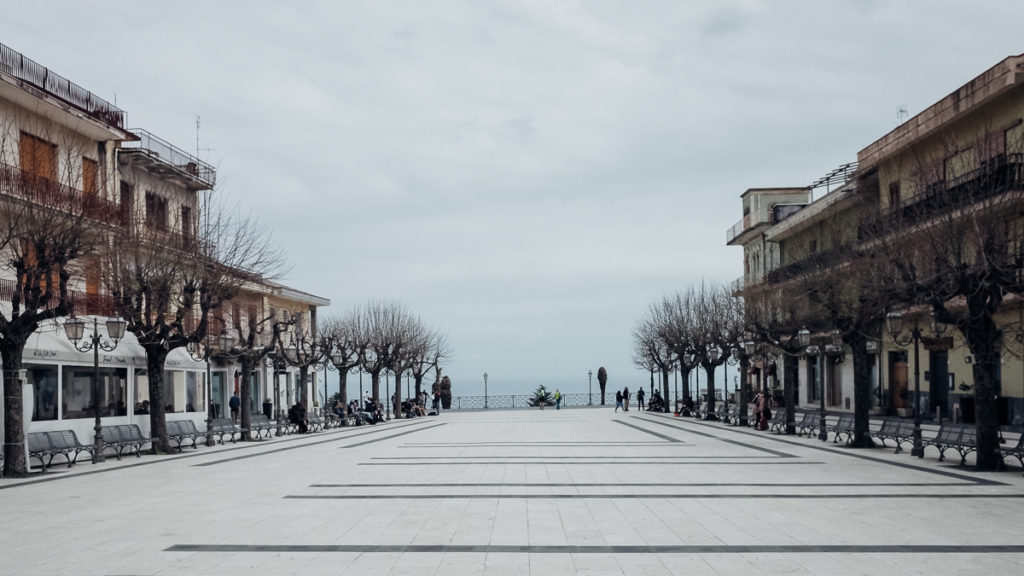
After leaving the Rifugio Sapienza behind, we drove towards Zafferana.
This is a small town with fewer than ten thousand inhabitants. The locals claim that the village was saved twice by Mount Etna’s lava because the Virgin Mary intervened on their behalf. When the lava was approaching the village, they brought an icon out in the streets, and the lava stopped its course. True or not true, that’s the lava story of Zafferana.
The minivan stopped in a small shop where the owners sell local products. You can try some wine from the lava vineyards, olive oil, and peanuts. You can also purchase items and support the local economy, quite obviously.
After the short pause at Zafferana, we started driving back to Catania. It took us one hour to reach it.
Practical info for visiting Mount Etna
Here is a short list of tips for your visit to Mount Etna. Please remember them before traveling and when you are there.
- First things first. It is always cold up there. At the Rifugio Sapienza, the temperature ranges from 15 to 20 degrees Celsius, which is lower than it would be in Catania. The day I visited Etna, it was 21 °C in Catania and 3 °C at the Rifugio Sapienza. However, the real feeling was -2 °C due to the extreme wind. Strong winds are, in general, the norm there.
- Bring warm clothes and comfortable shoes. Even if you take one of the most basic tours, the conditions are not ideal. The soil is hard, there are rocks everywhere, and the wind is extreme. You need to stay warm at all times. On the other hand, if you visit Mount Etna during the summer, be sure to bring a hat and sunglasses. It can be warm, and you may even get sunburned due to the sun’s intense rays.
- Respect the mountain. Mount Etna is one of the most legendary places in the world, being also a UNESCO World Heritage Site. It changed several times the course of history, and it might alter it in the future. Don’t think that you can do whatever you want there. Take your day seriously, and respect your guides as well as the other visitors.
- Prioritize your safety over taking selfies. In such locations, it’s better to have one less selfie than to run into trouble. Reaching the edge of a crater and jumping up and down for a cool selfie on a super windy day is not a wise idea. However, it was performed plenty of times by several people on the day of my tour to Etna.
- Although there are cafes and restaurants around, it’s a good idea to have water and a light snack with you.
Final impressions from the Mount Etna tour
Although I’m always skeptical about guided tours, I also understand that there are some places that I can’t reach on my own. Such was the case of Mount Etna. It would have been tough for me to visit the volcano on my own, and I wouldn’t have seen that much either.
The day I spent at Mount Etna was definitely a highlight of my journey to Sicily. A few like-minded friends asked me if it really deserves spending half a day there. My reply? Absolutely. The landscape seems out of this world, the mountain itself is impressive, and you won’t often have the opportunity to visit an active volcano.
If you ask me if I’d retake the tour, the answer is also yes. The next time, though, I would like to see a bit more of the volcano. I mean, who wouldn’t like to see some lava up close?
More about Sicily: A Taormina guide, I dreamed of Syracuse, A travelogue from Catania, Things to do in Catania
Pin it for later
Sharing is caring. Share this guide to Mount Etna with your friends.