

Last Updated on February 24, 2026 by George Pavlopoulos
Dear Barbara,
I’m standing in front of glorious waves, at the end of a continent. And I’m wondering: what am I doing here? I have no idea what I am really searching for in Alentejo Litoral. The southern coast of Portugal is one of the most beautiful regions in Europe. At the same time, though, it’s also one of the poorest. A blend of untamed nature and cheerful people paints Portugal’s coastline in vibrant colors. But here is what I always wanted to do: a road trip along the Costa Alentejana.
It took me almost four hours to fly from Berlin to Faro. I didn’t spend any time there, and I just got in a rented car and drove straight away. For one and a half hours, the car kept running through the fields. But don’t expect forests here or nature that doesn’t need water. The landscape is dry, yellowish, resembling an impressionistic painting. There are just a few clusters of trees, but they don’t occupy noteworthy surfaces: they are just details painted on that dry area.
All I see are these small hills. A lonely tree stands on top of every hill, scattered tofts anchor here and there, and a few men walk on the asphalt. They always raise their hand, and it’s as if they already know what I’m doing here. They probably know who exactly I am: I’m a stranger among strangers, a loner among loners.
Alentejo, a land of self-sufficient souls, betrays secrets that I usually wouldn’t dare to whisper.
A barn in Zambujeira do Mar
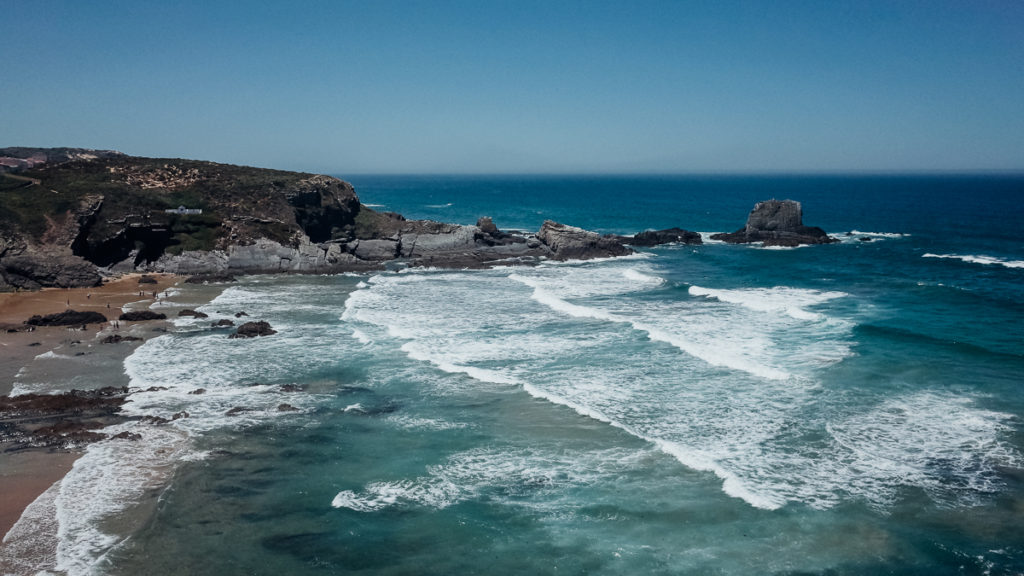
The most unique places are always the ones that offer odd accommodation options. You probably remember that once upon a time, I spent one night in a steakhouse; another time, I stayed in a cinema. But this time, in the Alentejo coast, I try something else: I’m staying in an old barn.
It is located in Zambujeira do Mar, very close to the start of the Alentejo coast. This is an old refurbished barn that the polite owner, Rodrigo, transformed into five rooms to let. Small rooms with wooden ceilings and a traditional feel make the Monte do Papa Leguas barn an ideal place to stay. At times, I feel that I’m in the middle of nowhere, but then, I re-evaluate: Rodrigo offers a bunch of free bikes that, after a couple of kilometers, will bring you to the most amazing spot: the Atlantic Ocean.
Later that first evening in Alentejo Litoral, I thought of leaving Zambujeira do Mar behind and going a few kilometers farther down the road to a well-known fish restaurant. And that’s actually where I’m writing to you from. I arrived here shortly before sunset: there were orange stripes in the sky, and I could stare at the sea. Then everything went pitch-black, but I could still hear the waves.
That Portuguese tavern serves excellent sea bass and has a name as long as the coast of Alentejo: Restaurante a Barca-Tranquitanas. I’m the last one to leave. The personnel have dinner: they are seated around a table, they share food, and they talk to each other.
That sense of community is the best start for my first night in Alentejo Litoral.
The Alteirinhos beach in Alentejo Litoral
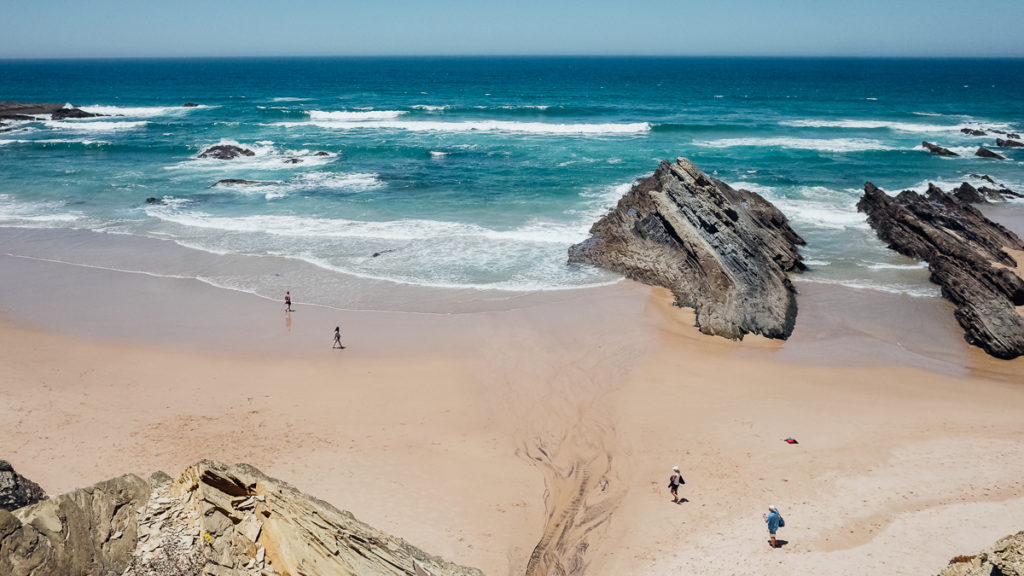
I always follow the same procedure when it’s summertime, and I’m near a beach. As you probably remember from my days in Anafi, I visit a local mini-market, and I buy provisions for the day: tomatoes, some local cheese, bread, and bottles of water. And then, I’m off to a less crowded beach.
The Alteirinhos beach lies less than two kilometers outside of Zambujeira do Mar. On the left side of the main beach, there is a parking lot, and then there are approximately two hundred stairs to the sea. As I walk down, I can feel the wind on my face, and I have an incredible view of the Ocean. The Atlantic is rarely quiet, and the waves are enormous. A few dogs are running around crazily, and this gives me a good dose of stress.
But the landscape is breathtaking, and I soon forget the dogs.
I walk all the way to the left, where the rocks create a natural border, and I lie under the sun. The waves are wonderfully noisy. And then, I realize how cold the Atlantic is. It actually feels frozen. The tide is powerful, and no one is currently swimming. Although I’d love to go swimming in the Atlantic Ocean, I know that I’d better remain rational.
All I do is stay close to the shore and just walk a couple of meters into the water. I can play with the waves, yes, but I can’t swim. My only attempt to swim fails: a couple of moments later, the current pulls me in quickly, and I have to imitate a windsurfer: I ride the wave with my body, swimming fast towards the shore.
Luckily, I succeeded. I lay down on the warm sand, and I let myself dry. The tomatoes are ripe, the cheese is delicious, and the bread is still warm. I have a book with me, but I want to read the Ocean’s waves. I study them one by one, and at five o’clock, I realize that I’m once again sunburned.
Football and 1000 Watts at Cabo Sardão

The Rota Vicentina in Alentejo Litoral is a hiking trail that runs along the coast. Dozens of kilometers await the ambitious hiker in Southern Portugal, but I must admit that I’m not one of them. I think I live more in the moment and less for the long-term goals. Once I find a place, I prefer to stay there for a while, even for hours, and appreciate it. You see, I need stories like others need adventures: stories are, in fact, the adventures of the mind.
The Cabo Sardão is one of the most beautiful places in Alentejo, if not the most beautiful. At the same time, it is also one of the most bizarre. The Cabo Sardão hosts a lighthouse on its edge, but oddly enough, there is a football pitch exactly next to it. All the lost balls of football games end up probably in the Ocean, and they might reach the United States of America one day, like messages in a bottle.
In front of the lighthouse, there is also a wooden platform, slightly useless, in my opinion. That platform doesn’t offer any significant views, though: it’s not an extension above the ocean, and it’s not high either. There are cliffs all around, and the view from the right side is outstanding. This is a scenery that naturalist painters might daydream of: a huge rock straight beneath the cliff and an angry Ocean dancing around it.
Those cliffs are where the storks nest. As far as I know, this is the only maritime place of nesting storks in Europe. I have no idea if the wooden platform caused environmental confusion, but it most likely did. As if everything has to reach some certain levels of bizarreness, the one-hundred-year-old lighthouse is built facing inland. Typically, a lighthouse’s entrance is from the land side, but here you enter from the Atlantic’s side.
Why did this happen? Well, just imagine Alentejo Litoral in 1915: an area hard to reach, and the Cabo Sardão itself being totally secluded. If the story I was told is right, then the local builder completed it without waiting for the authorities to inspect it. If it was an act of complaining or just pure bad planning, I couldn’t find out. The Cabo Sardão lighthouse was connected with the national network of electricity in 1984; its flashlight received a downgrade consequently: it went from 3,000 Watts down to 1,000.
So, in a rather deserted place, we have: a football pitch at the edge of the continent, cliffs with nesting storks, a wooden platform that offers little, an incredible landscape, and a lighthouse facing inland. What’s more to ask?
Unimpressed at Vila Nova de Milfontes

One of the following days, after swimming at the marvelous beach of Praia de Nossa Senhora, I decide to move further up. There is a place called Vila Nova de Milfontes, which seems to be the largest settlement on this side of the coast. It’s half an hour away from Zambujeira do Mar, and the road goes, of course, through fields. Driving in Alentejo Litoral is a pleasure: nature is everywhere, and the early summer scents create an atmosphere of fertility.
Vila Nova de Milfontes is located on one side of a lagoon. To reach it, you have to drive over a bridge with a view of the Atlantic. But when I arrive at Milfontes, I feel all of a sudden unimpressed: it seems to me that this is a much larger version of Zambujeira do Mar, but without the charm. There is a main street full of shops, but otherwise, nothing looks that special. On the edge of the town, I see the beach.
I’m still not sure if I will be able to swim, but since this is a lagoon, the waves won’t be that tall. I take the stairs down to the sandy beach: on one side, the huge waves of the Atlantic, on the other, the calm water of the lagoon. No one is swimming, and I’m really wondering why. Ten minutes later, though, I received my answer: the water is almost frozen. I truly think that I never swam in such a cold sea.
There is also an enclosed area in the sea. It somehow means this is the safe part to swim in. Once again, I’m wondering why, and, of course, I once again receive my answer within a matter of minutes. The current is so strong that you can be pushed in no time towards the open sea. I try to swim against the current, but it’s almost impossible: it seems that I’m not moving at all.
Feeling cold and being impossible to swim, I decide to stay close to the shore. There is a woman in her late sixties trying to swim, too: she is German, and she is traveling solo with a van. We carry on talking for a while until we are both frozen in the lagoon of Vila Nova de Milfontes.
The tavern at the end of the world
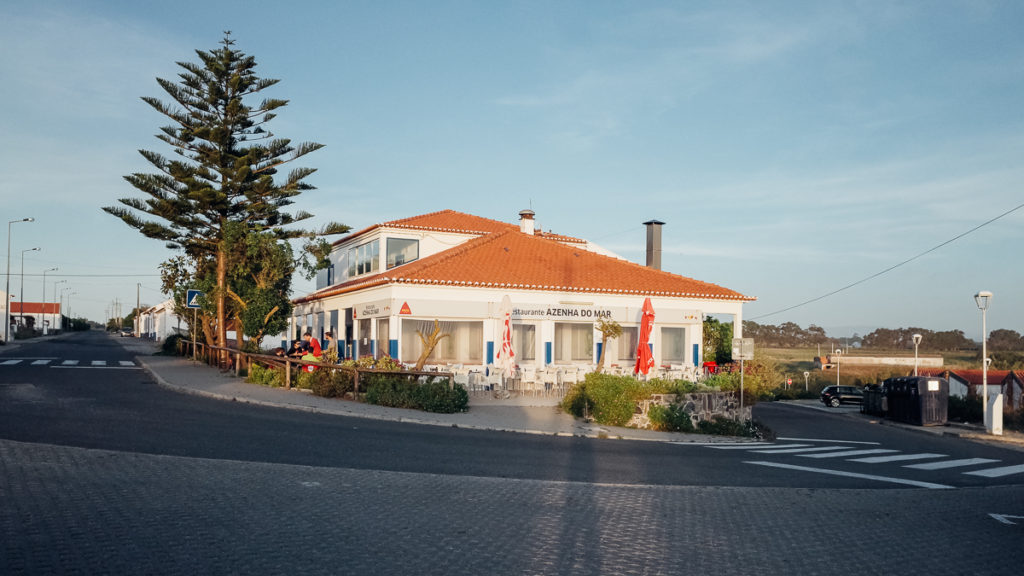
Sometimes, when you travel to the most remote places, you learn something about yourself. One night, the road takes me to A Azenha do Mar, a tiny settlement on the coast. There are just a few people living there, and the cliffs are breathtaking. There’s also something that looks like a small cafe, with a magnificent view of the Atlantic Ocean. It’s one of those places where you can reflect upon your life.
Too much thinking, though, can also bring you to the stage of hunger. The truth is that I’m here to try local fish in the only tavern of the settlement, also called A Azenha do Mar. It’s a beautiful place overlooking the cliffs, and rumor has it that it serves the best fish in this part of Alentejo Litoral. And indeed, the fish is delicious, but what makes it even more charming is the gentleness of the personnel. They are all friendly, they seem to know exactly what to say, and they try to teach me some basic Portuguese.
What I learn about myself is rather unimportant, but I know that you want to know it: I only need fish, the sea, and kindness in order to be happy. That’s what I’m thinking on the way back to Monte do Papa Leguas. The road is pitch black, and if you stop the car for a moment, you’ll see a trillion stars in the sky. The Atlantic is nowhere to be seen, but it’s still present: no matter where you are on the coast of Alentejo, you can always listen to the waves.
Love,
George
More travelogues about Alentejo: The second part of the travelogue & The third part
Pin it for later
Please share, tweet, and pin if you enjoyed reading Alentejo Litoral: the end of a continent (I). Your support keeps this website running and all the info up-to-date. 🙂