

Last Updated on January 30, 2026 by George Pavlopoulos
The best way to travel through Germany is definitely by train. Deutsche Bahn, Germany’s national railway company, operates an impressive fleet and can take you everywhere in the country. However, some things might seem a bit confusing for first-time visitors: from how to buy train tickets in Germany to the differences in fare classes.
This article explains everything you need to know before booking a train ticket in Germany. Specifically, you’ll find a guide to buying tickets on German railways, and I’ll share information about each fare category. Moreover, I include a short glossary with the German words you might come across before or while traveling. Last but not least, I’ll share several travel tips for your train journey with the Deutsche Bahn and what to expect from their services.
Let’s start.
*Some of the links are affiliate links. This means that if you make a purchase, I may earn a small commission at no additional cost to you.
How to buy train tickets in Germany
The first thing you want to do is visit bahn.com, the official Deutsche Bahn website in English. You’ll also have the opportunity to choose a couple of other languages, like French, Spanish, or Italian, among others. (If you speak German, you can head over to www.bahn.de)
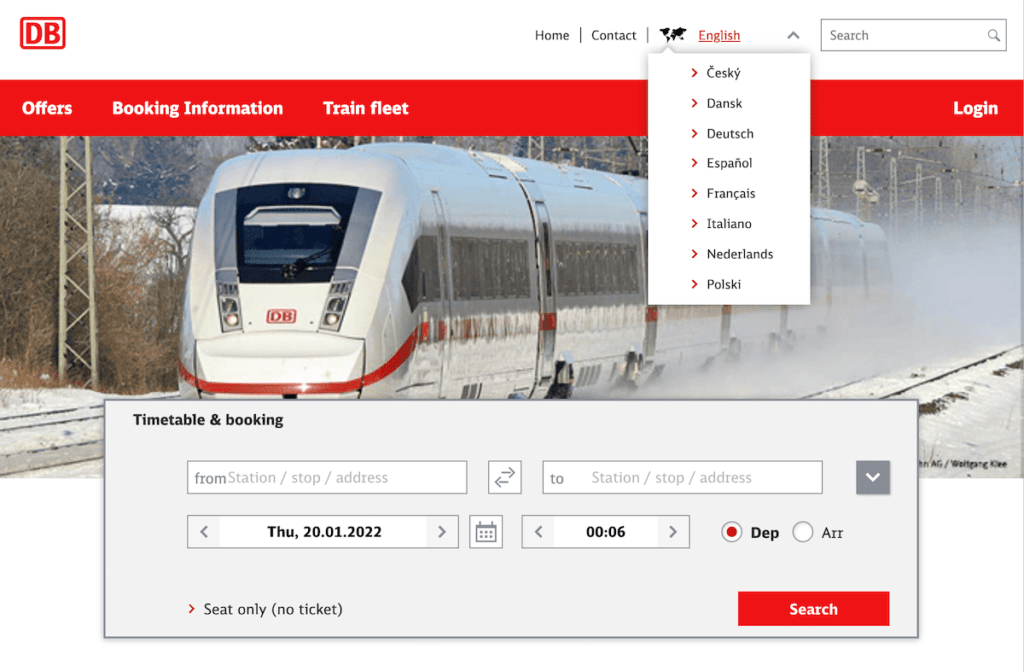
If you chose English in the previous step, that’s what you’ll see:

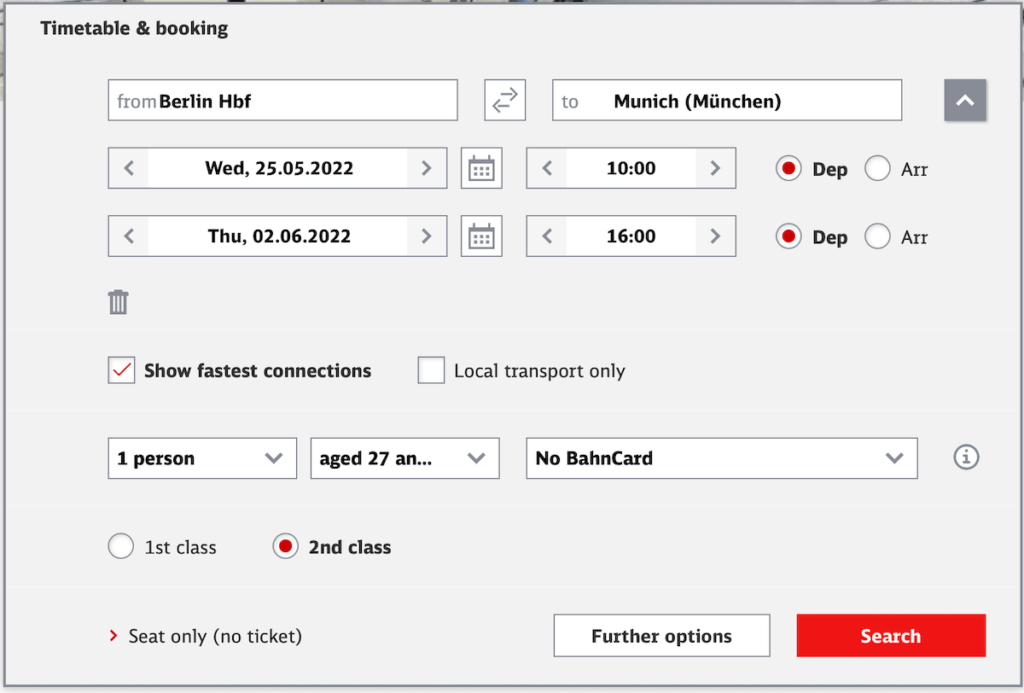
So, after choosing your language, you’re now ready to search for your itinerary and book your train tickets. In the example you see below, I chose to travel from Berlin to Munich with Deutsche Bahn. Apart from adding the dates, I chose “2nd class” and the “No Bahncard” option (I’ll explain these options in the next section).
Just fill in your itinerary and click “Search.” That’s how it should look:
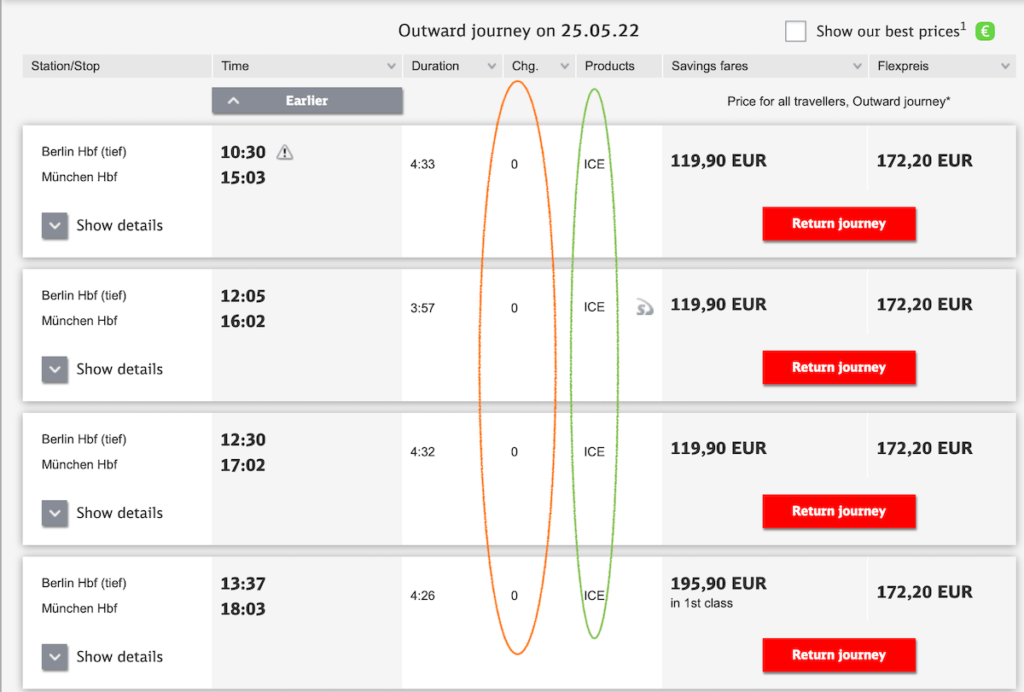
On the next page, you’ll see the options for your outbound train journey (here, it’s from Berlin to Munich). In addition to departure and arrival times, you’ll see the duration of your trip. Now, the orange-marked column shows how many times you’ll have to change trains.
In our example, it is “0”, which means that it’s a direct connection. The green-marked column is about the type of train (here: ICE). You’ll find more info later on.
Here’s how your screen should look:
If you have a return journey, you’ll need to choose your itinerary in the next step. Moreover, you’ll also see the price for your entire trip.
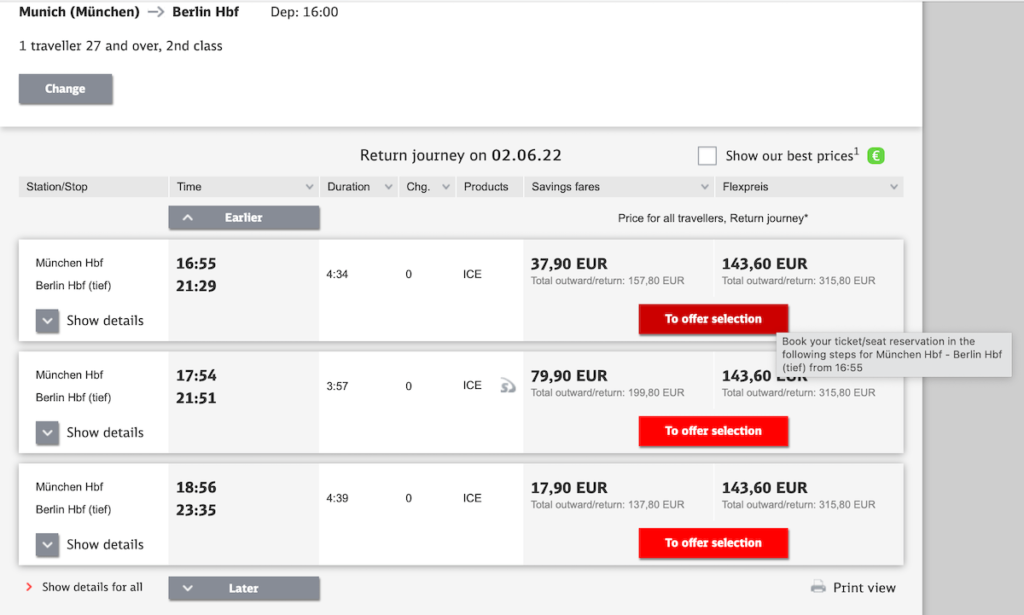
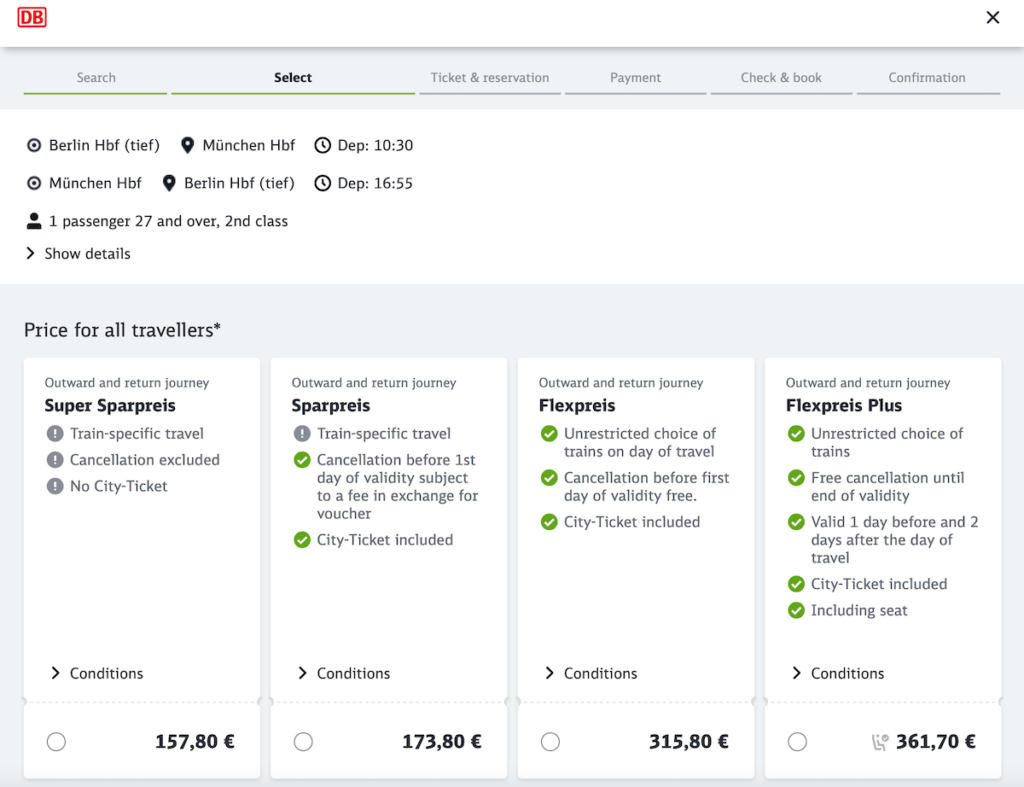
After choosing your itinerary, you’re now ready to select your fare and book your train ticket for your German trip. You’ll usually see four options: Super saver fare (from as little as EUR 17,90), Sparpreis, Flexpreis, and Flexpreis Plus.
These are the price categories, and you should think of them like airplane fare categories. You can get a glimpse of the image below, and I’ll share more about it later. Then, you can choose the one you prefer.
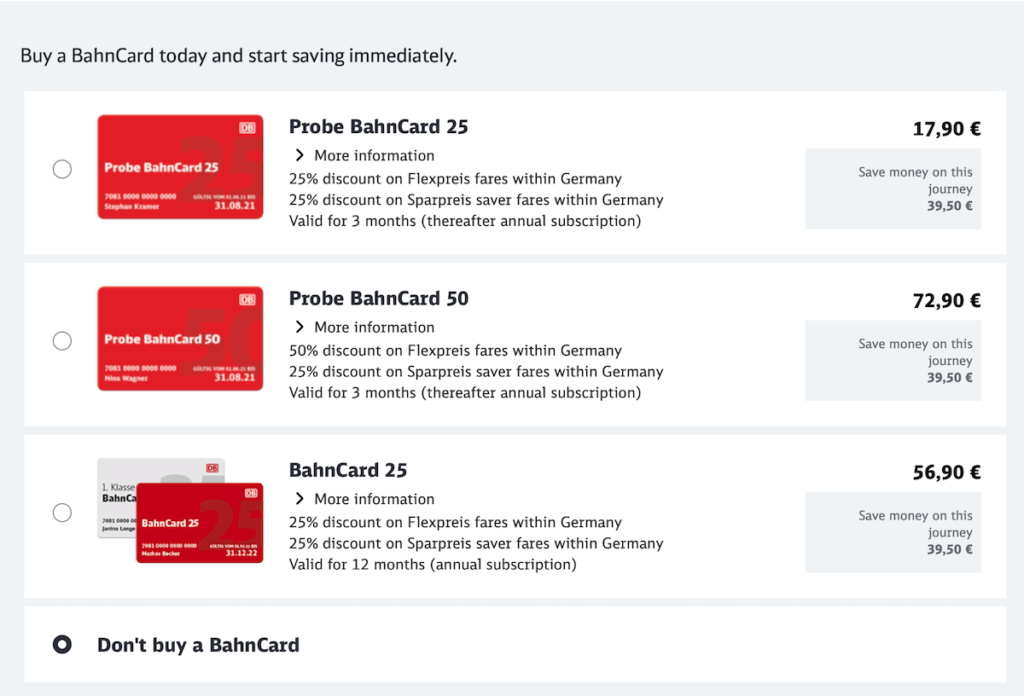
After choosing your train fare category, you will see the option to purchase a Bahncard. A Deutsche Bahn Bahncard lets you reduce the price of every ticket you buy by 25% or 50%. While I will write more about the Bahncard in the next section, I can tell you this: if you plan to stay in Germany for a long time, it makes sense to buy one.
However, if you just want to buy a single train ticket, you don’t need to consider it. In the example I follow here, I continued without buying one.
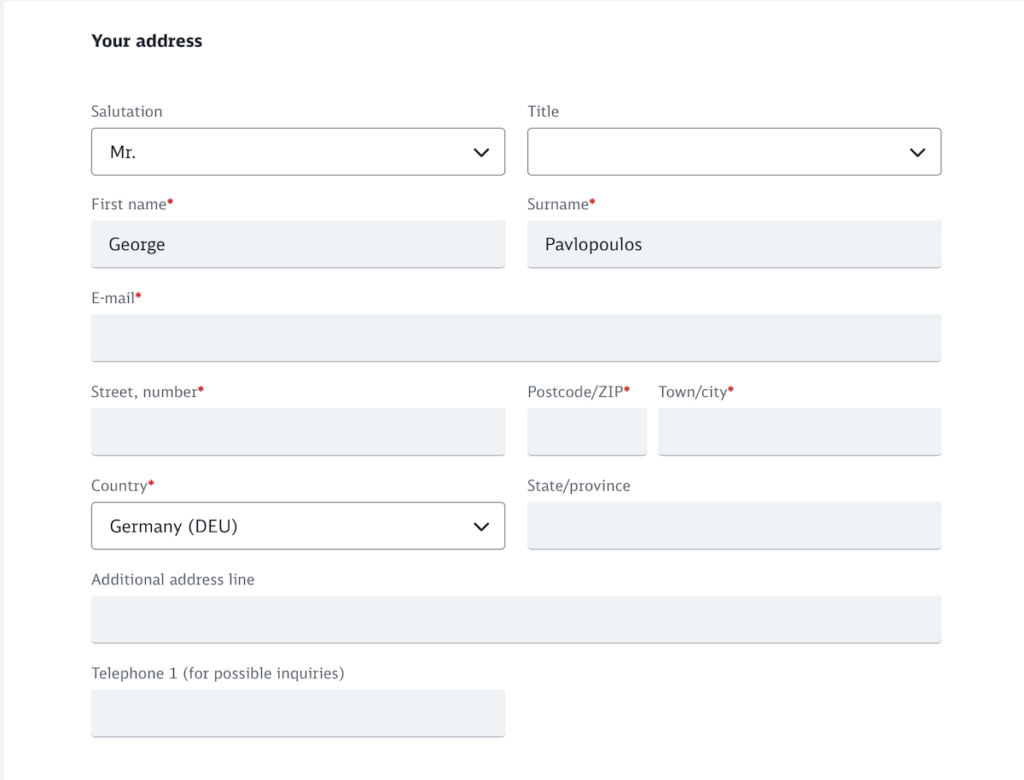
Now it’s time to add your first and last name. In this step, you also have the option to create a Deutsche Bahn account. If you’re here for just a ticket, please note that you don’t need to create one.
However, if you plan to book multiple tickets for your journey or intend to stay in Germany for an extended period, I strongly recommend creating an account. Apart from having all your train tickets in one place, you can also manage your bookings (buy seats, change bookings, etc.).
That’s what you’ll see.

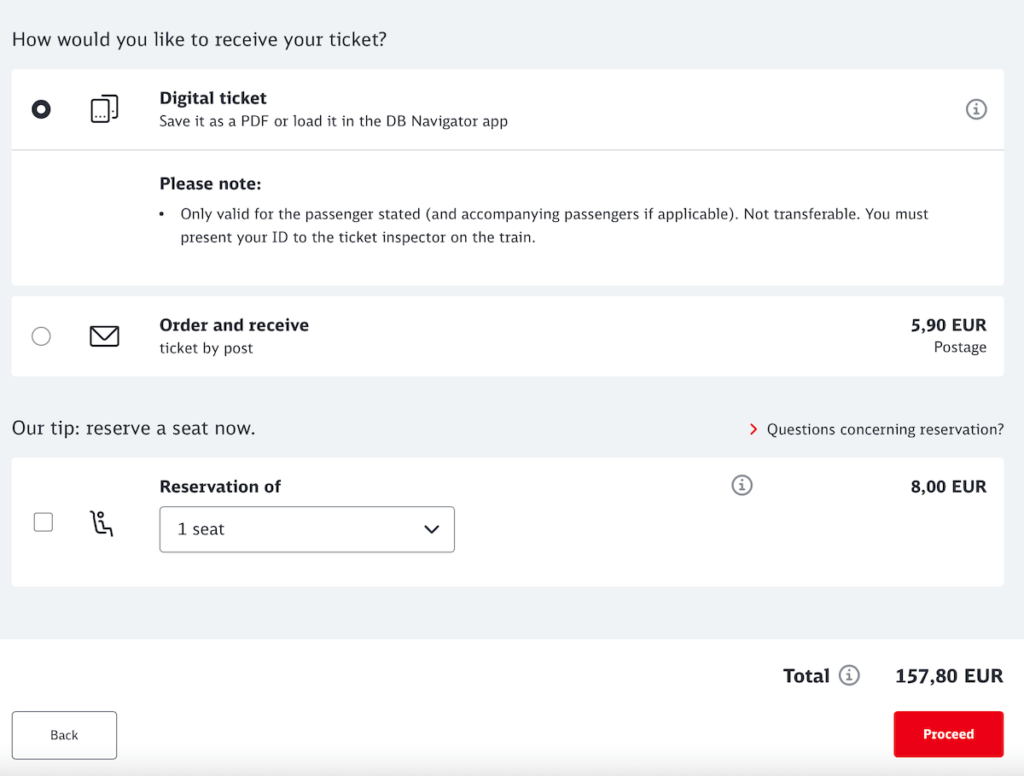
So, now it’s time to choose whether you want your train tickets delivered to your home or saved as a PDF file. The latter is the most common option and, of course, free. In this step, you can also reserve a seat.
Remember that buying a ticket doesn’t automatically allocate you a seat. The seats currently cost 4 euros per train; therefore, you’ll have to pay 8 euros for a return ticket. I’ll share my thoughts about reserving a seat below. Here’s what you’ll see:
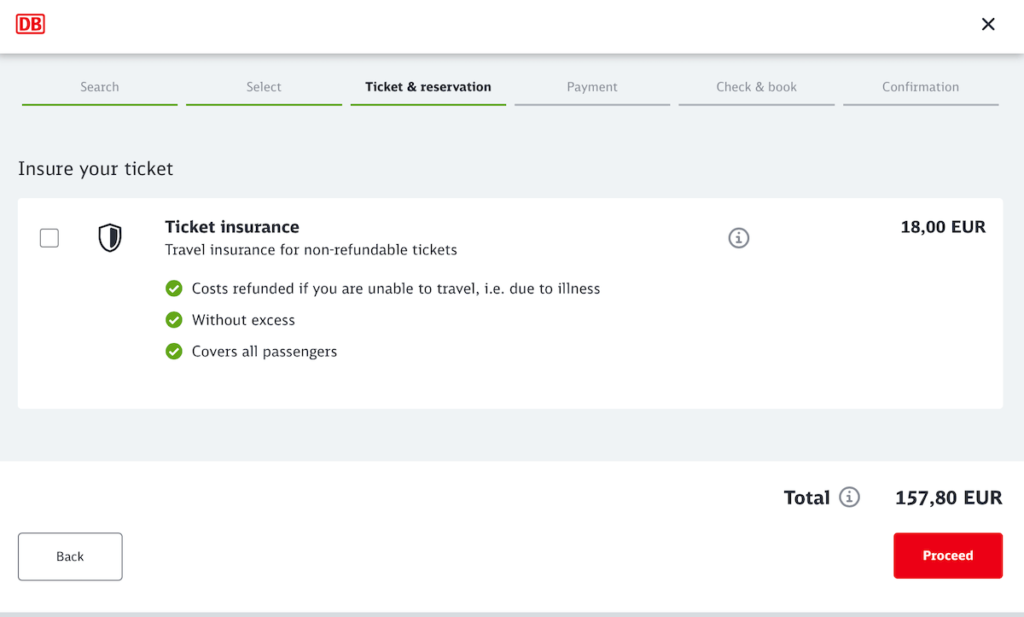
Before paying, you’ll also need to decide whether to purchase ticket insurance. I never add travel insurance on German trains, but that’s up to you.
Finally, it’s time to enter your details and proceed with payment. You can pay via bank transfer, credit card, or PayPal.
After completing your payment, you’ll see a confirmation screen and will shortly receive an email confirming your train ticket booking. Done!
Buy train tickets in Germany: Deutsche Bahn travel tips
While buying train tickets in Germany is relatively straightforward, some aspects might sound confusing. I wrote several times in the tutorial above that “I’ll explain to you below.” So, now it’s time to clear things up and offer you some Deutsche Bahn travel tips.
What do the ICE, IC, and RE mean when I’m searching for train tickets?
These codes refer to the various trains operated by Deutsche Bahn. When you see a train itinerary, you’ll also read the type of train you’ll be traveling on. In the example above, see the fourth photo with the green line marked. Here’s what they mean:
- ICE. These are the InterCity Express trains, which are high-speed and capable of reaching 300 km/h (185 mph), and they offer greater comfort. The ICE offers free Wi-Fi (although it is not always very reliable) and sockets located next to the seats.
- IC. Don’t confuse them with the ICE. The IC is the simple InterCity train, and most of them use locomotives. They are slower and feel somewhat outdated. However, they are reliable and have an extended network in Germany.
- RE. The code RE stands for Regional. They all belong to Deutsche Bahn, but other companies sometimes operate them. Some of them are double-decker and will take you everywhere in Germany.
To sum everything up: if you want the fastest connection available for your train journey in Germany, look for the ICE. That’s usually possible between major German cities, such as Frankfurt, Berlin, Munich, and Hamburg. For smaller places, you’ll have to use the IC or RE, at least for parts of your journey.
Should I buy train tickets in advance in Germany?
While it’s always a good idea to buy train tickets in advance, the correct reply here is: it depends. What does it mean? Well, it depends on the train(s) you’ll be using for your journey and how much money you’re willing to spend.
Here’s what you need to know.
Buy a train ticket in advance if you’re traveling on an ICE train. When you buy them in advance, these tickets can be really cheap, often starting from 19.90 euros. Then, after the first batch of tickets sells out, the cost will be 29, 39, 49, etc. That’s only for Super Sparpreis and Sparpreis tickets, i.e., the Saver fare (from as little as EUR 21,50). On the other hand, the Flexpreis has a fixed price, and it’s usually 4-5 times higher than the Sparpreis.
No need to buy a train ticket in advance if you’re traveling on a Regional (RE) train. Regional trains in Germany have unlimited availability, and prices are fixed.
How to buy cheap train tickets in Germany
If you’d like to buy cheap train tickets in Germany, then your best option is to book them in advance online. As soon as you have your journey’s fixed dates, head to bahn.com and book your tickets.
Try to find the Super Sparpreis, which guarantees the best available rate. However, keep in mind that cheap tickets won’t give you flexibility. Sure, traveling first class with Deutsche Bahn gives you plenty of space, but if the budget matters, go for the cheaper trains and tickets.
If you don’t plan to travel on public holidays or during rush hour, consider not reserving a seat. While seat reservation will give you peace of mind, it can save you some money, especially if you have multiple journeys ahead. Most of the time, you’ll find a spare seat -but don’t take that for granted.
Finally, consider skipping the ICE if you don’t mind stopping at several train stations and have plenty of time. These are the fastest and most expensive trains in the DB fleet.
To find the lowest fares, use the DB best prices finder. It will show you the best prices for your itinerary.
Can I buy a train ticket at the train station?
Yes, you can buy a ticket for German Railways directly at the station. There are dedicated Deutsche Bahn Centers at most stations, and vending machines are always available.
However, consider the previous answer: buying an ICE ticket on the day of your journey will most likely cost an arm and a leg. Therefore, do that only for Regional trains.
How much in advance can I buy my German train tickets?
In most cases, you can book your ticket for the German Railways six months in advance at bahn.com.
Do I need to show the credit card I used to pay for the train ticket to the train conductor?
Until recently, when on board a Deutsche Bahn train, you had to show your credit card together with your ticket and your ID or passport. However, over the last couple of years, you no longer need to show your credit card. All you need to show is your ticket (PDF, printed, or in the Deutsche Bahn app) and your ID or passport.
What is the Deutsche Bahn Bahncard? Do I need one?
If you’re on a short trip to Germany, you don’t even have to bother about the Bahncard. Buying a DB Bahncard only makes sense if you plan to travel extensively by train for a longer period of time.
Practically, the Bahncard gives you a discount of 25%, 50%, or even 100% on every ticket. Here’s what you need to know about them:
- Bahncard 25. This card gives you 25% off on every ticket you book in the next 12 months. At the time of writing, the Bahncard 25 costs 62,90 euros.
- Bahncard 50. This one offers 50% off Flexpreis tickets and 25% off Sparpreis and Super Sparpreis tickets for the next 12 months. It currently costs 244 euros.
- Bahncard 100. If you travel several times a week and would like the flexibility to hop on and off German trains, then this is your card. That’s actually a free pass, and you can use it for unlimited journeys for a year. But, as you can easily imagine, it comes at a price. It costs 4,899 euros.
All these cards offer a 3-month trial period. For example, if you’d like to use the Bahncard 25 for 3 months (then the regular fee applies), you can order one for 17.90 euros on bahn.com.
I have a Bahncard 25 for my German journeys, and it has saved me quite a bit of money. However, I live permanently in Germany and therefore use it multiple times per year. Therefore, if you don’t live in Germany but plan to visit Germany, the next section is probably more suitable for you.
Are there any special regional train tickets with Deutsche Bahn?
Yes, and they are a great option. Deutsche Bahn offers a variety of regional train tickets for your trips around Germany. They are mainly split into two subsections. So, here’s what you need to know.
Day ticket for Germany: the Quer-durchs-Land-Ticket
This ticket grants you access to all Regional Deutsche Bahn trains for a full day. Specifically, the ticket is valid Monday through Friday on any day of your choice, from 9 a.m. to 3 a.m. the following day. Moreover, it’s valid on weekends and national public holidays, all day until 3 a.m. the next day.
The Quer-durchs-Land ticket can be used for up to five people. How does it work? The ticket costs 42 euros per person, and each additional traveler pays 7 euros. That said, if you’re two people traveling, the ticket costs €49; if you’re three, it costs €56, and so on.
The ticket can be really great if you just want to be on a train for a day. However, since the ticket is valid only for regional trains (RE), it means that you can’t travel as fast as with an ICE. Germany is vast, and you won’t have the opportunity to see the entire country. However, it’s a great idea if you plan to visit more than one German state (Länder).
See the current offers for the day ticket for Germany.
Regional day ticket: the Länder-Ticket
Germany is divided into 16 Länder, meaning it has 16 independent federal states. Therefore, the Länder-Ticket grants unlimited regional train travel in the Länder/States of your choice. Once again, the ticket is valid Monday through Friday on any day of your choice, from 9 a.m. to 3 a.m. the following day. It’s also valid on weekends and national public holidays, all day until 3 a.m. the next day.
Again, the Länder-Ticket can be used for up to 5 people. Prices vary slightly by Länder, but they usually start at 24 euros per person, and each additional traveler costs between 3 and 7 euros. Therefore, check which Länder you’d like to visit and buy your train ticket accordingly.
Honestly, that’s one of the best train tickets you’ll find in Europe. Beyond seeing a region, you can use it even more creatively. For example, if you want to travel spontaneously within your region, you won’t have to pay the expensive Flexpreis ticket for an ICE train. Instead, you can buy a Länder-Ticket for a fixed price and travel on a slower train (RE) to your destination.
You can see all the DB day tickets for each region here.
The Bavaria Ticket
Deutsche Bahn promotes the federal state of Bayern separately. This beautiful Länder in the Alps has its own regional ticket called (surprise, surprise) Bavaria-Ticket. The ticket costs 26 euros; each additional passenger pays 8 euros, and the terms that apply to other tickets also apply here.
However, what makes the Bavaria Ticket special is that it lets you visit some great attractions in the region and travel to…Austria! Specifically, you can travel to Salzburg, the city of Mozart, and that’s one of the best day trips you can take from Munich, the capital of Bavaria. Plus, if you’re into fairytale places, don’t miss the chance to see the Neuschwanstein castle.
You can see the prices for the Bayern-Ticket here.
Tip for the day tickets of Deutsche Bahn
For all the tickets mentioned above, up to 3 children aged 6 to 14 will travel for free. This means that if you are a group of 4 adults with 3 children, you won’t have to buy a second ticket. Lastly, children under 6 years old travel for free on all German trains.
What is a City-Ticket in Deutsche Bahn?
When booking train tickets between major German cities (such as Hamburg, Bremen, Berlin, Munich, and Frankfurt), you can add a City-Ticket for a small fee. This ticket offers free travel on public transport to the station where you start your journey, and from there you disembark at your final destination. It’s convenient, especially if you don’t want to pay for a taxi.
Do I have to reserve a seat when buying a train ticket with Deutsche Bahn?
Well, once again, it depends. In rush hour, it’s not unlikely to travel on a packed train. Although it’s not usually the case, sometimes you’ll have people standing in the corridors -yes, it can be that crowded.
When booking a train ticket in Germany, you actually buy access to the train. That said, you are not allocated a seat for your journey. There are usually plenty of unreserved seats available, but if you want to avoid frustration, it’s always better to reserve one when booking your ticket. And it’s even more important if you’re traveling as a group, because no one can guarantee you’ll sit together.
The cost of the seat reservation is 4 euros per person per route. For first-class tickets, seat reservation is included in the ticket price.
How do I know where to sit without a seat reservation?

That’s indeed slightly confusing. While it’s pretty easy to find your seat when you have reserved one, things get a bit more complicated without a seat reservation.
When entering a German train, you’ll see an LED display above the seats or attached to the side of the seat. And here’s where the confusion starts—but I’ll help you figure everything out.
The LED says “ggf. reserviert”
This doesn’t mean that the seat is reserved. What it actually means is that the reservation system is not up to date. That’s the message you’ll see in every non-reserved seat. You can, therefore, take this seat, but if someone makes a last-minute reservation, they have the right to ask you to move. It won’t most likely happen, but be prepared for it, especially if you’re on a long-distance journey.
The LED display says “ggf. freigeben”
If that’s the case, it’s really likely that at some point, they’ll ask you to move. It means that someone reserved the seat at the last minute. If you’re on a short train journey, it might be okay, but you’ll probably have to move when the person boards.
The LED display says “Bahn.comfort”
These seats are for passengers with a Bahncard. Once again, you can sit there, but if a person with a Bahncard claims the seat, you’ll have to move. Don’t ask me how they know if you don’t have a Bahncard, too; it’s one of the mysteries of German trains.
The LED display says “Schwerbehinderte”
This is a seat for people with disabilities, and you should not occupy it.
The LED display shows an itinerary
If you see an itinerary on the LED display, such as Berlin-Munich, the seat is reserved for this part of the journey. It doesn’t make any sense to sit there because you’ll have to move. If you booked a seat on your train journey with DB, you’ll see your itinerary on the LED display.
Nothing on the display
The seat is apparently free.
Do I have to pay for my luggage on German trains?
No. You can bring as many things as you want. However, shortly after boarding the train, you will need to leave heavier items, such as suitcases, in designated racks. You can bring your backpack or small bags to your seat, and there are upper shelves available for storage.
Are there any restaurants onboard DB trains?
Most trains have restaurants, often referred to as DB-Bistro or BoardBistro. You’ll find a selection of meals and beverages, but the prices are usually steep. The restaurants also have tables and chairs, so you can enjoy your meal there. In some trains, onboard waiters walk through the train and sell coffee and something to eat.
Of course, you are allowed to bring your own food and have lunch or dinner at your seat.
What is the German Rail Pass?
The German Rail Pass is an excellent option for people living outside Germany. Depending on how you plan to use it, two different German rail travel passes are currently available.
The German Rail Pass for consecutive days of travel
This version of the German rail pass is for consecutive days of train travel. Specifically, you can choose to travel for 3, 4, 5, 7, 10, or 15 consecutive days. You can use every kind of train (also the ICE) and decide where you’d like to travel spontaneously. The prices start from 146 euros.
The German Rail Pass for traveling on days of your choice
As you can see from its name, the difference here is that you don’t have to travel on consecutive days. On the contrary, within one month, you can choose to travel for 3, 4, 5, 7, 10, or 15 days. It’s up to you to choose when you’d like to travel, which is ideal for people staying longer in Germany. Prices for this German rail pass start at 154 euros.
Common advantages of the two versions of the German Rail Pass
Both versions of the travel pass come with important benefits. First of all, they allow unlimited train travel within Germany. Moreover, you can visit nearby cities in neighboring countries, such as Basel in Switzerland, Salzburg, Kufstein, and Innsbruck in Austria, Liège and Brussels in Belgium, and Bolzano, Trento, Verona, Bologna, and Venice in Italy.
Apart from that, there’s also a price reduction when two people travel together with the so-called Twin Pass. Finally, children up to 12 years old travel for free when accompanying an adult.
Other rail passes you can buy: Interrail vs. Eurail
These are not strictly for Germany, but I added a short section since you can also purchase them via Deutsche Bahn. The Interrail Pass and the Eurail Pass are more or less the same -the main difference is who can buy them.
The Interrail pass allows unlimited travel for a period ranging from 3 days to 3 months. You can buy one if you come from any European country, Turkey, or Russia.
On the other hand, the Eurail Pass is available only to people living outside Europe, Turkey, and Russia. Regarding the period you can use, it’s the same as the Interrail: from 3 days to 3 months.
Both rail passes give you the option to buy either a single-country pass or a global pass. The latter allows you to travel to 33 countries around Europe.
Glossary for your train journey in Germany

You don’t have to worry if you don’t speak German at all. Most itinerary announcements will also be in English at major train stations. Moreover, most booklets, tickets, and other materials will be available in both German and English. However, you might come across a couple of words or phrases that might be useful to know what they mean.
In this case, a glossary comes in handy and can help you navigate better while traveling in Germany. Since I previously wrote about the LED displays above the seats, I won’t duplicate this information. So, here are some German words/phrases that might be helpful to know while traveling by train in Germany.
Abfahrt: The departure.
Ankunft: The arrival.
Bahnhof: The train station. The Hauptbahnhof, also abbreviated as Hbf, is the city’s central train station.
Bahnsteig: The platform.
Fahrkarte (Fahrscheine) : The tickets. You might hear the conductor use this word when entering the wagon.
Gleis: The track. It’s always accompanied by a number (e.g., 14) to designate the track from which your train departs.
Haltestelle: The stop. You’ll often hear “Nächste Haltestelle,” which means “next station.”
Klasse: The fare’s class. The first class is 1. Klasse and the second class is 2. Klasse.
Reservierung: The reservation.
Super Sparpreis. The Super Saver fare is DB’s cheapest ticket. Search and book the super saver fare tickets here.
Verspätung: The delay. Very useful (and very unpleasant).
How to Buy Deutsche Bahn Tickets: Conclusion
Train travel is among the most environmentally friendly modes of transportation. If you visit Germany, traveling by train is by far the best option. Deutsche Bahn has an impressive fleet and, despite some delays, is a reliable company. I always suggest booking your tickets in advance to find the best prices.
I hope you found this guide to train travel in Germany useful. If you have any questions, please do not hesitate to ask me in the comments below. Enjoy your German train journey.
More about Germany: The ultimate travel guide to Berlin, Gropiusstadt, Berlinale guide, Frankfurt layover guide

Pin it for later
Sharing is caring. Share How to book train tickets in Germany with your friends.