

Last Updated on December 9, 2021 by George Pavlopoulos
Dear Barbara,
The train from Berlin to Poznan has a distinct smell. At times, I think it smells like chickpeas; I don’t know if somebody has a strange breakfast or if this is the result of generations of commuters eating in trains. It is a strange journey. Shortly after leaving Frankfurt Oder behind, a woman sitting on the seat right in front of me stands up -or should I better say upheaves? Her eyes are facing mine, and she starts talking.
“Did you know that in the Polish trains, you don’t sit in the seat that the number indicates?”
“Um, and where do you sit?”
“One seat behind, of course.”
“Um, okay.”
“Good,” she then says. “Now that you’re aware of that fact, you should move one seat behind because you’re occupying my place.”
Right. She is probably the last person to be invited to parties. I inform the passenger sitting behind me about the fact, and he informs a lady behind him. Soon, half of the wagon is changing seats. Meanwhile, the woman observes this domino scene like Napoleon.
The journey from Berlin to Poznan takes less than three hours. When I finally arrive, I probably take the wrong escalators up because I end in a parking lot. From a train platform straight to a parking lot is something new to me. I cross the parking lot only to find myself inside a mall attached to the train station. And I keep on walking.
At some point, I think that I’ll never get out; I actually believe that Poznan exists only inside walls. But, luckily enough, after a few minutes, I’m outside. The weather in Poznan is marvelous: sunshine and a light breeze.
The Old Town of Poznan
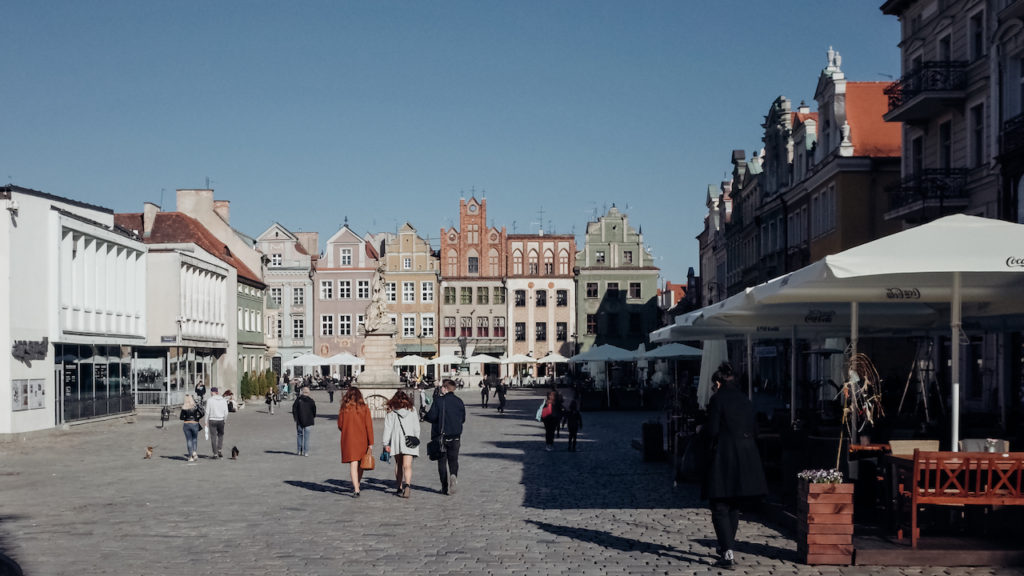
The Uber needs ten minutes to reach the excellent Park Inn Hotel, and straight after check-in, I go out to the city. Poznan is a city of half a million inhabitants, but it seems somehow smaller. Its main attraction, and the primary reason that I’m here, it’s the Old Town.
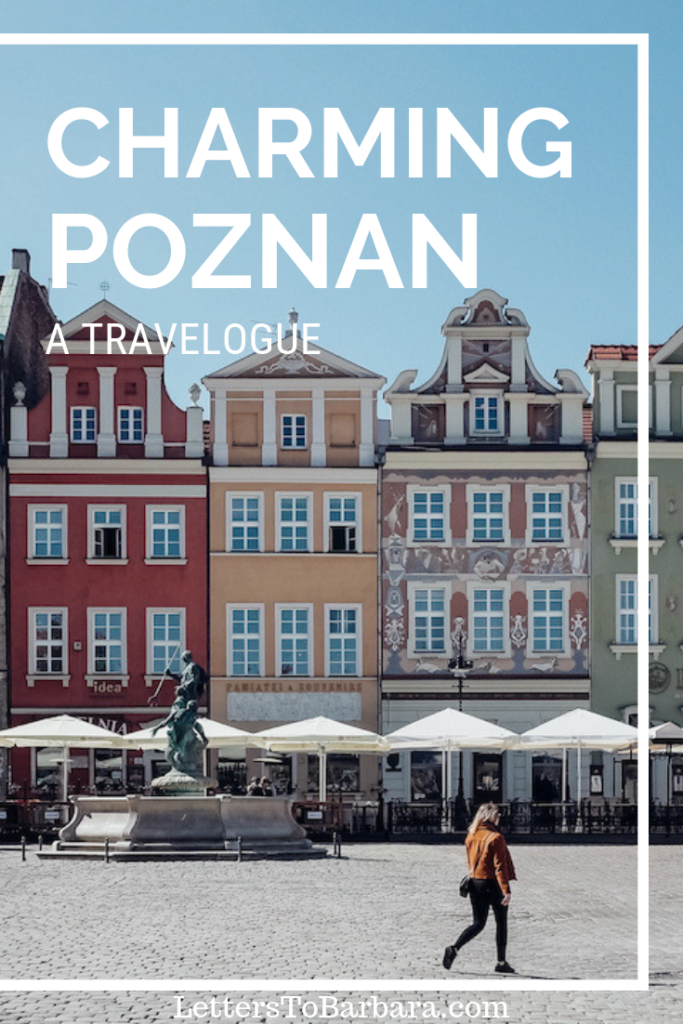
It is located in the heart of Poznan, and the renaissance buildings are so pleasing to the eye that one wants to admire them forever. Faithful to the tradition of Old Towns, there is an emblematic Market Square called Stary Rynek. In the middle of the square stands the beautiful Town Hall. Every day at noon, two mechanical goats appear from one of the towers of the Town Hall: they offer a short show by butting their heads.
All around the square you can see old tenement houses (kamienice) and many of them are nowadays cafes, restaurants, and pubs, pretty much like in Krakow. The Old Town of Poznan was largely reconstructed after the 1945 battle of Poznan. I walk several times around Stary Rynek: the surfaces are clean, the roofs jaunty, and the facades shiny. Then I try to observe the locals: their clothes, habits, and attitude. They look more presentable than Warsaw or Krakow, and their manners have a more sophisticated touch.
It’s a mild spring day, but few people walk around the square. Sure, there are some merchants, a couple of locals, and a handful of tourists. But tourism in Poznan is not (yet) a heavy industry. As a result, the city is attractive but remains largely undiscovered. Meanwhile, the mood in Main Square is pleasant. A couple of welcoming cafes, a few restaurants, and some fountains featuring statues of forgotten gods.
There are, of course, a few people advertising places, and I can only remember how irritating that was in Krakow. I do hope that Poznan won’t follow Krakow’s example.
A sad day for Europe
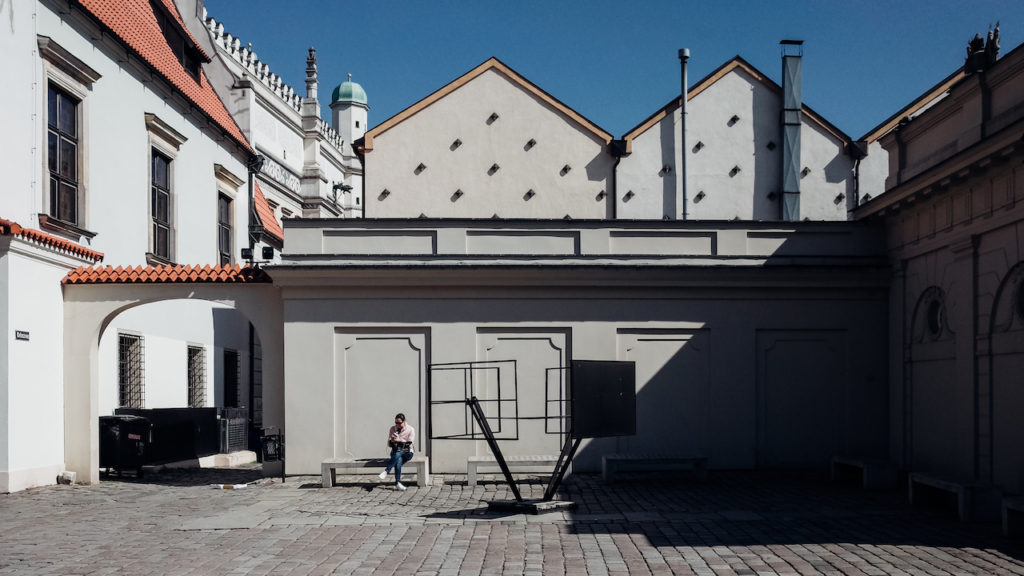
It’s the 15th of April, late in the afternoon. I think of having a quick espresso; after several weeks of continuous traveling, I feel exhausted. There is still sun in Poznan, and I sit outside at Charlie’s at the Market Square. I want to relax a bit, have a cigarette, and then write to you.
And then I check the news. There is a big fire in Paris: Notre Dame is burning. I follow the news being unable to believe what’s happening. As time goes by, the fire expands, and the roof collapses. It’s a disaster with a significant symbolic impact. I know that it has nothing to do with Poznan, but the thing is that I learned about the incident here, and it was impossible not to mention it.
I stay at the cafe for two hours, and I just refresh news websites and Twitter. Now and then, I check if the Market Square of Poznan is intact. We tend to believe that landmarks are forever, but that’s unfortunately not the case: once upon a time, a fire destroyed this square in 1536.
Tram rides forever – Poznan edition
You know it from Zurich, you know it from Prague; now, it was Poznan’s time. This recently developed habit starts to become some slight obsession. I’ve been looking forward lately to taking the tram, no matter in which city, and going on a slow ride.
Poznan has a mixture of old and new trams, and they are the main transportation mean of the city. There are also buses, but nothing compares to a tram ride. So the first thing I do after breakfast is to buy a daily ticket. And then, I embark on tram No. 3. The tram drives along the perimeter of the Old Town of Poznan before taking a right turn and heading towards the north. The city becomes less populated, and soon I see a big green park.
Then, I take the tram number 4, later the number 17, then the 13, and finally number 5. Embarking on trams, seeing people and places, then disembarking. In contrast with the train, a tram is always an integral part of a city’s traffic. The train, isolated and distant, is better for longer journeys. On the contrary, only on a tram can I breathe the city and feel its pains, hopes, and agonies.
The cemetery of the big wars
A heartbreaking tribute to casualties of wars lies a kilometer outside of the Market Square. The Park Cytadela (or Citadel Park) is where the locals usually hang out when sunny in Poznan. But this was not always the use of this vast green space.
There is a military museum here, and there are surviving parts of the old fortifications. But also, this is the place of military cemeteries. After World War II, most of the fortifications were torn apart. There are smaller and bigger monuments inside the park, and one can also see a Rosarium (imagine a garden with different varieties of roses).
I see people having a picnic, school kids on excursions, and mothers with babies taking a stroll. It is very peaceful, and it is hard to imagine that this was the battlefield of the Battle of Poznan in 1945.
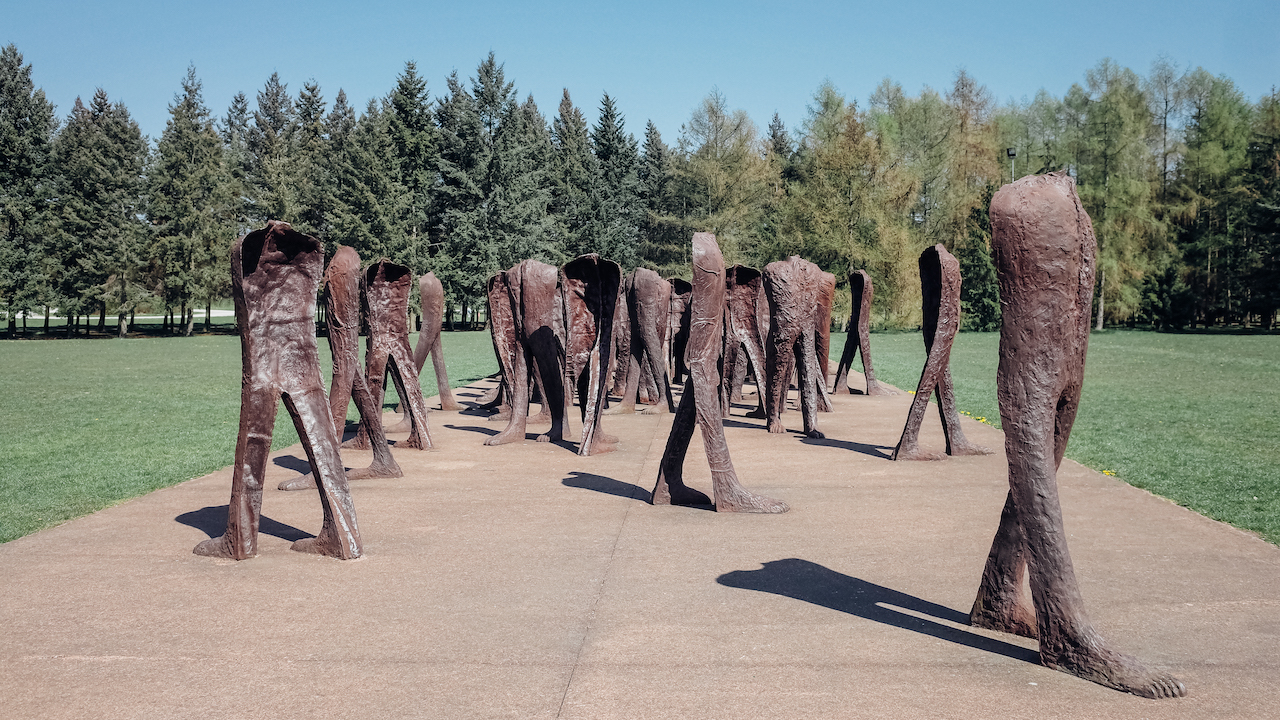
Almost in the middle of the park, I see the most impressive monument of Park Cytadela. It’s called Nierozpoznani, which translates to “The Unrecognized.” In an open space surrounded by trees stands a cluster of headless bodies. There are 112 statues with big feet that seem to move in different directions. I try to walk between the statues, but it proves to be hard, and I feel awkward. This is a monument by Magdalena Abakanowicz, who offered it to the city in 2002 for the 750th anniversary of Poznan’s founding.
There is an unsettling feeling surrounding the statues. I have no idea if they refer to ghosts of past wars or if they raise questions about who we really are. But walking around Citadel Park in Poznan is not the same anymore; something changed after trying to walk through the Unrecognized.
Suddenly, the fortress of Brest in Belarus comes to my mind. I almost have the same feeling I had when I saw the Courage statue. What an irony, though: in Poznan, there are headless statues, while in Brest, there is only an enormous bodiless head.
Late afternoon at Śródka

It’s my last day in Poznan, and I try to see as much as possible.
I thought of following the so-called Royal-Imperial Route, which is something like a pre-designed itinerary of the major attractions of Poznan. But the truth is that I always fail to follow such routes because I’m easily distracted by other things on the way. In the end, I only see fragments of that route: I keep on walking on the sunny streets, I follow interesting figures, and I stop at benches to see life unfolding.
I see the Imperial Castle of Poznan briefly, and later I walk through Chopin’s Park. After visiting Warsaw, I understood that Chopin is loved as a Saint in Poland. Later on, I have a quick lunch in a milk bar in the Old Town, and then I retake the tram. I stop at Lake Malta, an artificial lake with a huge mall overlooking it. Afterward, I walk a few hundred meters more, and I end up in a micro-neighborhood; its name is Śródka.
Śródka consists of just a couple of streets but has a long history. It’s on the right bank of the Warta river and what makes it important is the Cathedral: the Cathedral of St. Peter and St. Paul is one of the oldest churches in Poland, dating from the 10th century. Śródka itself has existed as a settlement since the 9th century. As for the name of Śródka, it probably derives from środa, which means “Wednesday,” and it’s a reference to the neighborhood’s old weekly market.
The streets are beautiful, and the sun is shining once again. Śródka is built in the shadows of the Cathedral’s towers, and nowadays, there are a few charming cafes in the area. After a long and wet winter in Berlin, I’m always searching for places to soak some sun. Dynx restaurant has an outdoor sitting area, and the sun goes straight to the tables. Perfect. I sit there for more than an hour, and all I do is breathe under the sun.
Charming Poznan
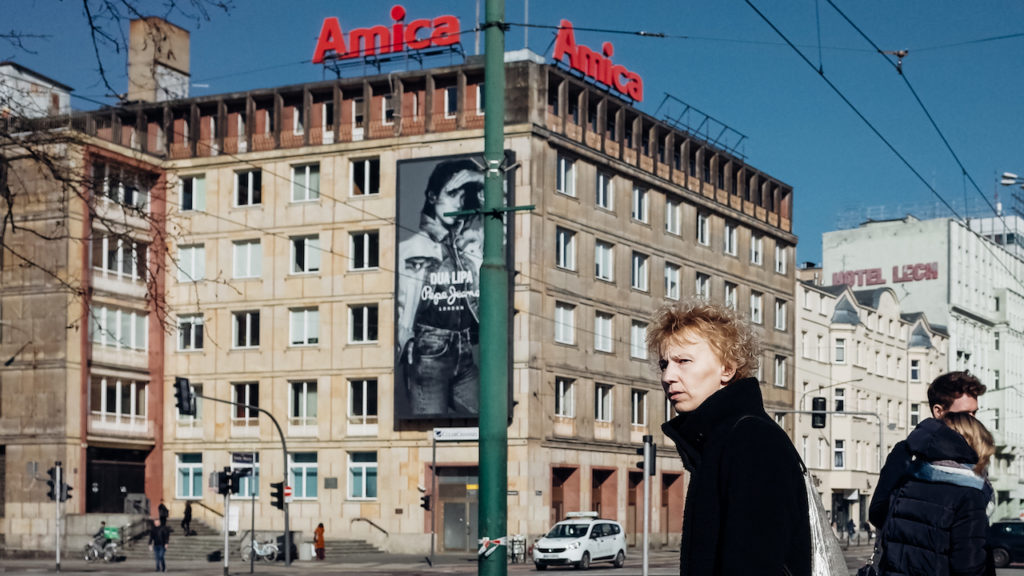
I’m waiting on the platform for my train to Berlin. I didn’t have to cross the parking lot this time, though. All I see is an endless network of rails. Sometimes I wonder if the real imperial castles of modern societies are the train stations.
I had a lovely time here. Poznan is compact, sweet, and charming. Walking around the Old Town will be a memory that won’t fade away. But, of course, it’s not a metropolis, and this has two sides: life is slower, which is nice, but there are fewer things to do in Poznan. But I’m not complaining; on the contrary, I’m happy I spent some days here. Poznan was the last stop on a very long month of traveling. I needed the carefree days, and I’m grateful beyond words that Poznan could provide it.
You see, Poznan unfolded slowly, exactly like Catania; I might even dub it from now on as Catania of the North. They have similar sizes and populations, and they both request an effort if you want to immerse yourself in the local life. Poznan seems to be folded like the traditional St. Martin’s Croissant created here: the local croissant has 81 layers in the shape of a horseshoe. Discovering the city offered me the same slow delight.
The train will be again full. This time though, I’ll try to find the correct seat, and I truly hope that I won’t meet that woman on the train. She didn’t stop in Poznan; she continued her journey to another city. No surprise: the people in Poznan are polite.
Love,
George
More about Poznan: A travel guide to Poznan
More about Poland: Chopin’s heart in Warsaw & Why, Krakow?
*Get my FREE Travel Writing Course*
Buy the camera I use | Book your hotel in Poznan
Pin it for later
Sharing is caring. If you enjoyed the Charming Poznan travelogue, please share it with your friends.