
Last Updated on May 16, 2020 by George Pavlopoulos
Dear Barbara,
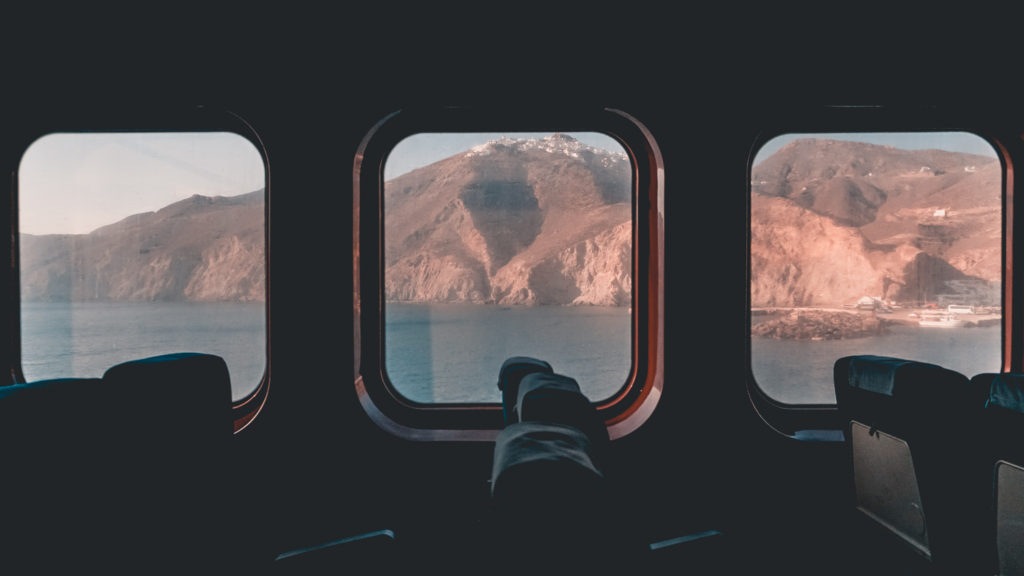
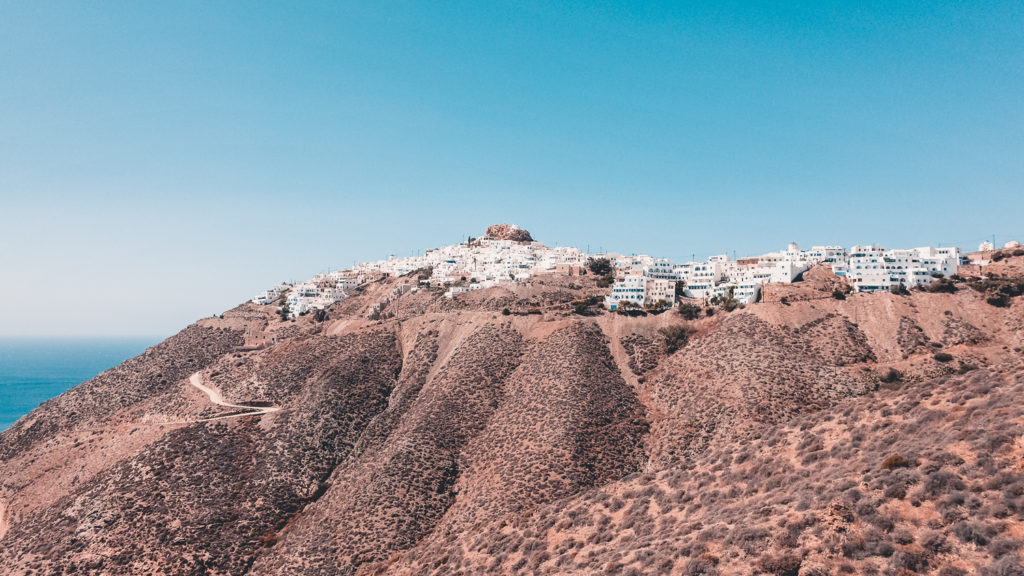
I am now in my beloved Anafi, and I’m happy beyond words. The veranda of my room enjoys the most beautiful sunset views: the sun sets in the caldera of Santorini. It is incredibly windy, but that’s how I remember Anafi anyway. The landscape is dry here, too. It didn’t rain at all in winter, spring and summer. I keep the door open, and I can see the hills, those brown buttes emerge like peaceful giants.
I feel comfortable here. The streets are narrow and the locals always friendly. Some of them seem to remember me from last year. Anafi has some totally inexplicable impact on me. From the moment I step my foot here, I feel that I have lived half of my life on the island. I will try to see if the feeling remains, now that I’m going to spend a few days in Anafi.
But there was something I didn’t like. When the ferry was approaching Anafi, I saw a building on the eastern part that looked like a resort. “Nah,” I thought, “this can never be a resort, not in Anafi.” But, to my surprise it was. It is a big hotel, built in just eight months. The owner owns some hotels in Santorini too, and he thought of doing the same here. I hope that this won’t change the character of Anafi though. This island is a jewel, and it doesn’t need mass tourism. This kind of tourism can be hosted in Santorini or elsewhere.
“Endochora” in Anafi
Endochora is a wonderful word. It stands for the mainland or the hinterland. This is a word that poets always adore since it can apply to several occasions. In Anafi though, Endochora is the name of my favorite taverna. It’s actually the yard of a house that has been transformed into a taverna. Here you will find the most delicious homemade food on the island, and it’s almost like it was cooked at home.
The ladies remember me from last year, and this makes me really happy. Unfortunately, the restaurant will remain open until mid-September. The kids have to go to school, and the whole family has to spend the winter in Athens. I sit on my favorite table that has an incredible view over the sea as well as of the two nearby islands: Pachia and Makra. Their names are truly bizarre: the Fat and the Long, and this is probably due to their shapes.
The little girl, she should be six or seven years old, brings the tablecloth. She is already a waitress. “You were here last year,” she says. I nod, and I tell her that this island is fantastic. “Will you come next year again then?” This is a question straight to my heart that I don’t have to rationalize it. I reply, “Of course,” and after she leaves the table, I start thinking about the summer, about the concept of Time, about Anafi, about my life, about pretty much everything a melancholic man would think of. We carry all those things with us no matter where we go, and a simple question can trigger a chain reaction. The landscape within never sleeps; our own Endochora is perpetually awake.
Lazy at Klisidi Beach
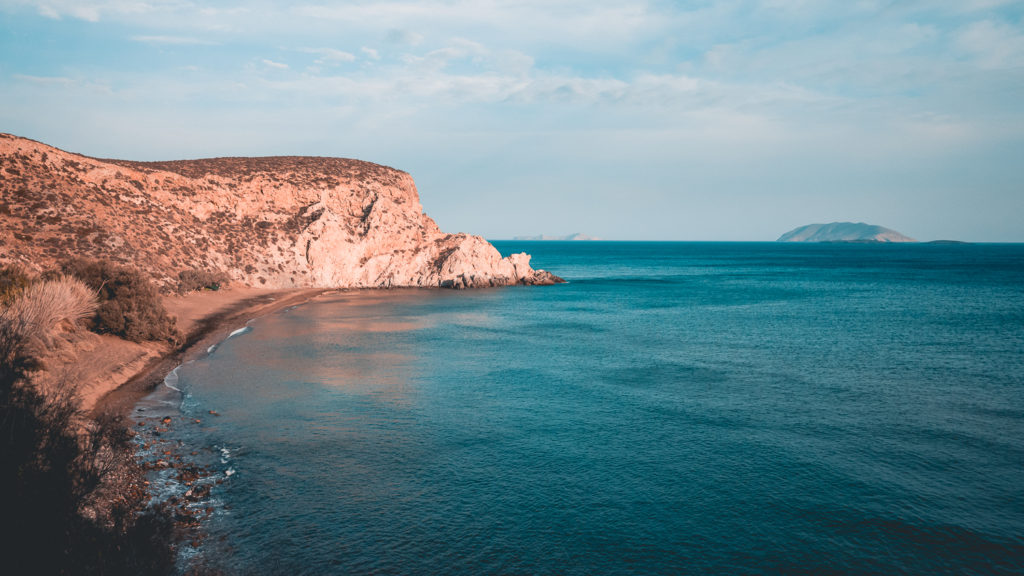
There are definitely more people this year on the island. I walk the last 500 meters to the Klisidi beach, which is one of my favorites. There is a rock on one side and a small inhabited hill on the other side. I lay beneath a tamarisk, and I close my eyes. I missed hearing the waves of Anafi and being here today is almost a reason for celebration. Writing for hours about Klisidi is possible, but I don’t want to do that. But all I want to say is: if I could choose one beach to swim every day, it would be this one.
Half an hour later, I realize that I have fallen asleep and my skin is burning. I have sunscreen with me, but I don’t really use it. My bag is almost on fire, the camera is boiling inside there. I move towards the shadow, and I take the knife in hand. I have the usual food with me, tomatoes and cheese.
Honestly, I have no real story to tell you from Klisidi. I just lay down, swim, and lay down again. I spend 7 hours at the beach and around sunset, I decide to return to Chora.
Taming the Big River of Anafi
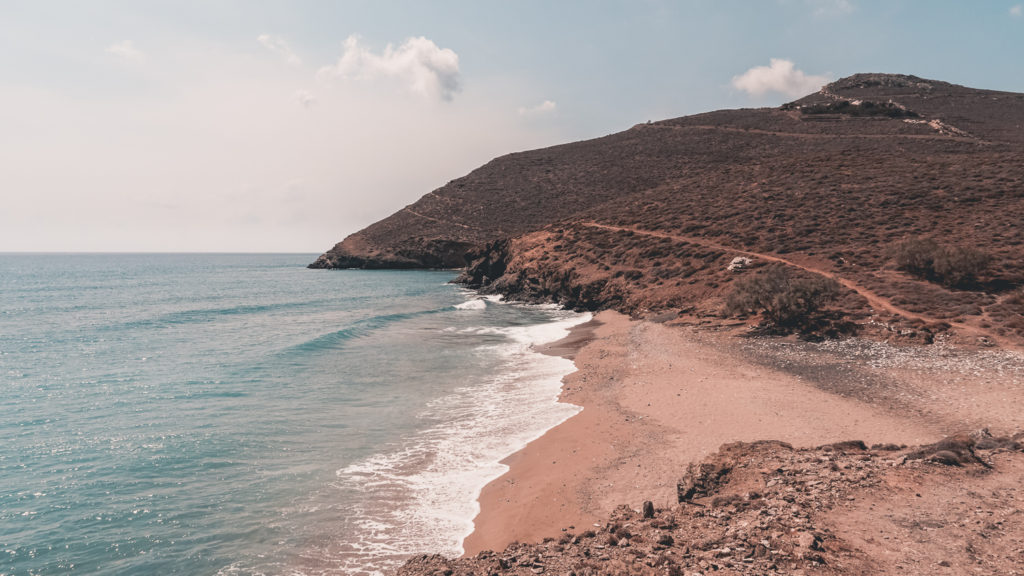
The wind transforms the beach. When I arrive at Megas Potamos, a beach with a magnificent view of the Monolith of Kalamos, I realize that the beach is not as I remembered it. The name Megas Potamos stands for Big River; there should have been some sort of a river in the past. The waves are two meters high, and while the beach remains sandy, the sea is full of stones. It is pretty slippery and definitely challenging to walk into the sea. An enormous wave, all white and powerful, throws me into the water. I try to stand up, but it’s so slippery that I fall down again. It is impossible to swim, and I decide to stay ashore.
But after a while, I decide to return to the water. There is only one couple on the beach, and I think that if something bad happens to me, they will help me. This somehow gives me courage. My second attempt is successful. I step into the water, and when I see the next big wave, I dive. I am under the water, but I still feel the power of the sea. When I emerge, I am already a few meters away from the seaside.
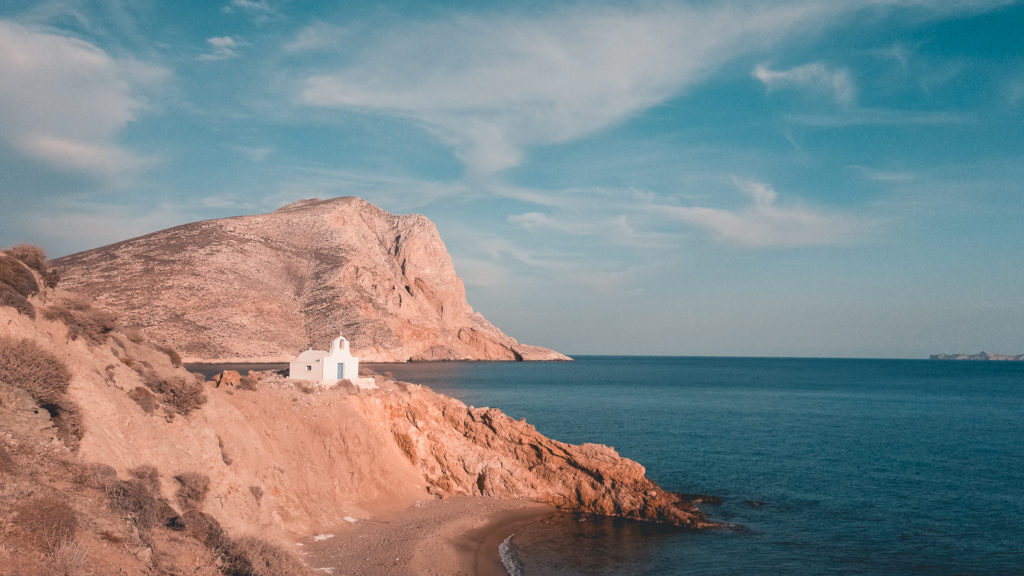
I see the Monolith in all its glory. A huge rock, the second biggest monolith in Europe after Gibraltar. This massive stone stands there like a giant. On its top, I can see a small white dot. It’s a monastery, that takes less than one and a half hours on foot to reach. I keep on swimming until I see the nearby beach of Agioi Anargyroi. It’s an equally sized beach with a church on one side.
The waves grow stronger now. It’s time to reach the beach. Every time I try to get out though, a powerful wave throws me back in. It seems that I’m caught in a loop. Then I think of the surfers, those guys that tame the sea by studying the waves. I decide to jump on every wave and let it carry me a few meters towards the shore. To my surprise, it works. Five waves later I’m on the shore again.
An accident in Anafi
One night, while I’m reading the news, the lights go off. There is a blackout in Anafi, and the whole island is pitch black. The first place with electricity seems to be two hours away, and it’s Santorini. At first, I take the blackout as part of the island’s charm but later that night I learn that there has been a terrible accident. A car crashed on an electricity pillar and caused the blackout. The crash was severe: the pillar was destroyed and the driver severely injured.
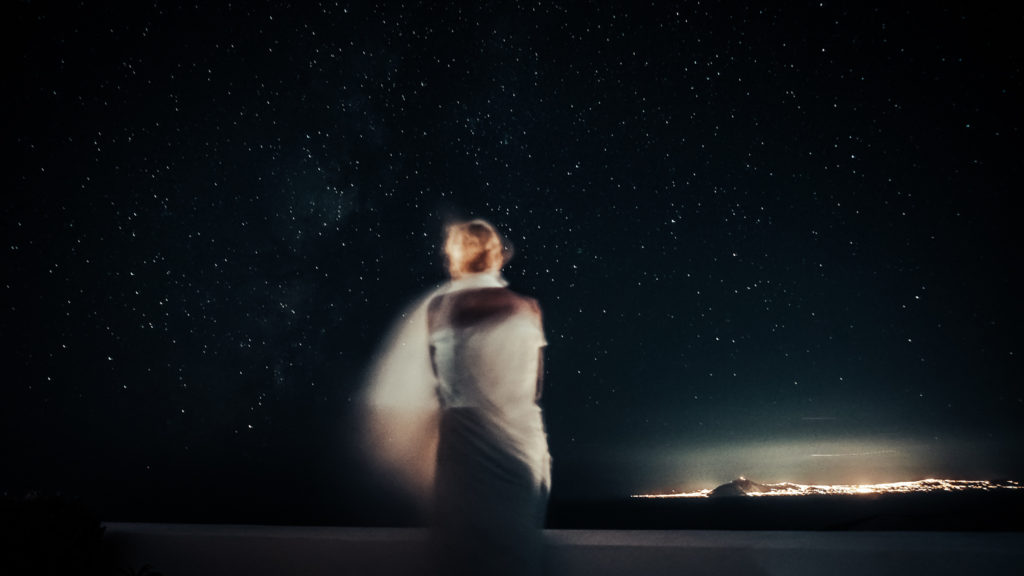
As I eat in a local taverna, I ask the guys running it who will take care of the injured man. “There is a 26-year-old military doctor stationed on the island”, a woman says. “He is doing his best, and he will stay here for eleven months.” Meanwhile, the workers are trying to repair the pillar. For the rest of the night, now and then, the lights go off. The island is totally dark and the service in the tavernas slow, but I don’t really care. I turn my head towards the sky, and I see stars, probably a trillion stars, and on one edge the clearest view of the milky way I have ever seen. You are a charming island, Anafi.
Towards the Monolith of Kalamos in Anafi
Before I start hiking on the Monolith, I have breakfast at Argo. It’s a hard day for the island: the electricity problem is not solved yet. When I wake up in the morning, there is no power in the room. The food in the fridge stinks, and I prefer to leave the room and have breakfast somewhere at Chora.
Next to me, an older guy is talking with his friends. He goes through all the legendary bird hunters of the island, most of them have funny nicknames. When the list is over, he says: “All of them were tough guys.” He is a hunter too, and he narrates his biggest complaint: he has never shot a rabbit. He claims that he has seen a rabbit (as a hunter) only once. “A tiny, fast animal,” he says. It appeared outside a cottage, and he failed to shoot it. “I will never catch one,” he says in despair.
I pay for breakfast, and I start my short hiking tour. On top of the Monolith, there is a monastery, and the locals celebrate there every September. According to the sign at the beginning of the path, it takes an hour and fifteen minutes to reach the monastery. It is a rutty, unpleasant surface and I have no hiking shoes. The path goes up, and I remain ecstatic from the view. I feel like a human drone, and I record my route with hungry eyes.
It gets steeper and steeper. After forty-five minutes of hiking, I decide to take a break. I was last year to the monastery, but this year the weather is so hot that I have to stop and drink some water. For a moment, I think I’m hallucinating due to the heat, but I realize that what I see moving fast is a rabbit. I have no idea how it ended up here. But the only thing I can think of is that this is the same rabbit that once upon a time escaped from the hunter.
The sea is departing
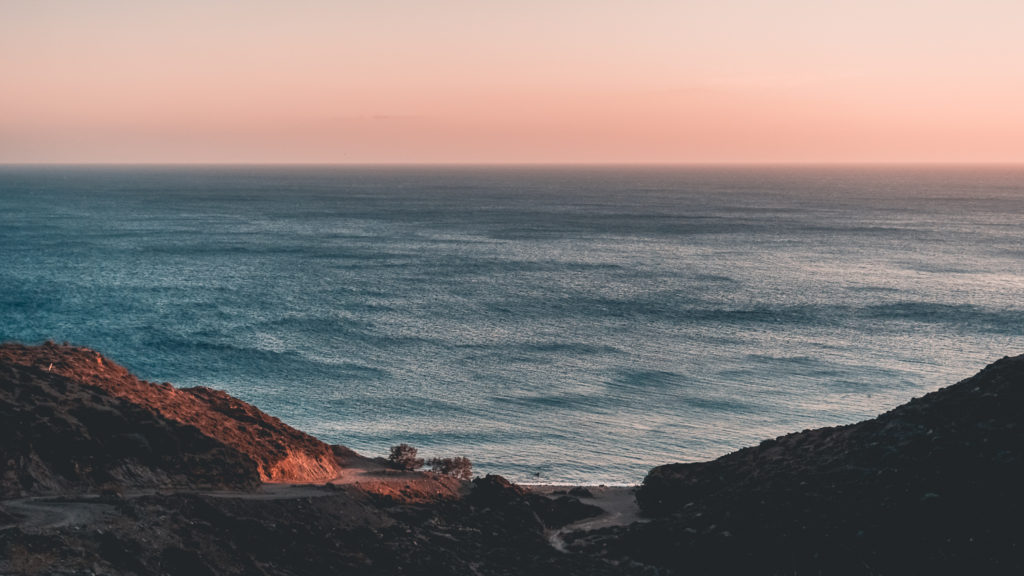
There is currently a strong northern wind on the island. You can’t see waves at the sea, but when you are close to the beach, the sandblast is really cruel. I stand in different buttes all over the island, at Klisidi, at Megas Potamos, at Agioi Anargyroi and I observe the sea. The whole island seems restless. It seems to me that the sea is leaving the island. The water moves away from the shore, and I’m afraid that the vessels won’t have any water to set their anchors.
One day, I stand at Megas Potamos, and I observe this odd phenomenon. Megas Potamos splits into two beaches, one to the right side and one to the left. Most of the people prefer the right beach though. I guess they are coming from Western countries, where the words are written from left to right. It seems that our minds work this way, to choose the right side when we find ourselves at crossroads.
Language affects the brain. I wonder what will happen if people from countries that write from right to left visit Megas Potamos. Will they choose the left beach instead? I stay there for quite a while because the bus is late. I try to evaluate my statement about language and choices.
Meanwhile, the sea is moving away in something that resembles counter-waves. There’s no whitecap at all, just a sense of departure. The sea is departing.
Oh, Anafi

“An island that doesn’t allow you to drink a cup of coffee in the winter, doesn’t deserve the hassle.” That’s what a local says, he is sitting next to me, and he is a friend of the hunter I saw the other day. The truth is that most of the cafes and tavernas will shut down by the end of September. In August there were 4,500 people in Anafi; but in November there will only be 180, half of them being older people.
Some of the locals seem desperate. “I have no idea what we ‘re gonna do during winter,” says another man — Grey hair, mustache, wearing a shirt that survived countless summers until it couldn’t discolor anymore. “We should probably start visiting each other’s houses.” There is only one hope for them: the soldiers. Out of the blue, it was decided that Anafi will get an airport. A bunch of soldiers is currently sent in Anafi: they will build a part of the airport. They are stationed on the island, and both the eateries and the cafes might remain open to serve them in the winter.
“Oh, Anafi,” says the oldest man in the company. “You always depend on others.” I see no women in the taverna, but all those older guys talk about the island in a way that reminds me of their lost loves.
The last waltz in Anafi
It’s the end of September, the end of the season, the end of the legendary Greek summer. I sit at Tholos, and I eat homemade fries. A sip of wine in my glass, some music in the background. In a couple of hours, late at night, the ferry will take me away from Anafi. A long winter will start soon. No more salty skin, no more tomatoes, and cheese at the beach.
I will see you soon, Barbara. It’s been a while. And then, I will start traveling. I will search for stories all winter long. For sure, I ‘m going to track down the whereabouts of an assassin; I’ll visit flying relics of past times; I’ll try to meet a bizarre widow. Last but not least, I’ll try to step into a country that doesn’t exist. The stories will be countless, the places too.
But I’m still in Anafi, and this is my last evening here. I clink glasses with the guys at the taverna. There is a bitter wind blustering outside, and the radio plays some Greek waltz. It’s a very old song, I can’t even recall the last time that I listened to it. I see a lonely tree dancing in the dark. It’s tall but hard as a rock. The locals call it “Immortal.” It flourishes just once in its lifetime, it gains all its height during this period, and it never dies. It stays there forever, and only the wind can uproot it. Just like Anafi.
Love,
George
More about Anafi: Things to do in Anafí & Did Wim Wenders visit the island? , Anafiotika
& bonus: Greek islands on a tight budget
*Get my FREE Travel Writing Course*
Did you know that I have written a book about Anafi? You can learn more about it here. There is also a limited edition of the book; check out the availability of the book on my online shop.
Pin it for later!

Please share, tweet, and pin if you enjoyed reading Divine Anafi. Your support keeps this website running and all the info up-to-date. 🙂