

Last Updated on June 23, 2025 by George Pavlopoulos
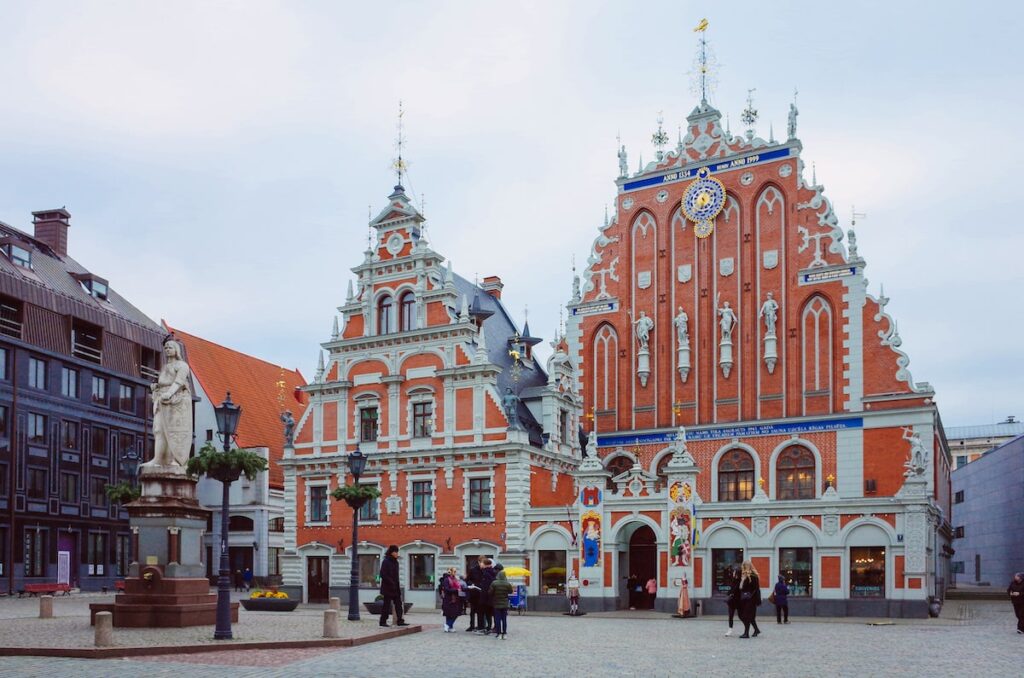
The House of the Black Heads is the most prominent building in Riga’s Old Town. Erected in 1334 under the name “New House of the Great Guild,” the building has dominated the famous Riga Town Hall square ever since. Its impressive 27-meter-high facade hosts various sculptures and reliefs and has become a symbol of the Latvian capital throughout the centuries, ranking among the top things to see in Riga.
Although the House of the Black Heads now serves as a museum, its original purpose was significantly different. Back in the day, its purpose was to host the Brotherhood of the Blackheads, a medieval association of unmarried local male merchants, ship owners, and foreigners residing in Livonia. This area corresponded to contemporary Latvia and Estonia.
The building’s history is rich -the same goes for its architecture. After I visited the House of the Black Heads in Riga, I decided to dedicate an article to this famous Gothic building. Therefore, in the following lines, you’ll find a photo report about the so-called Melngalvju nams (or Schwarzhäupterhaus in German). Moreover, I’ll share information about its past and how you can visit it as well.
Let’s start.
*Some links are affiliate links. This means that if you make a purchase, I may earn a small commission at no additional cost to you.
The House of the Black Heads in Riga: History & photos
The first thing that will impress you in the House of the Black Heads is the stunning facade. It is rich in detail and features numerous sculptures, including reliefs of Saint Mary and Saint Mauritius. The facade’s architectural style suggests the Dutch Renaissance; however, since the building underwent several renovations throughout its history, it often resembles a patchwork of architectural styles.
Specifically, although it was built in 1334, the building wasn’t completed until the early 1600s. It was at this time that the majority of Mannerist-style decorative elements were installed on its facade. Moreover, the sculptures we see today were constructed by August Volz in the late 19th century.
August Volz in Riga, Latvia
Volz was a German sculptor from Magdeburg, Germany, who worked in Riga for decades. While it remains unclear how many statues August Volz constructed in the House of the Black Heads, it’s safe to say that four of them are his work: the sculptures of Hermes, Poseidon, Peace, and Harmony belong to him.
And here’s another interesting fact that highlights August Volz’s contribution to downtown Riga. In front of the House of the Black Heads, you will see a Roland statue created by Volz in 1894. However, the statue you see today is a replica, as the original was damaged during World War II and later destroyed during the Soviet occupation. The original Roland statue is housed in St. Peter’s Church.
Elements on the facade
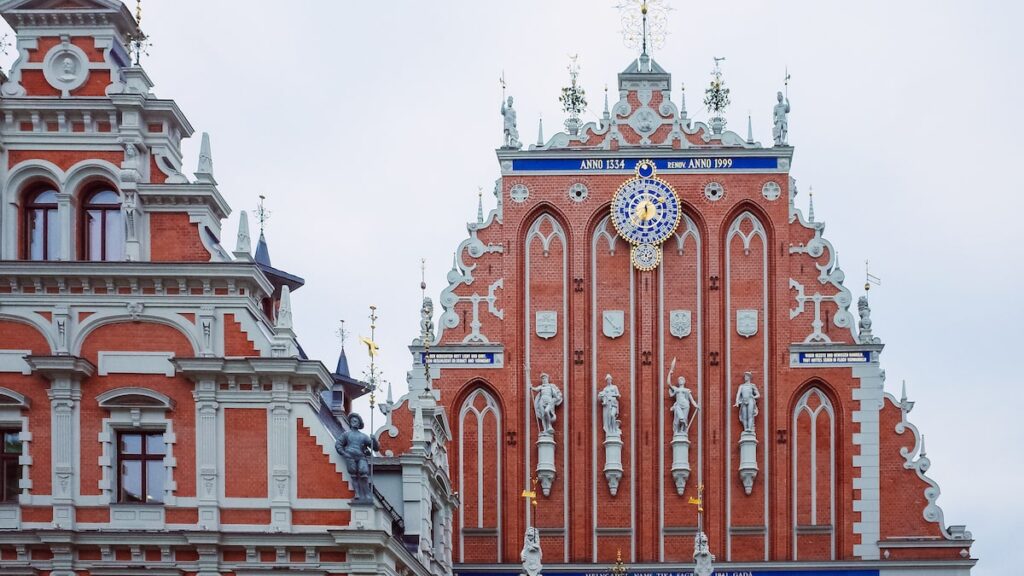
On the gable’s top, you can see a weather vane depicting “Saint George fighting the dragon.” Directly below on the gable, you’ll spot the relief of King Arthur with a scepter and orb. On his left side, there is a lion with a shield, and on the right is a flower with a seagull.
One of the facade’s most beautiful ornaments is straight below King Arthur’s relief. That’s a stunning astronomical clock, constructed in 1626 by the watchmaker Matis as a “Calendarium Perpetuum” (English: “Perpetual Calendar“). Apart from the phases of the moon, the zodiac signs, and the time, the astronomical clock also shows the date and day of the week. However, since the original building was destroyed, the current clock is a replica constructed in Regensburg, Germany.
Below the clock, you can see the coats of arms of the Hanseatic cities of Riga, Bremen, Lübeck, and Hamburg. Lions guard the four coats of arms on both the left and the right sides.
A brief history of the House of the Black Heads
As I wrote in the introduction, the House of the Black Heads hosted a guild of unmarried merchants, ship owners, and foreigners — among them many Germans — who called Riga home in the 14th century. The Brotherhood of the Blackheads was initially a military organization that participated in the defense of Tallinn, Estonia (then known as Reval), during the Saint George’s Night Uprising. It took place between 1343 and 1345 when the indigenous population of Estonia unsuccessfully tried to wipe out all foreigners and eradicate Christianity from Estonia.
However, as the years passed, the Brotherhood abandoned its military identity and gradually evolved into a social organization. The members of the Brotherhood had strong connections; every night, they hung out to “rest from honest labor.” Apart from hanging out, the Brotherhood of the Black Heads was also active in celebrations, including extensive meals, horse riding, and tournaments.
To them, Riga owes its first Christmas tree. On a marked spot outside the building, you can still see where the Brotherhood installed what is known as the first Christmas Tree of Riga in 1510. According to various sources, they used to dance around it for hours.
The House of the Black Heads was destroyed in World War II
The building’s history wasn’t always a shining one. On June 28, 1941, shortly before the launch of Operation Barbarossa, the German army bombed the House of the Black Heads. Unfortunately, the building was severely damaged, and when the Soviets took charge after the War, they demolished it in 1948.
The building you see today is, therefore, not the original. Between 1996 and 1999, Valērijs Kargins, the president of Parex Bank, financed the house’s reconstruction. In addition, local people who wanted to see the house again on the Riga Town Hall square also donated money. Specifically, each citizen donated 5 lats (~10 euros), and each added a brick to the wall. According to local media, over 5,000 residents participated in the initiative.
The legendary House of the Black Heads reopened its doors shortly before the new millennium. The opening took place on December 9, 1999. An added element to commemorate the important date was added to the facade. When you look up, you’ll see on the top left side the inscription “Anno 1334,” and on the right side, you can see “Renov. Anno 1999.”
The House of the Black Heads today
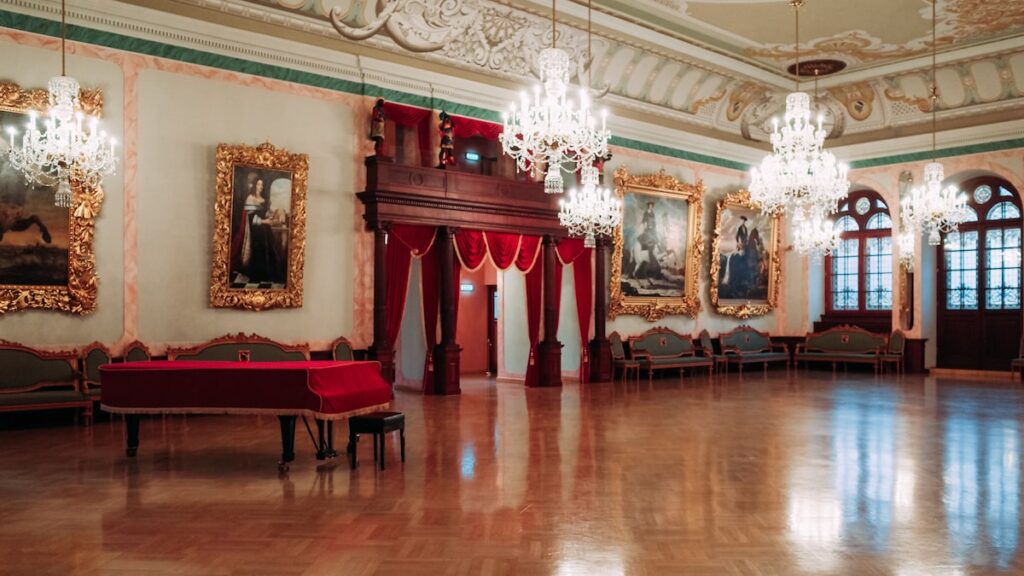
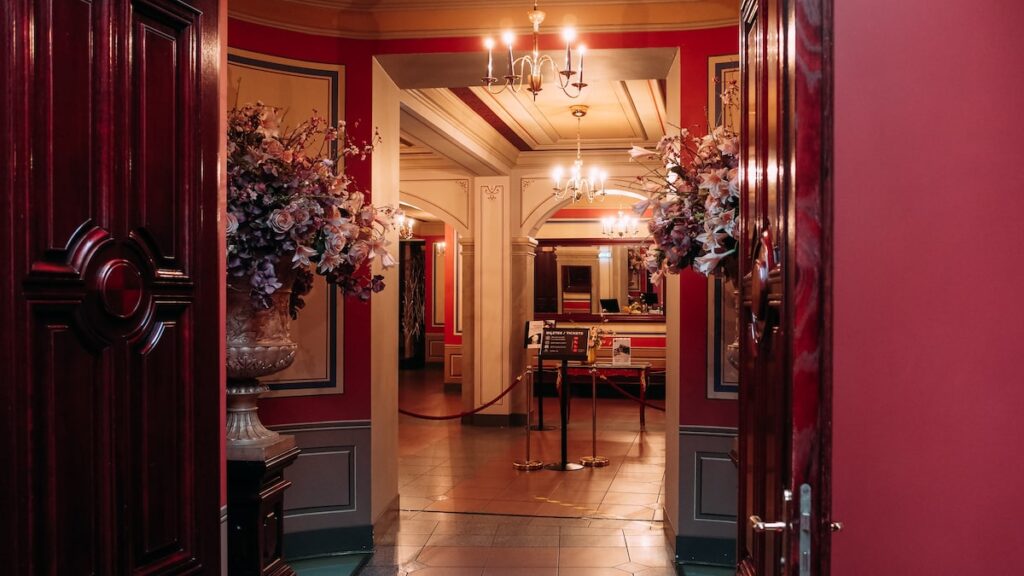
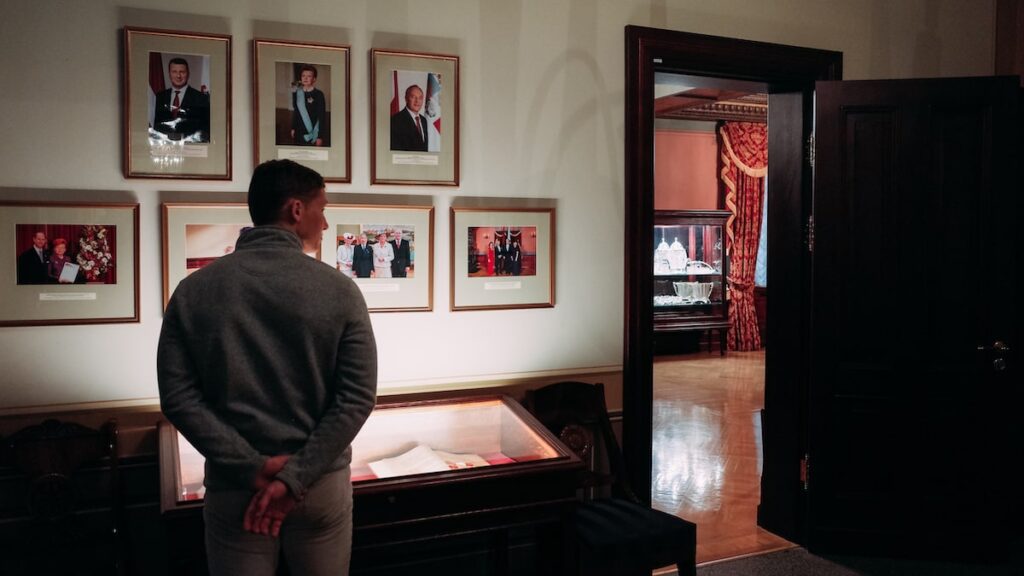
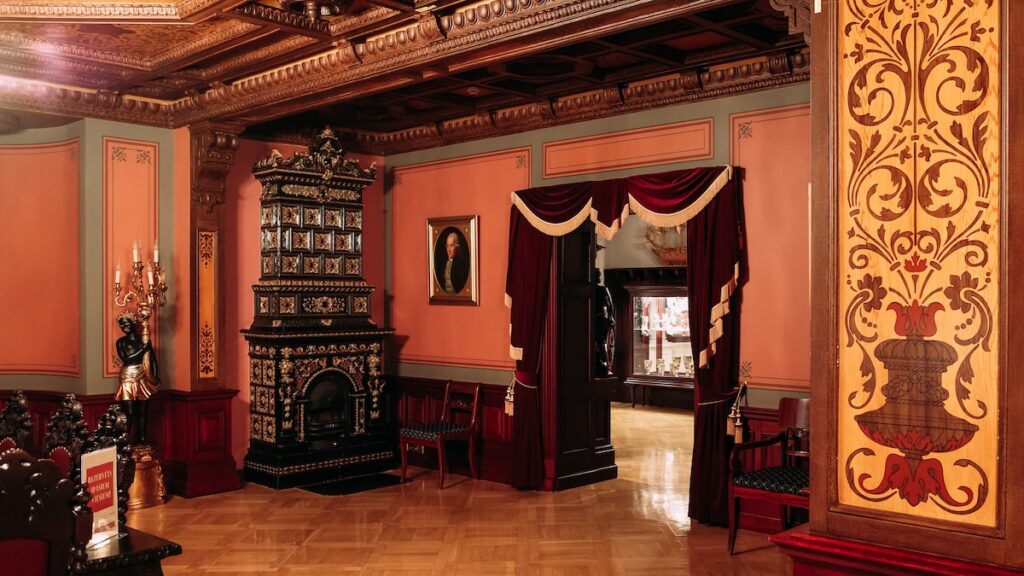
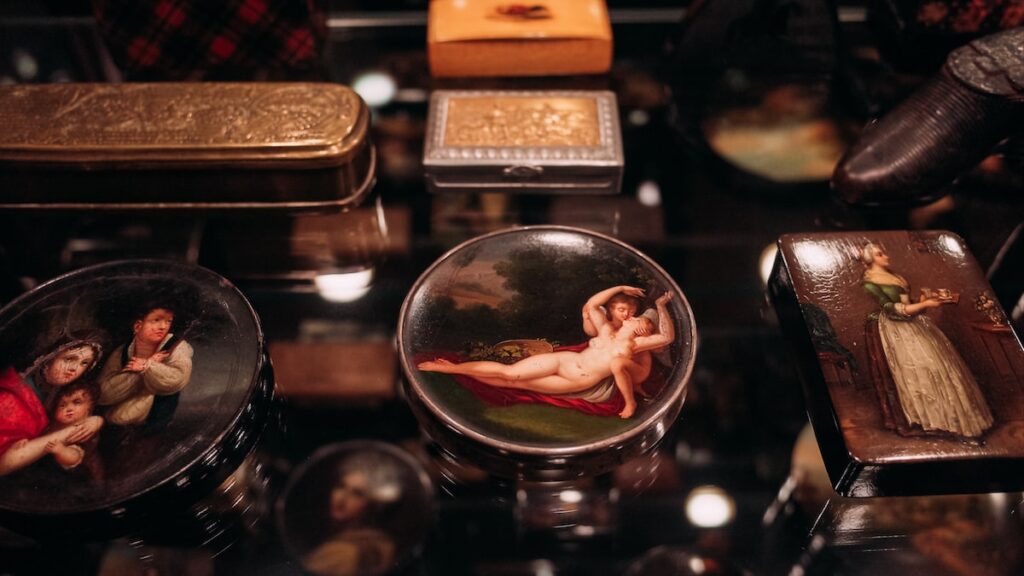
Nowadays, the House of the Black Heads houses a museum that exhibits many historical elements, as shown in the photos. It has three floors: the ground floor, a basement, and an upper level. In the latter, you can find the impressive ballrooms where many significant political events took place. The ground floor, with its silver collection, and the upper level are by far the most impressive ones, and they offer a glimpse of the glorious past of the building.
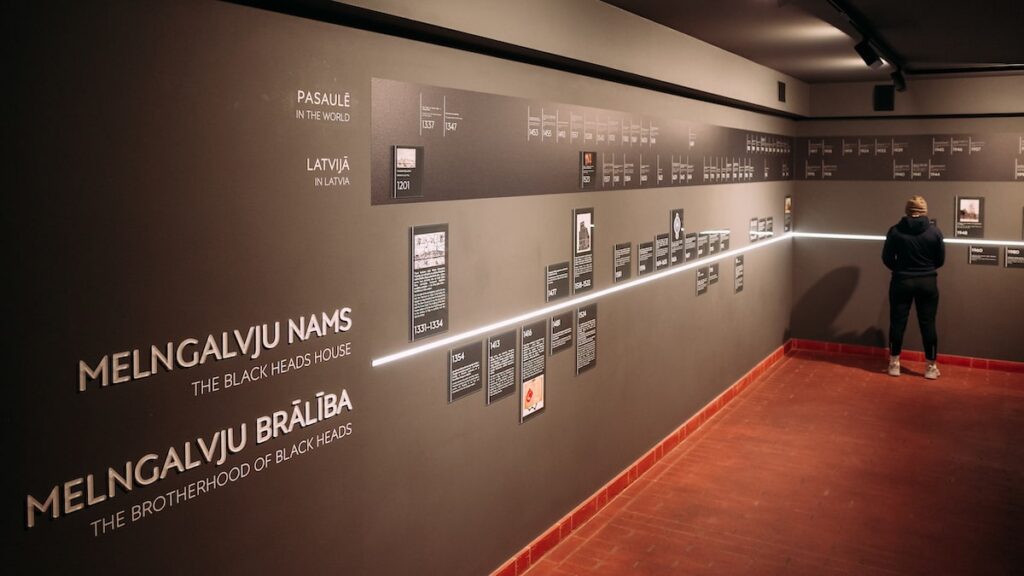
However, the basement is the most interesting part, despite being the most humble. Resembling a medieval cellar, the basement is the only part that survived the German bombings and the Soviet occupation. Therefore, that’s the only original element of the building, and it remained intact throughout the centuries.
Walking in its rooms, it’s one of the most original Riga experiences: it feels like walking in medieval Riga. Moreover, apart from the interesting info in the exhibition hosted there, you can also see the original wooden stairs and walls. The cellar used to be a storage room for all kinds of things, and walking through its narrow corridors felt like walking in the times of the Brotherhood of the Black Heads.
A hypocaust in the cellar
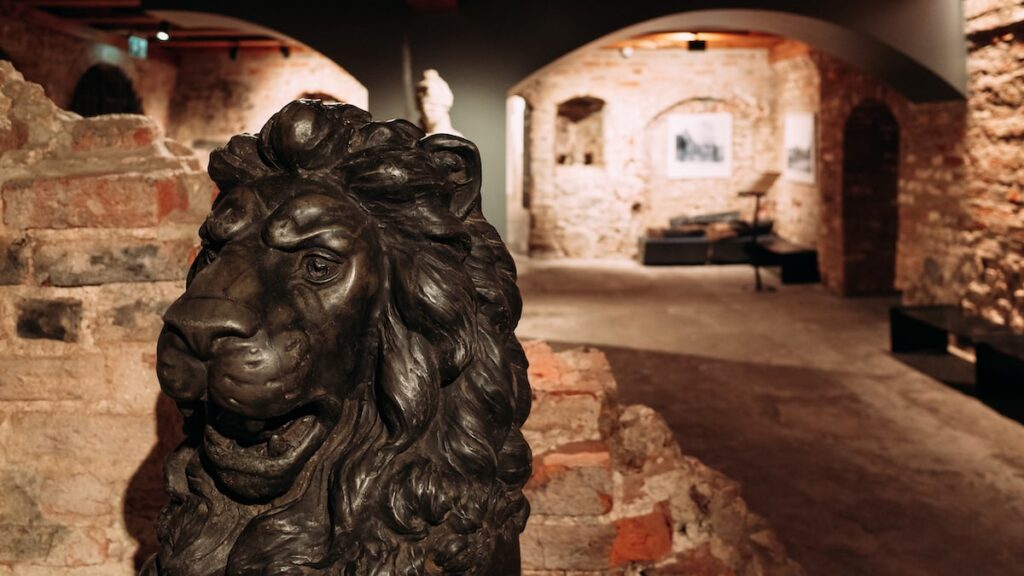
In the cellar, you will also see the Hypocaust. Hypocausts date back to Ancient Rome and are strongly connected to brick architecture. A hypocaust describes a system of central heating that produces and circulates hot air beneath the floors.
In Latvia, hypocausts were used until the early 17th century; around this time, they were replaced by tile stoves. The House of the Blackheads had three hypocausts, and one of them was still in use until the early 20th century.
Details on the Upper level
The House of the Black Heads hosted numerous prominent people throughout its history. Therefore, it seems fair that one of the most impressive elements is the association with famous people who had ties to the Brotherhood.
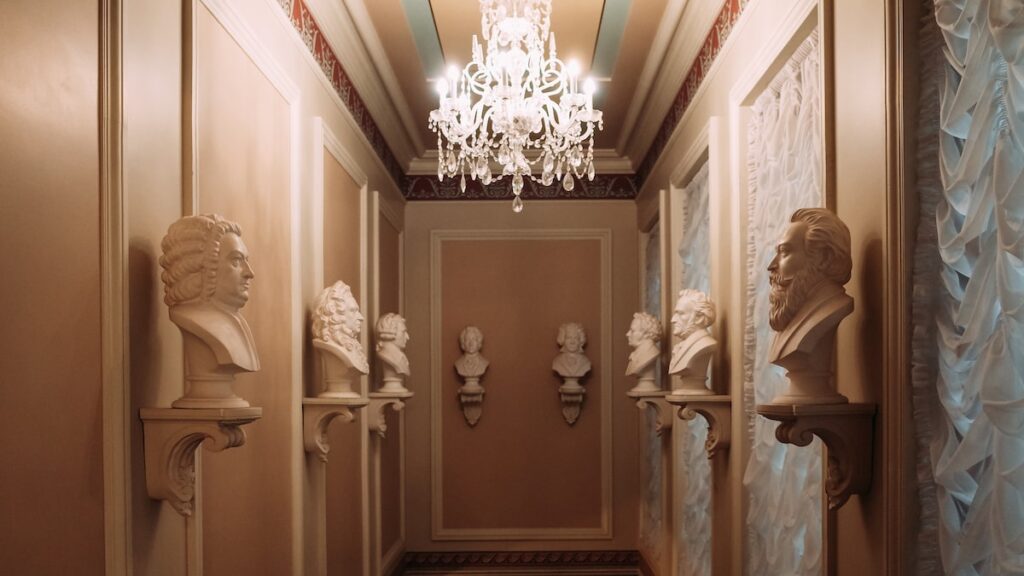
On the way to the upper level, you will see the busts of some prominent members. The busts of Johann Sebastian Bach, Georg Friedrich Handel, Joseph Haydn, Wolfgang Amadeus Mozart, Ludwig van Beethoven, Franz Schubert, Richard Wagner, and Johannes Brahms decorate the impressive entrance of the upper level. They are located on the staircase leading to the main ballroom.
The Great Ballroom occupies an area of 330 m², and it’s hands down the most beautiful room in the house. Restored to resemble its glory days, the Great Ballroom features wall decorations and paintings of Swedish kings and Czars.
Why is it called the House of the Black Heads?
The origins of the name Blackheads remain unclear, and there’s a lot of speculation about the Brotherhood’s name.
One possible explanation comes from the patron Saint, Mauritius, who is also included in the coat of arms of the Brotherhood. A Moor’s head symbolizes him, and some associate the name with the patron saint. However, other people claim that the name is actually a counterpart to the “grey” or “whiteheads” of the older members of the Guild.
Finally, one more possible explanation is that the Brotherhood’s name derives from the black balaclava that soldiers wore in medieval battles. The Brotherhood of the Blackheads defended its cities, and since it started as a military organization, one cannot reject the possibility.
Visiting the House of the Black Heads: info & guided tours
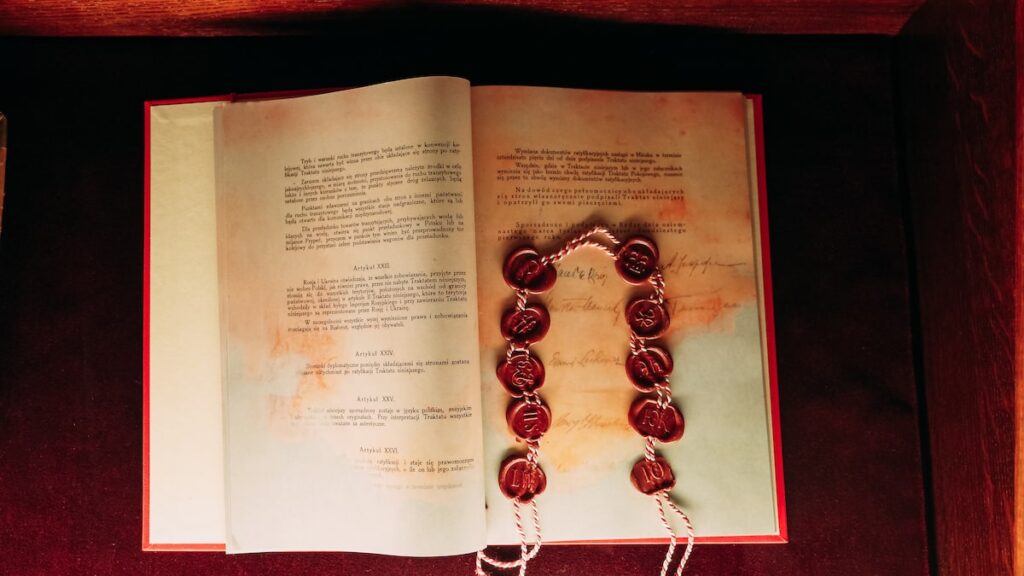
In this section, you’ll find practical information about your visit to the House of the Black Heads. Apart from information about the opening hours and the ticket price, you’ll also find details about the guided tours.
Opening hours & location
The House of the Black Heads is centrally located at Rātslaukums 7, at the Town Hall Square of Riga. You can see (and save) its exact location on Google Maps here.
It is open Tuesday to Sunday between 10 am and 5 pm. The museum is closed on Mondays.
Tickets
The tickets for the House of the Black Heads start from 7 euros. However, there are some extras you can enjoy. Specifically, you can buy an entry ticket and a cup of coffee for 8 euros or a ticket and a glass of sparkling wine for 10 euros. Then, you can enjoy the drinks while strolling around the museum. A rather bizarre policy, I must admit.
You can buy your ticket here.
Guided tours
Guided tours are available in English and last approximately one hour. However, you must book them in advance. The price at the time of writing is 30 euros per person. The guides will share background information about the House of the Black Heads and the Brotherhood’s daily life. You can book your guided tour here.
Riga travel tip: If you are interested in Medieval times, there’s also an excellent guided tour showing you the hidden gems of Riga’s Old Town. It’s an action-packed two-hour tour that provides an excellent overview of the past. You can book the Old Town tour here.
House of the Black Heads in Riga: Final Thoughts
The House of the Black Heads rightly ranks as one of the best things to see in Riga. The building’s architecture is fascinating, and the same can be said for its residents’ background stories. The medieval Brotherhood marked the city’s past, and visiting the house where they lived offers a unique experience of a bygone era.
Therefore, if you’re about to visit the capital of Latvia, add the House of the Black Heads to your itinerary. It is a fantastic place, full of charm and century-long treasures.
More about Riga: The KGB Museum in Riga, Riga Art Nouveau guide, Riga Airport Guide

Pin it for later
Sharing is caring. Share this article about the House of the Black Heads with your friends.