

Last Updated on April 29, 2026 by George Pavlopoulos
Dear Barbara,
The few trees of the island lean towards the south. The northern winds whip them all year long, and their trunks bend towards Crete. There might be a metaphysical interpretation for this: thousands of years ago, Minos’ son, named Folegandros, led the Cretans to the island. Today, these arched trees seem to pay homage to an ancient journey.
In mid-June, just a step before the second pandemic summer, Folegandros emerges as a promise of freedom for the confined. Folegandros is tall, sharp, and has fleshy slopes. However, this anthropomorphic island is not attracted by youth. On the contrary, it provokes it. The bulimic plastic sunbeds haven’t devoured the landscape yet: it’s the sun and the green stones that still dominate here.
This narrow strip of land is full of capes, coves, and deserted beaches. The Phoenicians called it “rocky land”; the Greeks called it “iron.” One visits Folegandros because one has heard about its Chora, but ends up silent before what he discovers beyond it, away from the short road network: on the trails.
Towards Livadaki beach in Folegandros
Politics never lets the stone decide its future. Greece, a rugged and rocky territory, bypassed the landscape and replaced it with tawdriness. It -inevitably- surrendered to money and, in return, smoothed the experience. The way of the traveler ceased to be the way to discover Greece. The trails ended out of place, the tamarisk trees out of time.
These are my thoughts while descending the rough path to Livadaki Beach. For forty-five minutes, the sharp stones chop the old soles of my summer shoes. Every stone I step on wakes up a forgotten muscle. I feel like an acrobat trying to balance along vertical cliffs that reveal a lonely, untamed landscape.
On the slopes of Folegandros, goats graze carefree and sometimes approach me. They speak something in their language, and then they run down the slope towards the sea. The path descends smoothly between golden brooms and drywalls that demarcate the labyrinth.
In the last meters, however, the path becomes steep. In the background, the lighthouse of Aspropounta has been coordinating the relationship of seamen with the land for more than a hundred years. I descend slowly; I see the sea but not the beach. Having almost arrived, an illusion: the end of the path and on the opposite side a high rock. Where’s the beach, though?
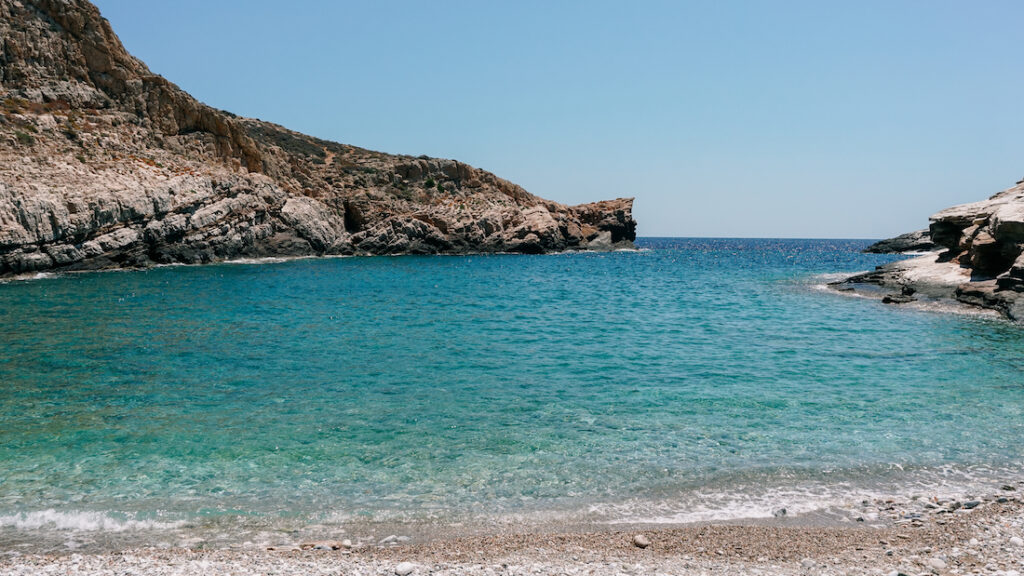
And then, after every step, a strip of water pops up, unraveling the distance. Until I go down to the pebbles, I have seen the whole Livadaki. It is a closed inlet with calligraphic rocks, and at its left edge, the rock disappears into the emerald sea, looking like a person staring out at the sea.
Maybe the old Cretan journeys still sculpt the landscape.
Katergo Beach, Folegandros -and how the color returns
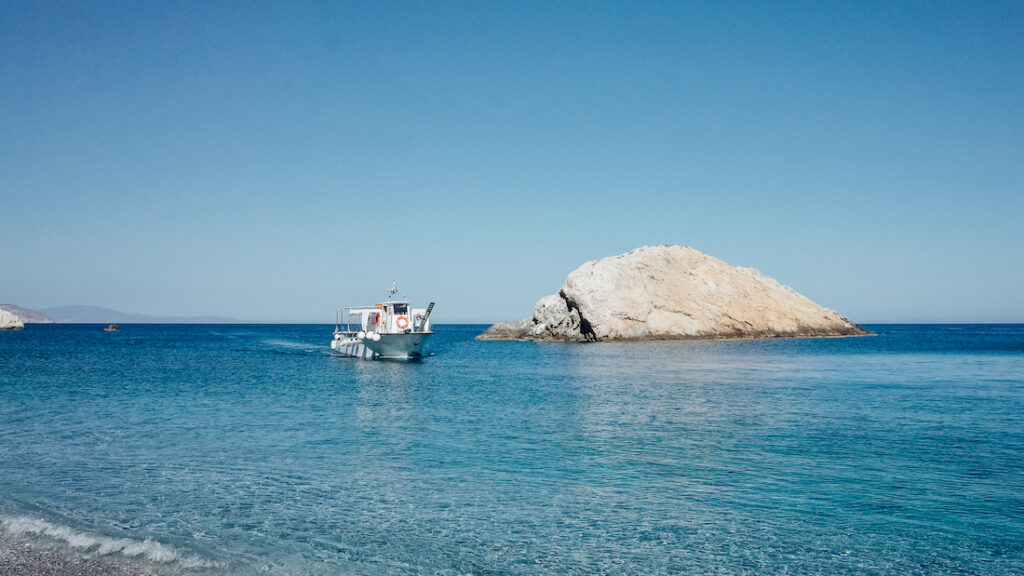
Another day, I see Katergo Beach. The name translates to “labor camp” or “galley”; it sounds weird, but it’s not incompatible. On this beach, the inhabitants mined hematite for decades under the relentless sun to paint their houses and boats.
White pebbles and a steaming rock in the middle, on which some Americans climb, shouting. Young boys and girls dressed in tight swimsuits dive from the rock’s highest point. They have crossed the Atlantic and are in this sea, falling airily into the water.
As I swim, I see their descent to the bottom and then their emergence from the depths. In each dive, a million fish are upset and run towards the open sea. Even in this moment of carelessness, in a geographical nowhere based on the coordinates of their hometowns, they say something about the vaccination process before traveling.
They are extroverted, above the decibel limit that Europe can withstand. However, their vitality seems reassuring after such a terrible winter. They finally swim back to the beach and lie down on the hot pebbles. When the tallest girl in the group dries off, she runs to her towel and grabs a camera. Dozens of clicks are spent under a dazzling white light.
An hour later, a boat that murmurs unhappily comes to pick them up. It will take them back to the port of Karavostasis. It is not a regular service; the boat has come just for them, out of schedule. They board one by one with flexibility. The ease with which they balance on the slippery steps indicates they have used this small vessel several times.
They laugh. On the one hand, they hold towels; on the other, I see 50-euro banknotes, reminiscent of hematite. The color returns to the landscape timidly, defeated. The boat is white.
The ghosts at Agios Georgios and how to chat with them
The path to Agios Georgios starts at the tavern Synantisi, where one must stop for matsata and kalasouna. The beaches on the north are out of consideration when the northern winds blow, but a merciful westerly wind touches Folegandros that afternoon.
At first, the path is paved, but when the first church appears next to the beehives, the first stones show up off the red soil. The hiking trail to Agios Georgios is rugged, and the drywalls are in harmony with the berms (Greek: αναβαθμοί). These berms are the only way to keep the ground from becoming desertified.
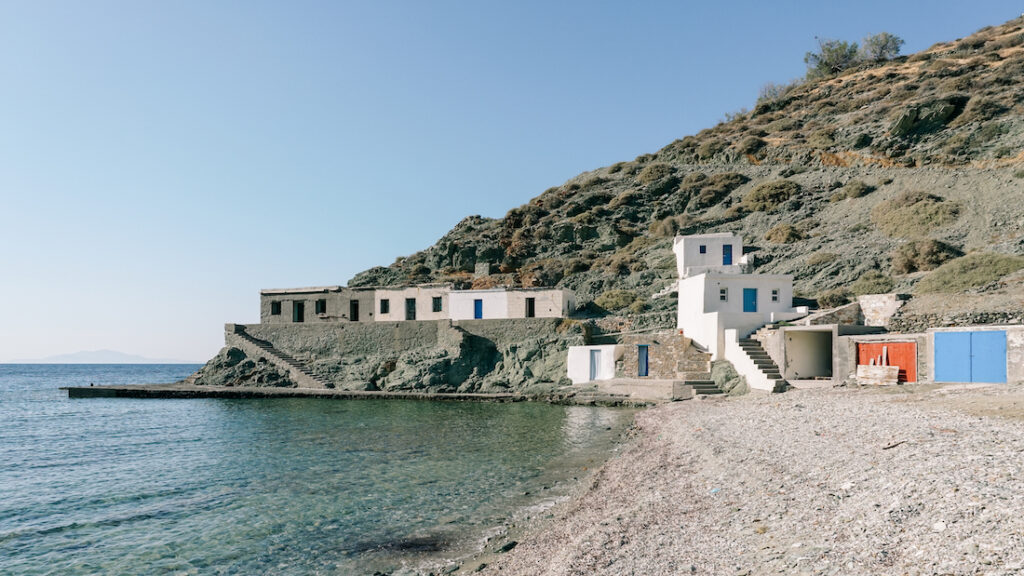
An hour later, three tamarisk trees and two tourists stand before the green rocks. It is a beach that on the left has a haunted house and on the right a cluster of abandoned buildings. A local word appears in the eerie landscape: sirmata (Greek: σύρματα). It translates to “wires,” but it refers to spaces dug into the rocks that serve as shelters for the boats. Some of these sirmata are half-open, while most houses have curtains in front of the doors so that the sea salt doesn’t ruin them.
The church fence is boiling. I sit there to cut a tomato and drink some water after the hike. The settlement of Agios Georgios seems ready to be inhabited again. A farmer’s car rolls down the slope, raising clouds of dust. The driver, a man with an honest face, gets out of the car and dives straight into the water.
It is a moment of silence before a landscape that seems to have been revealed from within. Reminiscent of old, pre-adolescent lunches by the sea and under the song of cicadas. However, the landscape that has emerged and is suddenly established before me is almost empty of people. I wonder: is there a reason to return to deserted memories?
The man with the honest face comes out of the water. But he does not return to the car. Instead, he emerges from the right side, in front of the green rocks. He climbs some steps that seem to lead nowhere and, two moments later, enters an unfinished building.
From that time until I leave Agios Georgios behind, he works with an electric drill. A violent noise covers the beach. At some unexplored wavelength, he may communicate with the ghost of the house on the opposite side.
Away from the Chora of Folegandros
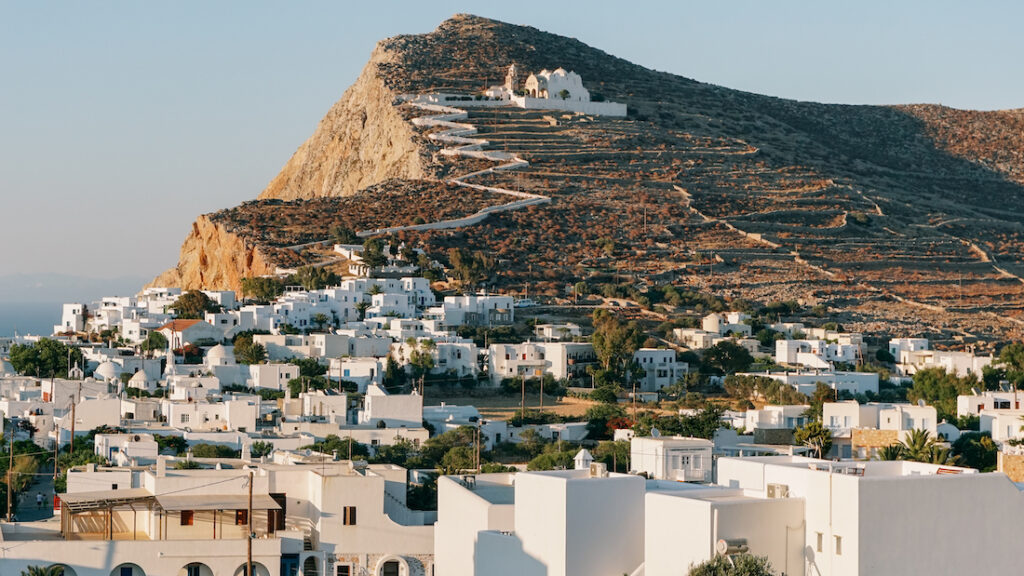
Six paths later, lost beyond the themonies (Greek: θεμωνιές) of Ano Meria, I catch myself staring at a benevolent donkey. The road ends there, maybe even the comprehensible world. There is a church with bending palm trees, and from there, other paths begin.
It seems to be the last veranda in the Aegean Sea, with a view towards the orange sky. Every traveler, sooner or later, becomes a vacationer; the confrontation with the landscape ends in harmony. However, the vacationer’s way is similar to that of the beggar: he seeks to get something in order to invest it in himself when he can no longer stand life.
But a rocky and iron land like Folegandros can only deny charity. I make sure my returns to Chora are short: to steal a picture of the church on the rock, quickly cross the Castle of Folegandros, have something to eat at Sik, or drink one last cocktail at Rakentia.
Then I walk away quickly. The rest of the day, I stay away from the ornamented Chora and return to the paths, out of fear of losing Folegandros.
More about Folegandros: The ultimate travel guide to Folegandros
Pin it for later

Did you enjoy reading Iron Land, Folegandros? Share it with your friends on FB or Twitter.
I found your Folegandros guide online, and after going through it, it pointed me to this article. And I read it and I loved it. It actually made me want to visit Folegandros -and that’s what I did. I spent 8 fantastic days on the island with my bf. Thank you so much for the inspiration!
Hey Claire,
What a wonderful comment -thank you! That’s so nice to hear. I’m glad that my Folegandros travelogue made you and your boyfriend actually visit the island. I also had a fantastic time there, and I wish I could stay longer. I think it’s one of the most beautiful islands in the Cyclades.
Take care & thanks again,
George