

Last Updated on December 19, 2021 by George Pavlopoulos
It took me two years to return to Anafi. Apart from being one of my favorite places on Earth, Anafi is also special for the Polaroid Diaries. That remote Greek island is actually the birthplace of these polaroid travel diaries. I decided to start shooting polaroids from my journeys back then, and I took the first photos in Anafi using the OneStep+. However, this year, I returned to Anafi with another camera: the SX-70. I knew that the light was harsh on the island, and I found it tempting to shoot some photos with the Polaroid SX-70 in Anafi.
I stayed almost twenty days on the island, and I had several films with me. However, this didn’t mean that I shot polaroids every day. On the contrary, I found myself shooting even less. As I often write in this blog, polaroids make us thoughtful. Having eight shots per film means that you should spend it wisely. Therefore, instead of photographing whatever appeared before me, I slowed down more than usual.
That said, if I thought that the light wasn’t correct, I wouldn’t take a photo. So instead, I decided to return another day to the spot and try to get an image. Spending twenty days on a small island gives you flexibility (apart from relaxation). And that’s what I did: I returned to the places that interested me the most.
*Some of the links are affiliate links. It means that if you buy something, I might earn a small commission at no additional cost to you.
What you’ll see in the Polaroid Diaries: With the SX-70 in Anafi
In this edition of the Polaroid Diaries (I can’t believe it’s the 14th!), you will actually see my most extended polaroid diary to this day. I actually shot three packs of SX-70 films in Anafi. As it’s always the case, not every polaroid I took found a place in this edition. Some of them weren’t looking good, while others I gave as gifts/souvenirs to the locals.
No matter what, I had enough material for this polaroid diary from Anafi. Overall, I’m happy with the performance of the SX70 even though sometimes it seems to have “a mind of its own,” as I wrote in my SX70 review. Last but not least, as I always do, you will see the settings I used to shoot the diary at the bottom of this post.
So, let’s start.

Polaroid Diaries: With the SX-70 in Anafi
The ferry needs approximately 12 hours to reach Anafi, and part of the journey takes place through the night. While I always enjoy traveling by ferry (see my Ferry Tales, for example), the truth is that the journey is also exhausting. Barbara and I arrived at 04:30 a.m. at Anafi, and the island was pitch black. We went straight to sleep, but when I woke up in the morning, I knew that the usual view would wait for me. I always stay at Dream Studios in Anafi, and the first thing I did when I opened the door was to shoot a photo of the view.
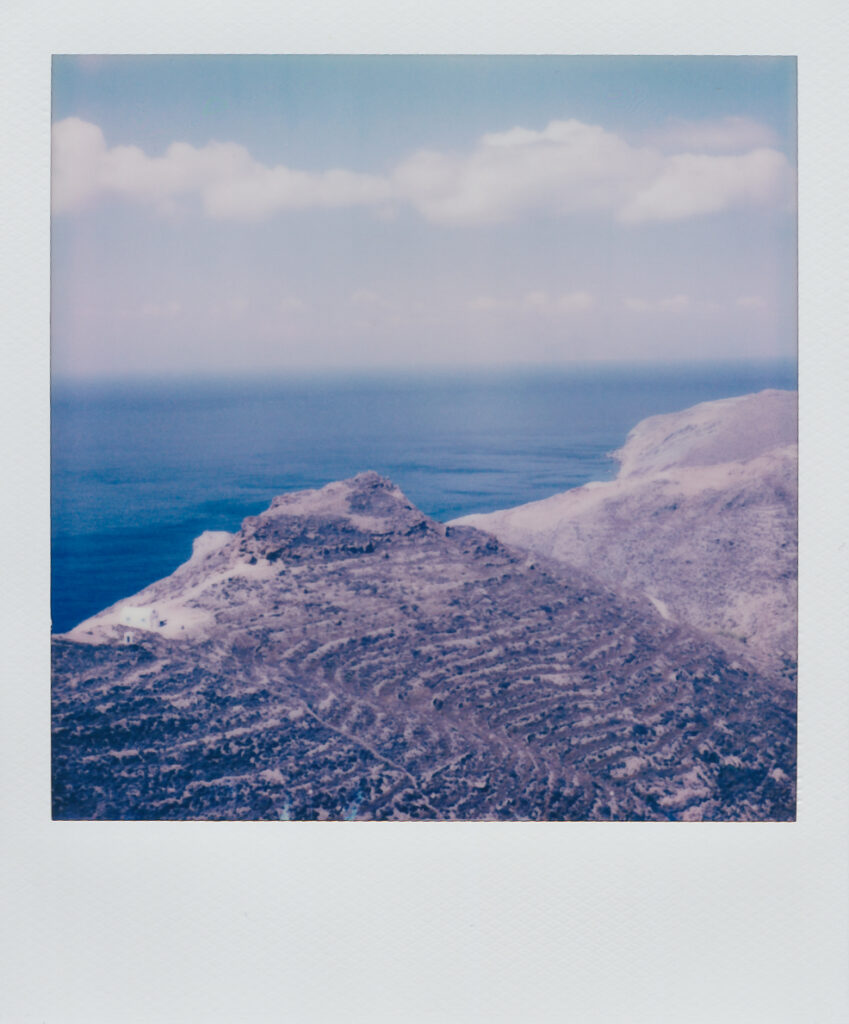
Shortly after breakfast and before heading to the beach, I decided to go on a short walk around the Chora, the main settlement of Anafi. The light in the Greek islands is always harsh and the heat intense. But I was so happy to be again in Anafi that I thought of taking a photo from the top of the hill. Apart from the few white houses, you will also see how rocky Anafi’s terrain is and the Monolith in the background (more about it later).
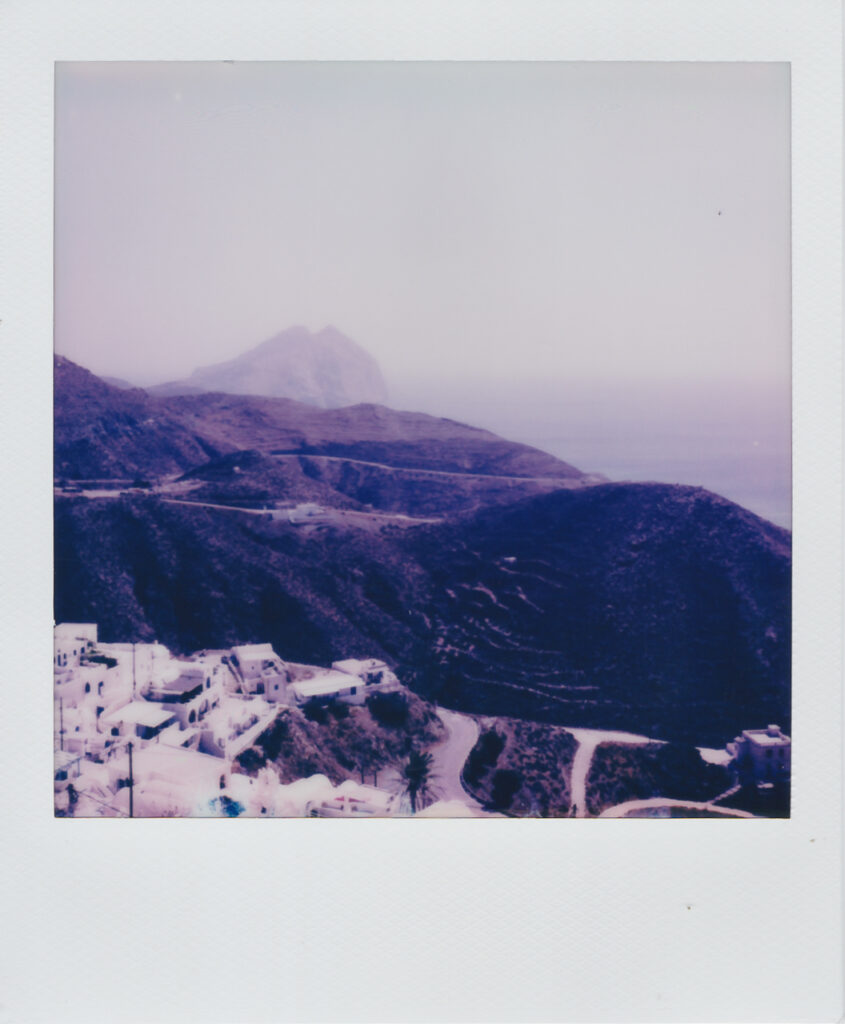
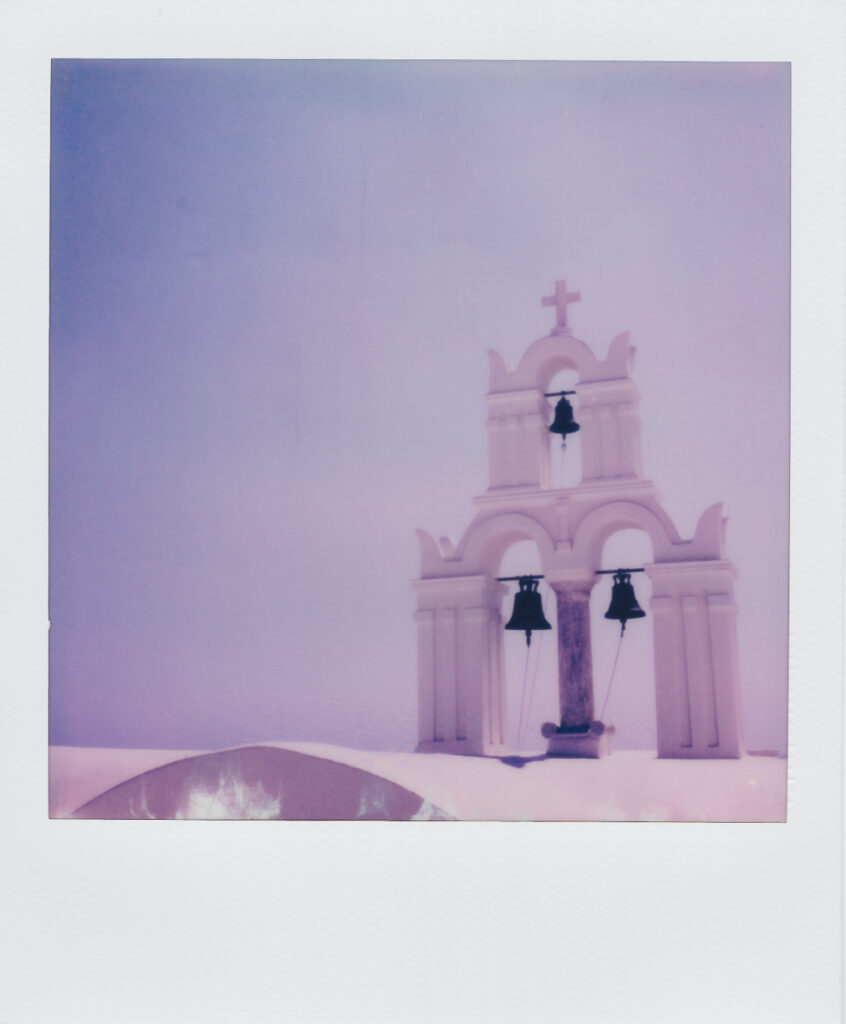
Religion is an integral element of the local culture. There are loads of churches and small chapels everywhere on the island. While walking through the Chora, you’ll also see a couple of them, but most churches are scattered in various remote places on the island. In the polaroid below, you will see one of Chora’s main churches. I returned several times at the spot, and I took this polaroid a couple of days before leaving the island.
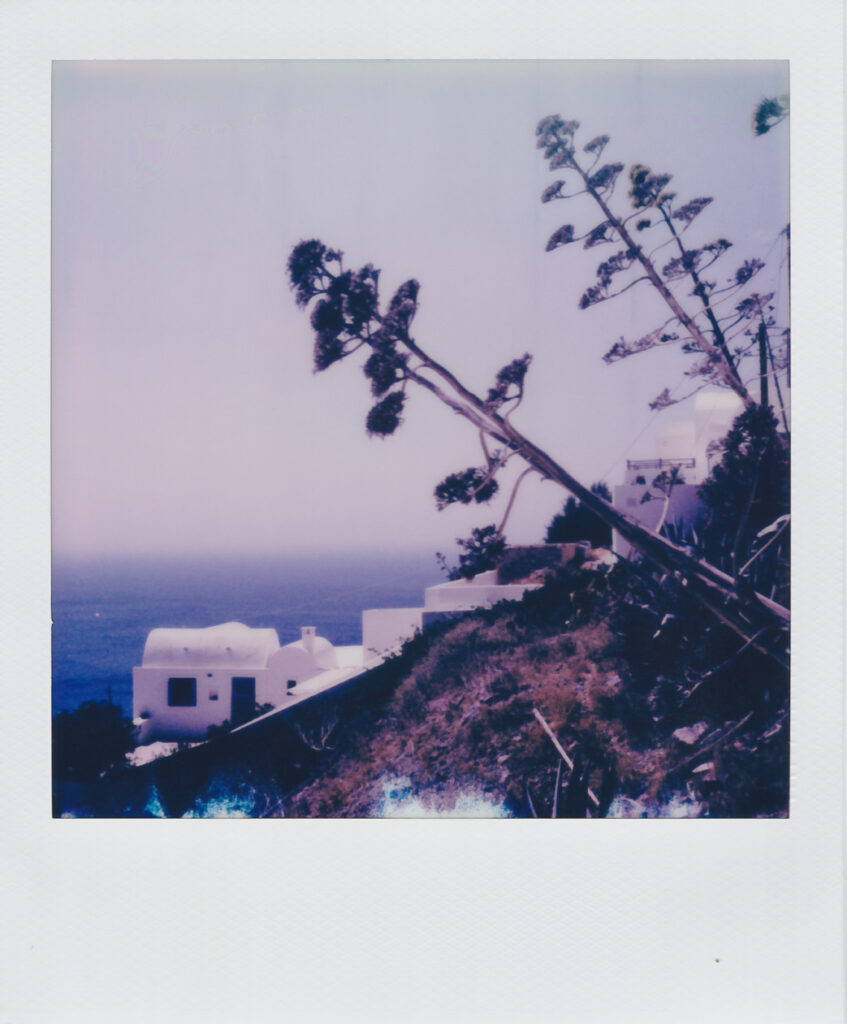
One of my favorite places to eat and/or drink on the island is Tholos. It’s a small taverna with delicious food that enjoys spectacular views of the open sea. In the polaroid below, you can see the view from Tholos. The trees that occupy half of the frame are the so-called “immortals”: they gain their height suddenly, most likely during one summer, and never die.
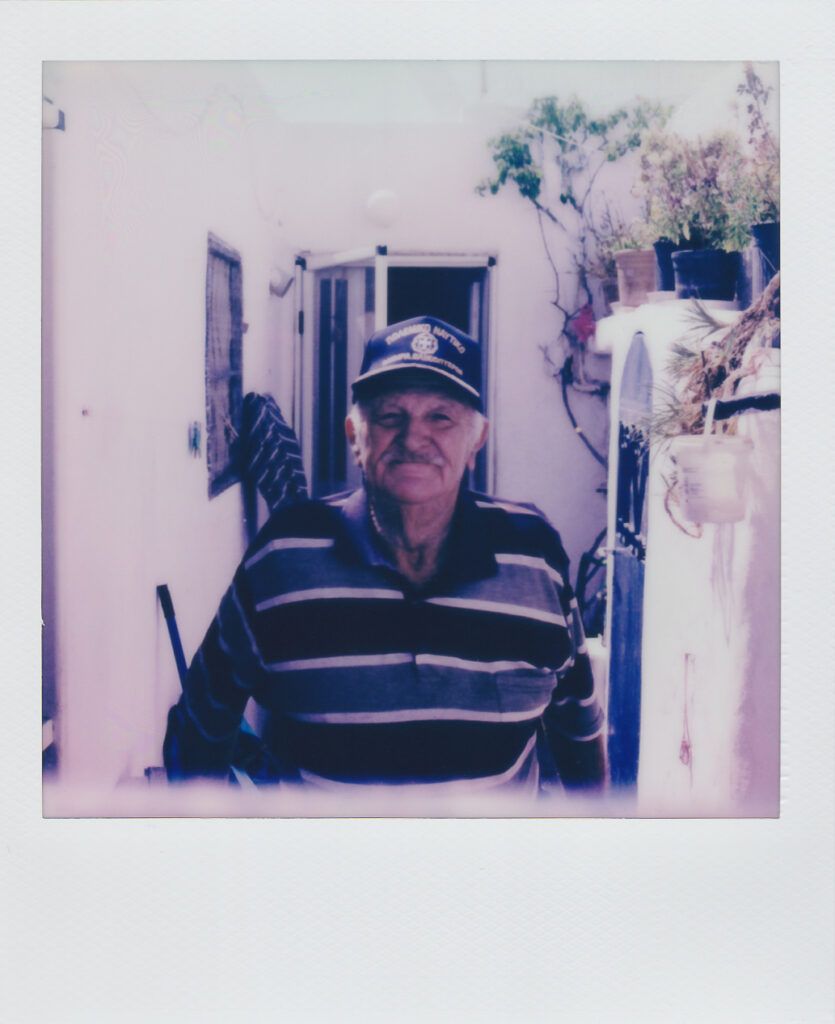
After visiting Anafi several times in the past, I also got to know some locals. Anafi has more or less two hundred permanent inhabitants, and they are some of the friendliest people you’ll ever meet. One of them is Manolis, a 90-year-old man I know from my previous visits to the island. The last time I met him, he told me about his knee problems and how he dealt with the issue. He tries to get as many bee stings as possible because this -he said- is an excellent treatment for his chronic knee pain. And here’s a polaroid portrait of Manolis with the SX-70 (see the camera’s prices here: US | EU | UK).
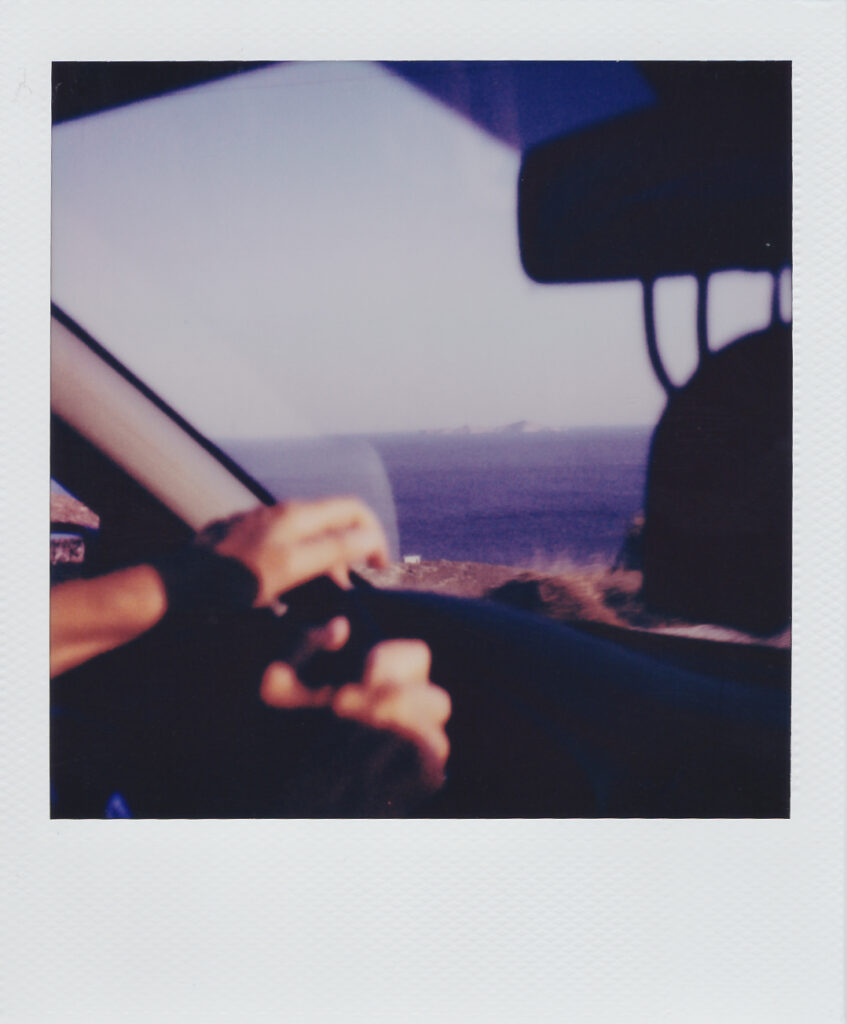
Even though you don’t need a car in Anafi, we decided to rent one. The main reason was that the bus in September doesn’t run that often, and we wanted to have flexibility (which means: sleep until late). While the road network is short, it’s always fun to drive around Anafi. Late one afternoon, I decided to shoot a polaroid while driving through Anafi. I mainly wanted to focus on the nearby island of Makra (it means “the long one”) while including Barbara’s hands on the wheel and my face mask hanging on the mirror. Here’s what I got.
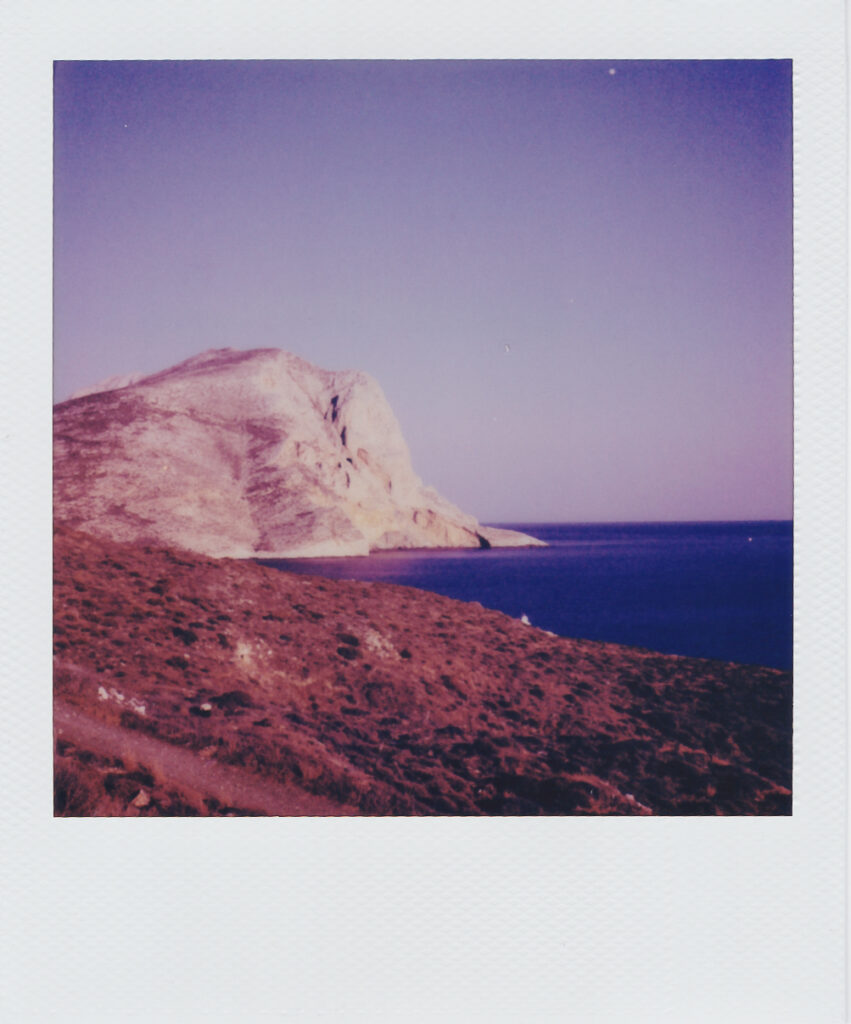
I wrote earlier about the Monolith of Anafi, called Kalamos, but here I’ll share some more info about it. That’s actually the second biggest monolith in Europe; the first is Gibraltar. Kalamos is visible from almost everywhere on the island, and there’s a small monastery on its top. Climbing to the monastery of Kalamiotissa is one of the best things to do in Anafi -I took several photos, and I wrote about the monastery here. The afternoon light dresses the monolith in eerie orange light, and one day I decided to take a picture.
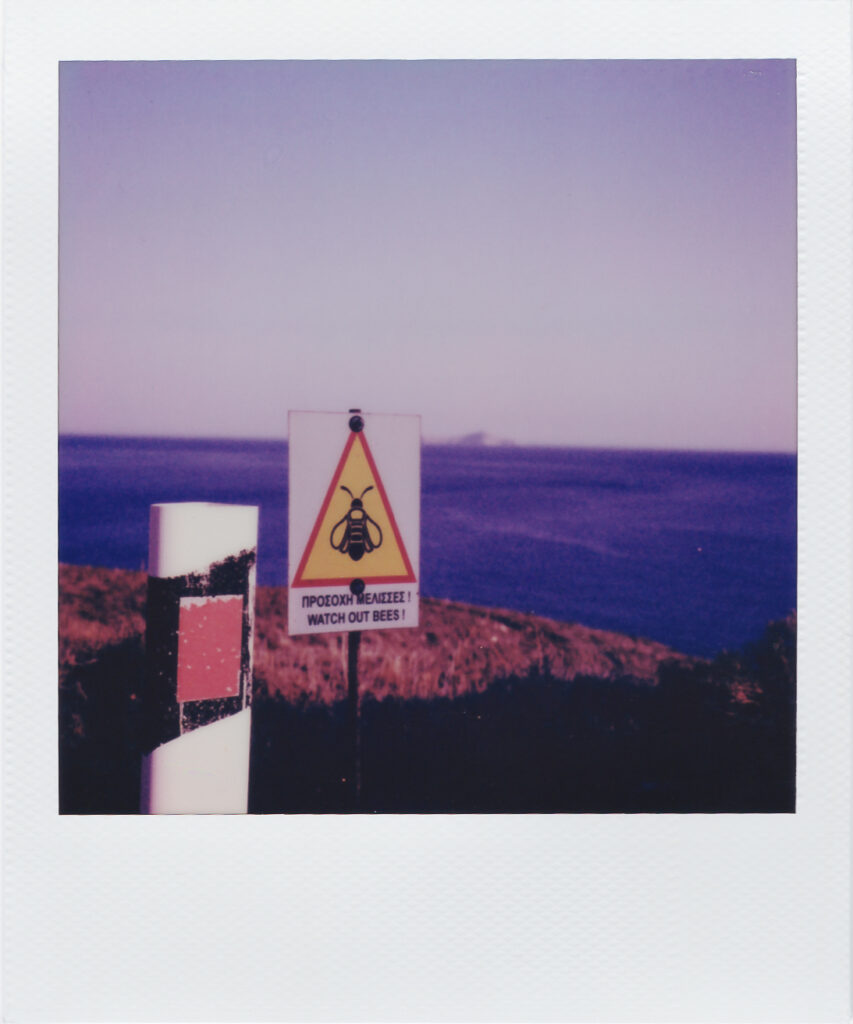
I wrote earlier about the bees of Anafi, and the truth is that the island has plenty of them. The locals produce high-quality honey, and if you want to bring something unique home, look no further. While you aren’t in danger of getting stung because the vast majority live in beehives, there are several signs here and there. Here’s how these old-fashioned signs look like.
I guess it’s rather apparent that Anafi has marvelous beaches. The water is crystal clear, and most of them are sandy. So far, you won’t find any sunbed in Anafi, and that’s part of the island’s charm. One of the most impressive beaches is Livoskopos, which is in the island’s northern part. The locals will advise you not to visit it if the north winds are strong, which is usually the case during summertime. I was lucky enough to visit Livoskopos on a relatively quiet day. You’ll need to hike to reach Livoskopos, but here’s the landscape you’ll see before descending to the beach.
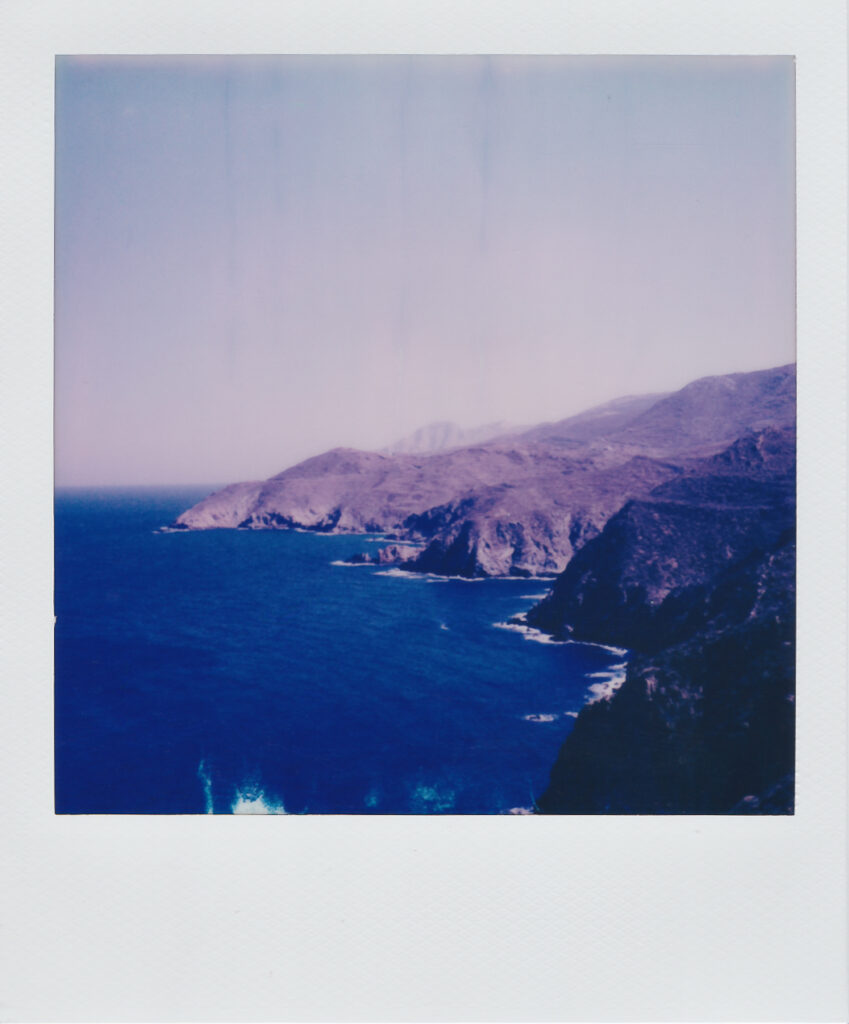
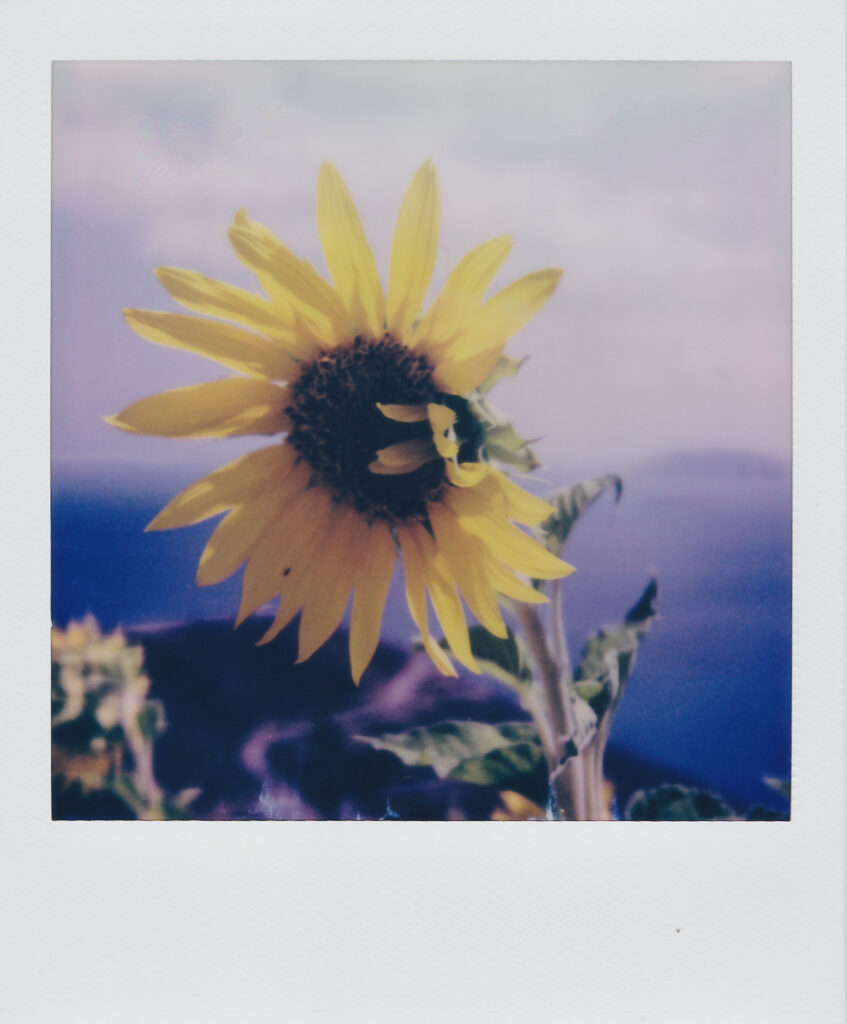
Anafi is a dry island: sometimes, you might not get rain for more than a year. Therefore, the landscape is also arid, but here and there, you’ll often see colorful flowers popping. Even though I’m bad at recognizing the flora, their colors fascinated me so much that I decided to take some photos. While I tried my best to find out the plants’ names, if you see any mistakes, please share them in the comments below. So, anyway, here’s one that I think I guessed correctly: a sunflower.
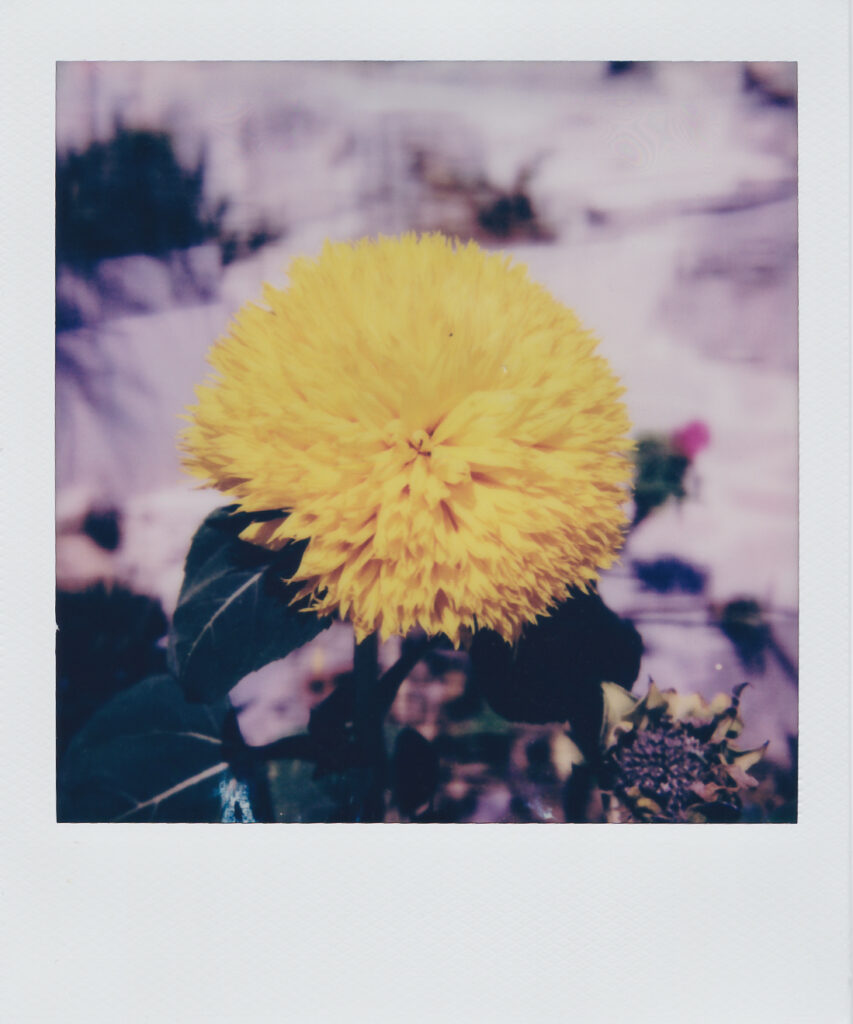
And here’s another flower, that it’s -probably- a yellow chrysanthemum.
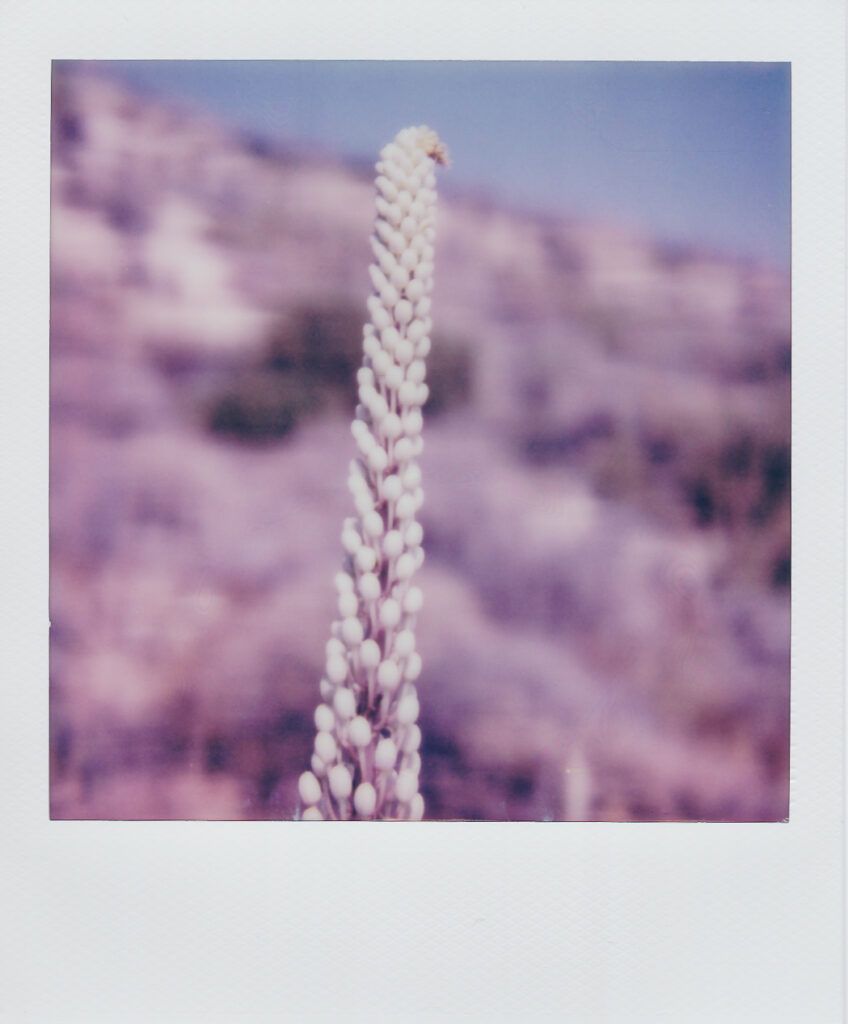
While hiking the slopes of Anafi, you will constantly see the flower below. Sometimes it stand all alone; other times, you’ll see a bunch of them. Its name is Drimia Maritima (Greek: Αγιοβασιλίτσα), and it’s also known as squill, sea squill, sea onion, and maritime squill. I think it is one of the most beautiful flowers. Here’s one of them:
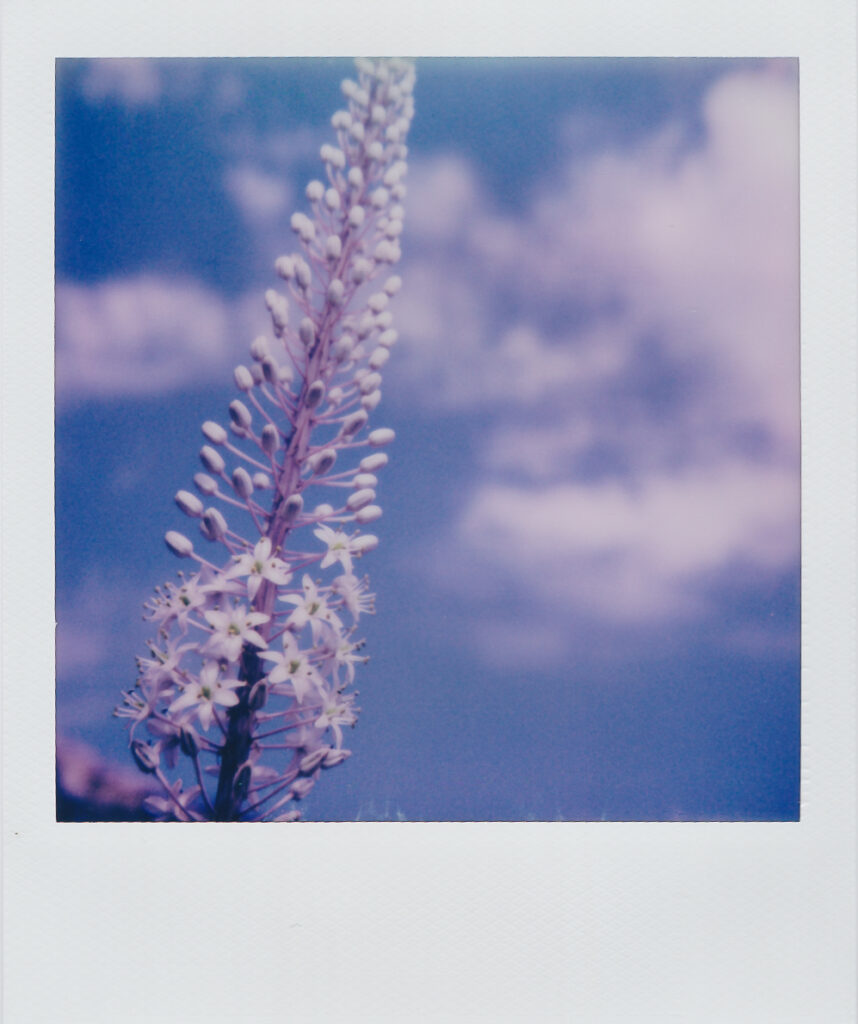
And here’s another:
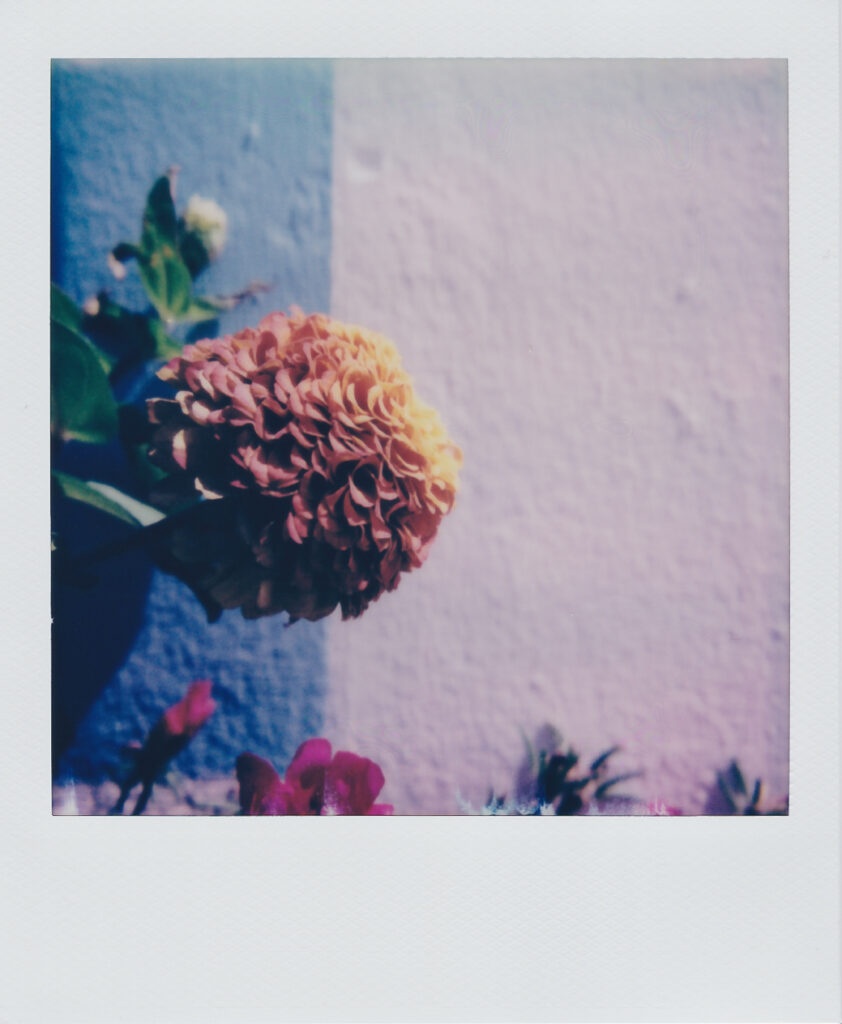
Last but not least, here’s another one. I believe it’s a dahlia. I discovered it in a pot at the Chora of Anafi, and I kept staring at it every time I walked by.
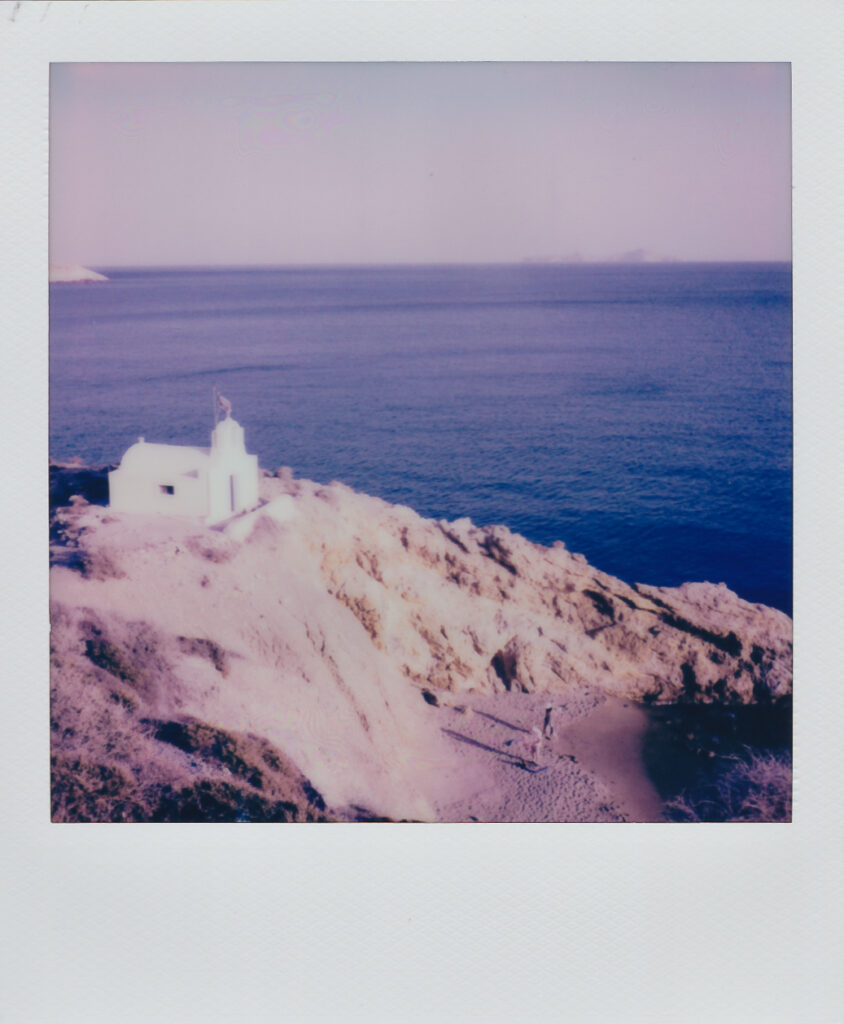
The following polaroid is from one of the nicest beaches of Anafi. Its name is Agioi Anargyroi, and it derives from the little church on the rock. Unfortunately, the photo below is not that good: it’s kind of soft and overexposed. However, I decided to include it for two reasons. First, because I think that no journey to Anafi is full without swimming at Agioi Anargyroi. And second, because it serves as a reminder for Polaroid SX-70 shooters: the moment you think you know how the camera works, it will prove you wrong.
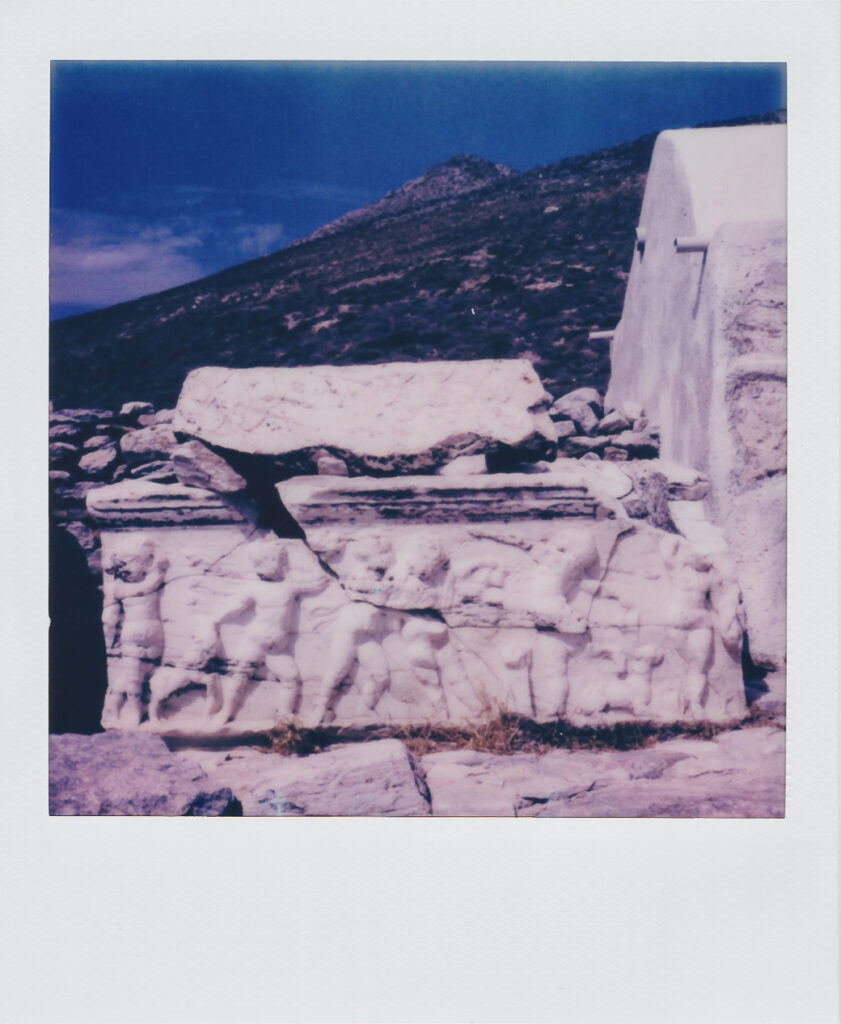
Anafi was inhabited for millennia, and there was also a Roman period for the island. The ancient settlement of Kastelli still exists, and there you can see ancient walls. Now, on the way to Kastelli, there’s a small church called Panagia in Dokari and, next to it, one of the most impressive findings: a Roman sarcophagus. No excavations have ever taken place, and the marble sarcophagus is still there in the wild. Here’s how it looks.
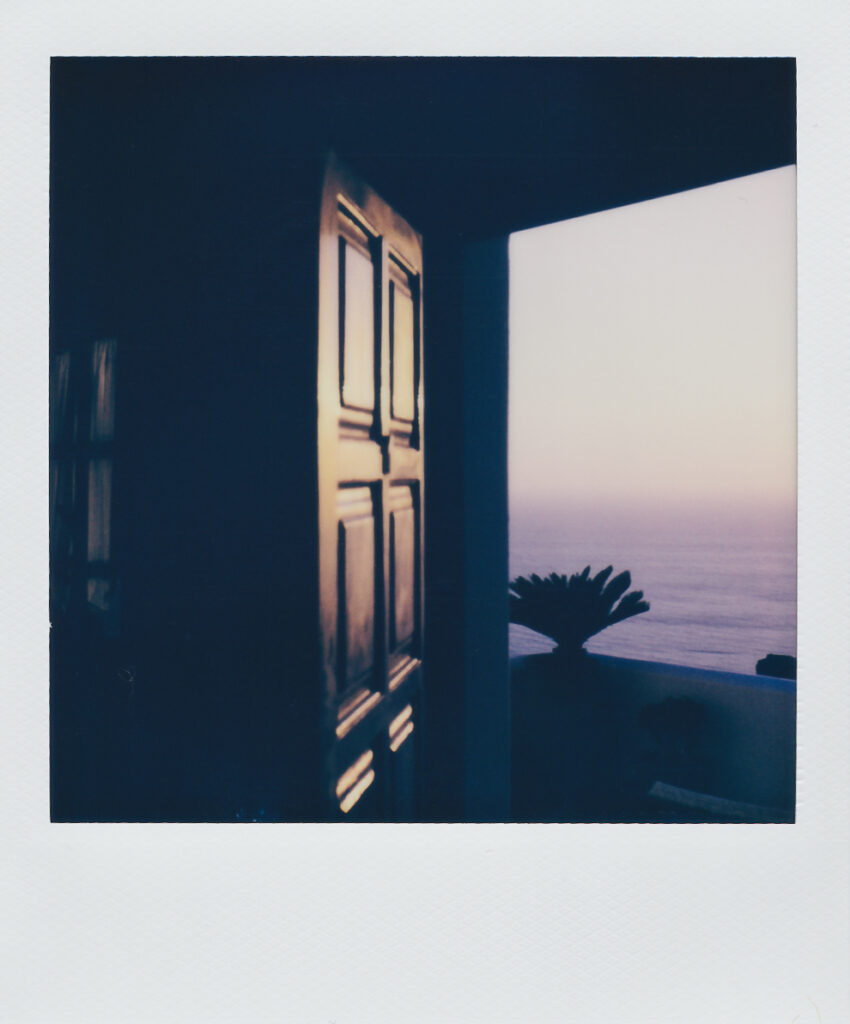
And, one day, I realized that the journey to Anafi was about to end. The last evening, I was in the room enjoying the sunset. The light was very mild, and it was getting dark. The door was open, and a strong wind was blowing. I thought it was an excellent time to take a polaroid.

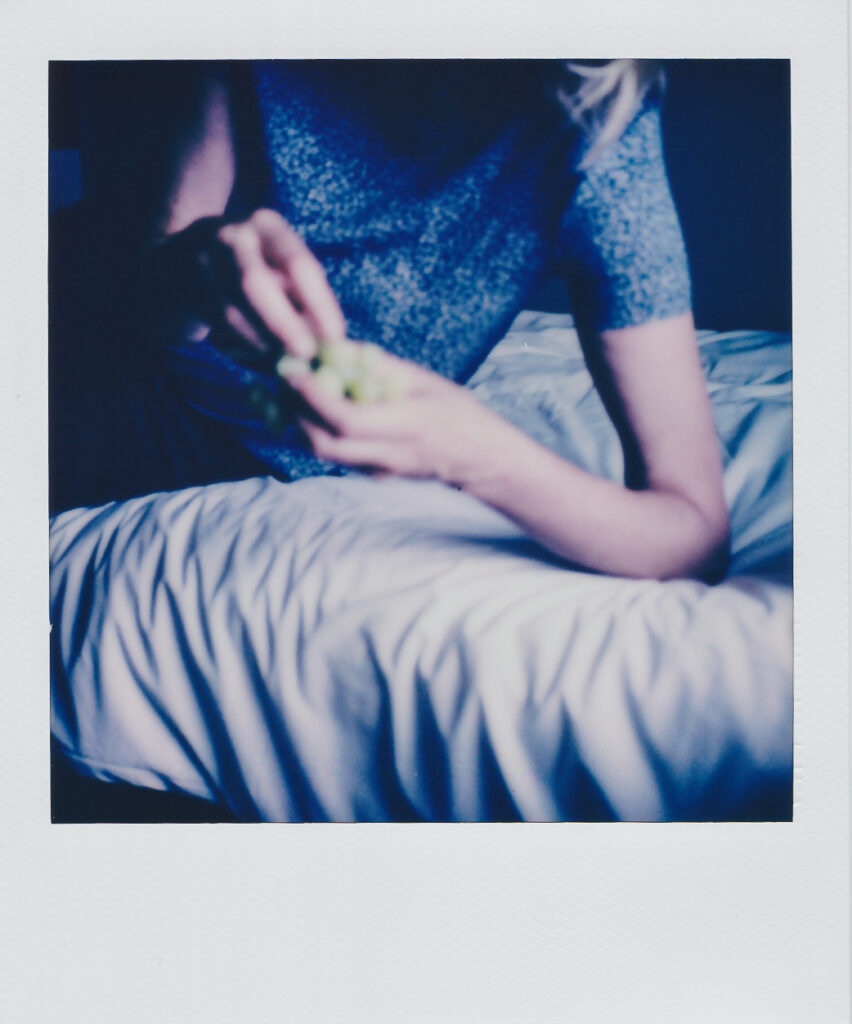
On the way back with the ferry, the sea was rough. Since we had in front of us another 12-hour journey, we decided to book a cabin. It turned out to be a perfect idea because it meant that we could get some proper sleep. After sleeping for a couple of hours, we woke up early in the morning. Barbara started eating some grapes she bought in Anafi. I thought of shooting one last polaroid. However, the light was relatively poor, which meant a slower shutter speed. And since the sea was rough, I couldn’t keep myself still.
My Polaroid SX-70 settings for this edition of the diaries
For the previous edition of the diaries, I had to experiment a lot with the exposure wheel. However, for this edition, everything seemed to be easier. Despite the harsh light, the SX-70 in Anafi proved to be a good companion. Apart from the photo at the Agioi Anargyroi beach, I think that every other image worked pretty well.
For every photo you see in the Polaroid Diaries: with the Polaroid SX-70 in Anafi, I underexposed by 1/3. I didn’t change the settings even for the sunset image that I took inside the room. For this specific photo, this meant that the camera chose a slower shutter speed, but I think the mood it created was charming.
I’m also delighted with the sharpness of the flowers. I went really close to shoot them, and I find both the detail and the bokeh impressive. Due to the harsh light of Anafi, I believe that underexposing was the right thing to do.
Last but not least, I didn’t post-process any of the polaroids you see here. I just scanned them, and apart from a +10 in sharpness for web optimization, there’s no post-processing. Part of the polaroid fun is the straight-out-of-the-camera result.
So, that’s it with one more edition of the Polaroid Diaries and the photos with the Polaroid SX-70 in Anafi. There will be more travel polaroids in the future so make sure to check back soon. And, if you want to see more polaroid tips, polaroid camera reviews, and photos, don’t forget to subscribe to the mailing list below.
*You can buy the newest (and freshest) films and Polaroid cameras directly at Polaroid’s official websites.*
The US Store | The EU store | The UK Store
My polaroid zines: Vol. 1, Vol. 2, Vol. 3
More Polaroids: The full Polaroid diaries, My Now+ review & My Polaroid GO review

Get my Polaroid Camera on Amazon | Buy the film on Amazon
Pin it for later

Feel free to share on FB or Twitter the Polaroid Diaries: with the SX-70 in Anafi.
George, staying for twenty days on Anafi would be a dream! Looking back now, how was the length of your stay? Did it feel about right, was it too long, or would you have liked to have stayed for another week if you could? Were there many people at the beaches? Your Polaroid photos are really good. I like the one with Barbara in it.
Did you underexposed by 1/3 for this photo as well? I would have thought you would overexpose (turn the dial wheel so that more white is shown, since there is less light in the room). I want to take a photo of the beach looking out through a window. If it is sunny outside with nice blue sky and a bit darker inside the room, how would you take the photo? What position would you have the white/black dial on the polaroid camera? I want to take a photo like this at a certain spot, and was thinking that I would have to place the dial about 6/10 white and 4/10 black (so it would be overexposed). I’m assuming if more white is shown on the dial, the polaroid will get overexposed. Or am I getting it mixed up?
Hey there John!
Ah, Anafi was a dream. Initially, we planned to go to another island, but soon after arriving, we decided to stay there. I could easily stay another twenty days: if you like swimming, hiking and eating delicious food, you can’t go wrong with Anafi. I mean, if you enjoy this kind of vacation, then you can stay even two months. While I always love seeing new places, I also realize that it’s essential to explore slowly the places you visit. If it wasn’t that horrible the past winter, I think we would have visited 1-2 more islands. But after all that stress, relaxing was the right thing to do.
Yes, I underexposed the photo of Barbara by 1/3 as well. What you can’t see in the picture is how intense the early morning light was. However, the (relatively dirty) cabin window diffused the light and made it look softer. If I went for a balanced exposure, I’d have more highlights but probably more washed-off colors. And if I overexposed (which I also considered), I wouldn’t probably have the details on the bed linen.
You get it right, yes. If more white is shown on the dial, the polaroid will get overexposed. In general, I don’t overexpose unless it’s late evening and the light is almost gone. Now, for a shot through a window, I would first think about how I imagine the photo. Then, if you’d like (for example) to have negative space around the window (i.e., black around the window), I would underexpose. These will give you a nice window view with lots of detail, given of course that it’s taken during the daytime.
On the other hand, overexposing will give you some interior detail, but I’m afraid that the window will be white space, like a frame of blown highlights. For such shots, I’d generally keep the exposure either balanced or I’d underexpose. This will guarantee that I can see what’s out of the window. An overexposed one will probably make the view disappear, and it’ll focus more on what’s inside the room.
Every Polaroid SX-70 is, somehow, unique. So if that’s a shot you’re interested in, I’d suggest taking two photos back-to-back. Shoot one with balanced exposure and then another one slightly underexposed, like 1/3 (or 2/10 following what you said). This will show you what’s the optimal setting for your camera. But I’d avoid overexposing if I want details out of the window.
For reference, have a look at the Folegandros Polaroids here, where I took a photo similar to what you describe. For my camera, the exposure wheel is in the middle. The shot is taken before noon, so if the sun were intense later, I’d underexpose. On the other hand, in my first Polaroid Diary from Anafi two years ago, I underexposed for the open-door-and-view photo, even though I used another polaroid camera.
I hope I helped a bit 🙂
George
George, thanks for this awesome reply. I have just created my second post which focuses on the SX-70 Sonar camera. The post is titled: What happened to Atlantis? Find Plato
I put a link to your website in the post as well. Hopefully, you will find it interesting. All the best, John
John, these are all awesome polaroids! So glad you enjoy your SX-70 Sonar. All of them look wonderful, even the underexposed ones. Especially the Atlantic Tower is fantastic! I think the Sonar suits you perfectly; you nailed the focus in every polaroid. And -if I might say- there’s remarkable progress in this second post about your polaroids.
I am looking forward to seeing more! Shall I ask if you officially caught the polaroid bug? 🙂
Cheers!
George
Thanks, George. I am happy with this series of photos. The SX-70 Sonar Autofocus is a great camera. And yes, I think I have caught the Polaroid bug. It is exciting to wait and see how the films turn out. Looking forward to my next round of shots. All the best, John
That’s good to know. Looking forward to your next round of polaroids. Enjoy shooting!