

Last Updated on June 23, 2025 by George Pavlopoulos
In the heart of Bremen’s historical center lies one of the most beautiful neighborhoods in Germany. Its name is Schnoor, and it’s the only location in Bremen that has retained an original medieval style. The oldest Schnoor buildings date back to the 15th century, narrating stories from a distant era through their picturesque architecture. Moreover, the neighborhood’s history offers a rare insight into the daily life of what Bremen once was.
So, in this article, you will find information about the iconic area of Schnoor, Bremen. Additionally, you’ll see plenty of photos and some Schnoor guided tours to help you make the most of your visit. Lastly, if you want to stay overnight in Bremen and prefer a more local experience, I’ll share some recommendations for accommodations in the neighborhood.
Let’s start.
*Some links are affiliate links. This means that if you make a purchase, I may earn a small commission at no additional cost to you.
Schnoor, Bremen: A guide to one of the most beautiful European neighborhoods

Schnoor is one of Bremen’s most famous locations today. However, this was not always the case. In former times, Schnoor was actually one of the city’s poorest areas. Schnoor was initially developed in the 10th century by fishermen who settled in the area due to the proximity to the Balge, Bremen’s old harbor. On the other hand, the merchants resided in the Obernstraße, a wealthier area more befitting their status.
What does Schnoor mean?
The name Schnoor seems to be a reference to the cables and ropes produced by fishermen in the area. Schnoor translates to “string.”
However, there’s a second interpretation inscribed on the neighborhood’s street sign. The name potentially derives from Schnur (again, “the string”), but it refers to the street’s architecture because the houses are lined up like a string.
Despite the slight differences, both interpretations seem valid, and the etymology has a solid connection to the fishermen who developed it.
What’s the difference between Schnoorviertel and Schnoor?
Schnoorviertel (English: Schnoor district) refers to the neighborhood as a whole, while Schnoor is the name of the main street. However, nowadays, the word Schnoor is used on both occasions.
How can you get to Schnoor?
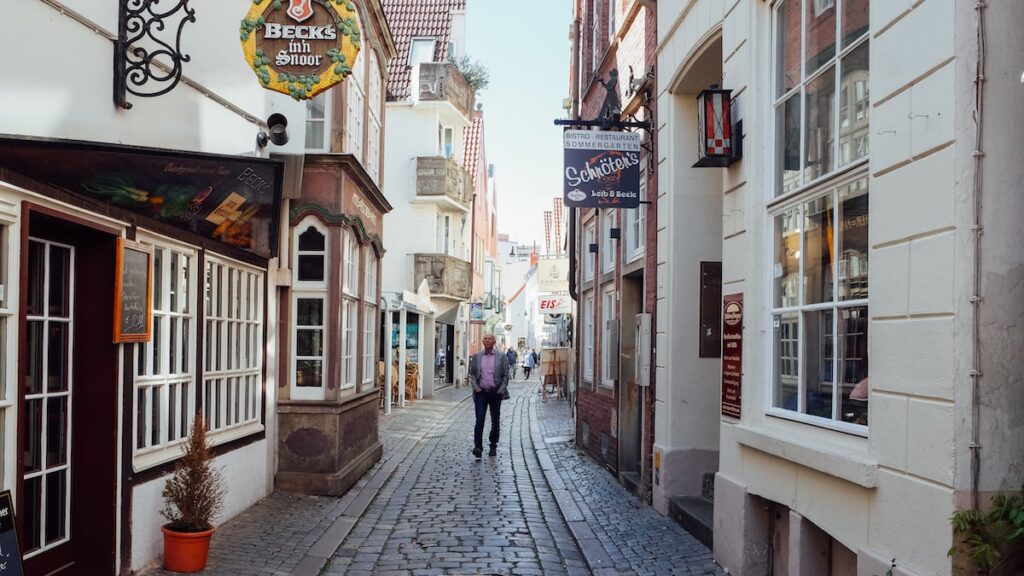
Schnoor is a micro-district in downtown Bremen. All the city’s major attractions -like Market Square, the Bremen Town Musicians, and the Roland statue- are nearby. However, despite its proximity to the city center, Schnoor remains hidden.
The easiest way to reach it is from the Lange Wieren, where anchor chains and wire cables were once constructed. Alternatively, you can walk from Marterburg, on Schnoor’s edge.
Can you reach Schnoor by public transport?
Yes, you can reach Schnoor by bus or tram. The closest tram and bus stop is Domsheide, and buses (24 and 25) and trams (2, 3, 4, 6, 8) stop there.
Schnoor is a car-free hood
In the late 19th century and for a good part of the 20th century, Schnoor had a significant disadvantage: its narrow streets couldn’t host any traffic at all. As a result, poverty increased, and even the simplest renovations were impossible. However, as time passed, the hood’s disadvantage contributed to Schnoor’s original flair, and the cobblestoned streets are still exclusively for pedestrians.
Moreover, in the late 1950s, the Senate of the Free Hanseatic City of Bremen decided to restore Schnoor, and it is now a historic district under official heritage conservation.
Historic houses and landmarks
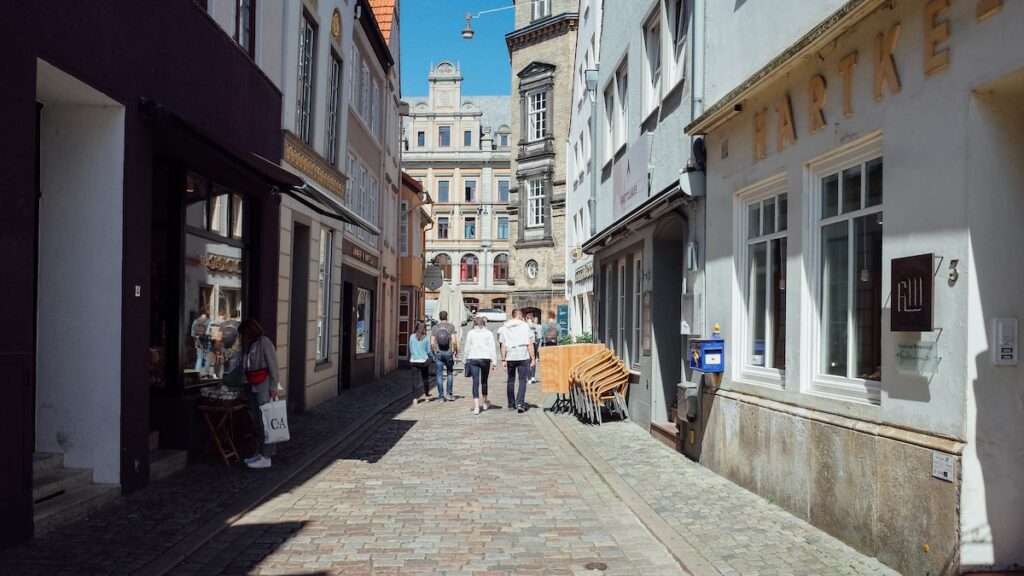
The neighborhood is the only one that retains its medieval character intact, and there are numerous historic buildings to see. While a few buildings date back to the 15th century, most were built between the 16th and 17th centuries. Some of the most important buildings of Schnoor are:
Schifferhaus. The so-called Shipper’s House was built back in 1630 and was declared a monument in 1973. It has seen several uses throughout its 400-year history, serving as an inn, a restaurant, and a private museum.
Badestubenbrunnen. That’s a fountain hosting the sculpture “The Happy Bathers,” standing in front of the Schifferhaus (both on the cover photo of this article). While the fountain is relatively new (1986), it’s an important element of the Schnoor. That’s because it commemorates a time when there were still public bathhouses in the quarter. In medieval times, most houses didn’t have bathrooms, and people frequently visited public baths.
St. John’s Church. That’s a Roman Catholic church (German: St. Johann) in Bremen. It was initially built in the fourteenth century as a Franciscan abbey church, and you can see it nowadays on the district’s edge.
Landherrnamt. Designed by Alexander Schröder, the Landherrnamt is a fine example of Neo-Romanesque architecture. It dates back to 1856.
Wohnhaus Wüstestätte 1. The two-floor house features a beautiful half-timbered facade. Nowadays, it hosts offices and shops. The street name Wüstestätte (Wüste= desert) most likely refers to a deserted area due to a fire that destroyed everything nearby.
Concordenhaus. That’s one more attractive building constructed in the Renaissance style. It features a brick exterior.
What’s the distance between Schnoor and Böttcherstraße?
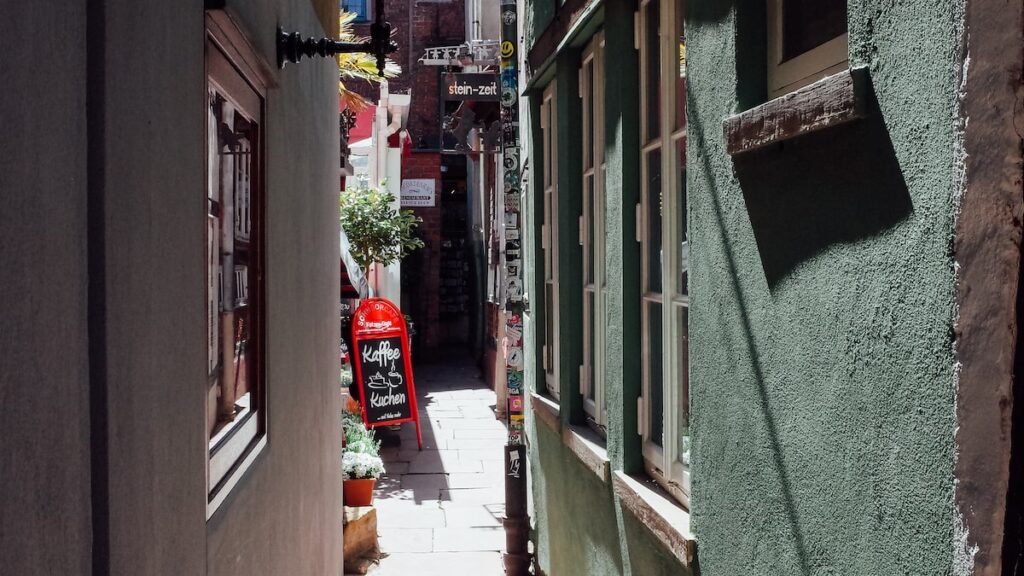
Despite their different historical backgrounds, the two iconic districts of Bremen are very close. The distance between Schnoor and Böttcherstraße is just 500 meters, and it won’t take more than a 5-minute walk. Therefore, you can easily visit both places in one day and, as you’ll see later in the article, most Bremen walking tours stop at both.
What you’ll see while strolling around Schnoor
Nowadays, Schnoor is a laid-back district with lots of cafes and restaurants. Moreover, you’ll find local workshops, galleries, antique shops, and even small museums. Strolling around Schnoor is one of the best things to do in Bremen, and spending some hours there (or even a couple of nights) will feel like time-traveling.
Where to stay in Schnoor, Bremen

As you can easily imagine, Schnoor doesn’t host an excessive number of hotels. In fact, if you’d like to stay overnight in Schnoor’s heart, you only have a couple of options. In this section, you’ll find only the accommodations you can book straight at Schnoor, not those nearby. Apparently, these are old, historic buildings, and you can’t expect modern hotels. However, all of them are equally charming, and if you appreciate old-fashioned stays, you’ll feel at home.
Schnoor hotels
Schmuckstück. That’s a small house featuring a sun terrace with a view, a private bathroom, and free wifi. In addition, Schmuckstück provides bed linen, and it’s located in the heart of the district. See prices and availability for Schmuckstück.
Bremen Apartments Nath Schnoor. This small inn offers rooms with balconies and private bathrooms. Some rooms come with a kitchen, but all of them have kettles. Free wifi is available throughout the property. See the Bremen Apartments Nath.
Romantisches Haus im Schnoor. This is one more charming accommodation in the neighborhood’s heart. The house is next to cafes and restaurants and has a cozy interior. See prices and availability for the Romantisches Haus.
The best Schnoor walking tours

Schnoor has a fascinating history, and it’s not an exaggeration to say that every building has a unique past. Several local guides offer guided walking tours in Schnoor in English. Below you’ll find two of the best Bremen tours you can take right now: the first is dedicated entirely to Schnoor, while the second one will take you all around Bremen’s historical center, and it’ll stop at Schnoor too.
1-hour Schnoor walking tour. This guided tour will introduce you to the quarter’s beauty. Moreover, your guide will share several facts and information about the district, and you’ll see some iconic buildings, such as the “Brasilhaus” and the “Packhaus Schnoor 2.” This walking tour is ideal for individuals who are eager to learn as much as possible about the area. The cost is 12 euros, and you can book it here.
2-hour Bremen city center tour. If you are just in Bremen for a couple of hours, but you’d still like to see as much as possible, that’s one of the best tours you can join. You’ll see the famous Marktplatz, the UNESCO World Heritage Town Hall, and the iconic Roland Statue. Moreover, apart from the Old Town and the Bremen Town Musicians, you’ll also discover Böttcherstraße shortly before the Weser River, before reaching Schnoor. The tour costs 12 euros per person. You can book the Bremen city center tour here.
Schnoor, Bremen: Final Thoughts
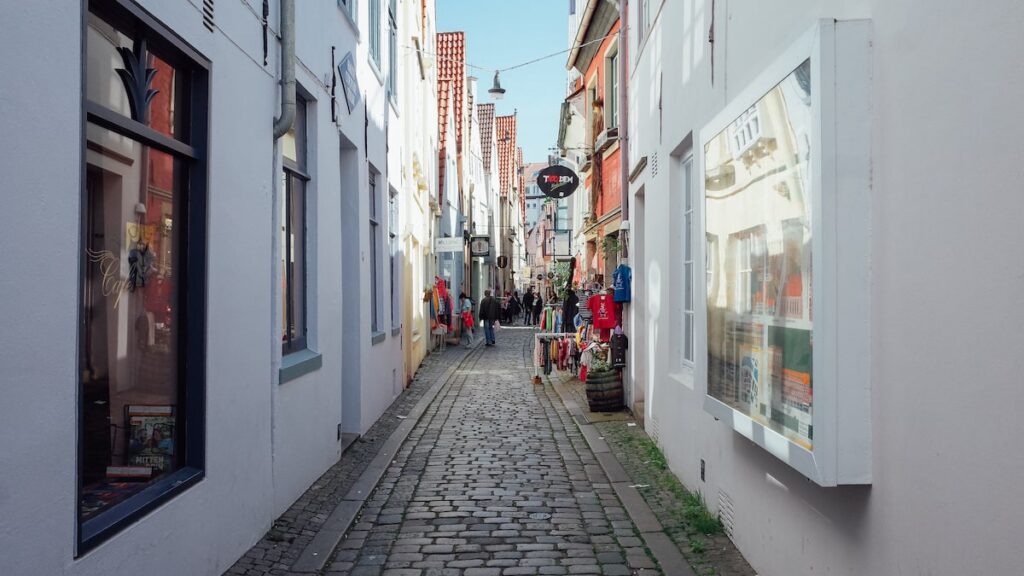
Schnoor is undoubtedly one of Bremen’s highlights. A couple of years ago, The New York Post nominated Schnoor as one of the coolest streets in the world. This tiny district is rich in medieval buildings and often feels like an architectural study, with its half-timbered houses and narrow lanes creating a fantastic atmosphere.
It doesn’t get more picturesque in downtown Bremen: make sure to visit Schnoor and discover one of the most charming neighborhoods in Europe.
More in the area: Böttcherstraße guide, Things to do in Osnabrück, Germany

Pin it for later
Sharing is caring. Share this article about Schnoor, Bremen with your friends.