

Last Updated on June 13, 2026 by George Pavlopoulos
I always wanted to visit the Stasi Museum in Leipzig, and when I stepped inside the former Runde Ecke, it felt like entering a Cold War time capsule. From the outside, the building seems no different from plenty of others in Germany. However, behind this impressive facade, the headquarters of the notorious Stasi in Leipzig were housed. It was here, on December 4, 1989, that the citizens stormed inside to stop the destruction of the Stasi files. And since August 1990, the former Stasi headquarters have been converted into a museum that hosts the exhibition “Stasi: Power and Banality.”
To better understand the museum’s context, one must appropriately frame Leipzig’s role in the events that led to the Fall of the Berlin Wall. Leipzig is tied to the Peaceful Revolution, a wave of nonviolent protests and resistance in East Germany in 1989. These protests helped bring down the GDR dictatorship, paving the way for the Fall of the Berlin Wall and, a year later, for German reunification.
What fascinated me most at the Stasi Museum in Leipzig was how thoroughly the Stasi’s methods were described. In other words, walking in the Runde Ecke feels like touching history. You will see the logistics of terror, as well as the backbone of control and the methods of surveillance. There are various rooms at the museum featuring devices, diagrams, labels, and indices that illustrate the mechanisms and provide a rough idea of the bureaucratic procedures under which the Stasi operated.
*Some links are affiliate links. It means that if you make a purchase, I might earn a small commission at no additional cost to you.
The Stasi Museum in Leipzig: The eerie atmosphere of the Runde Ecke
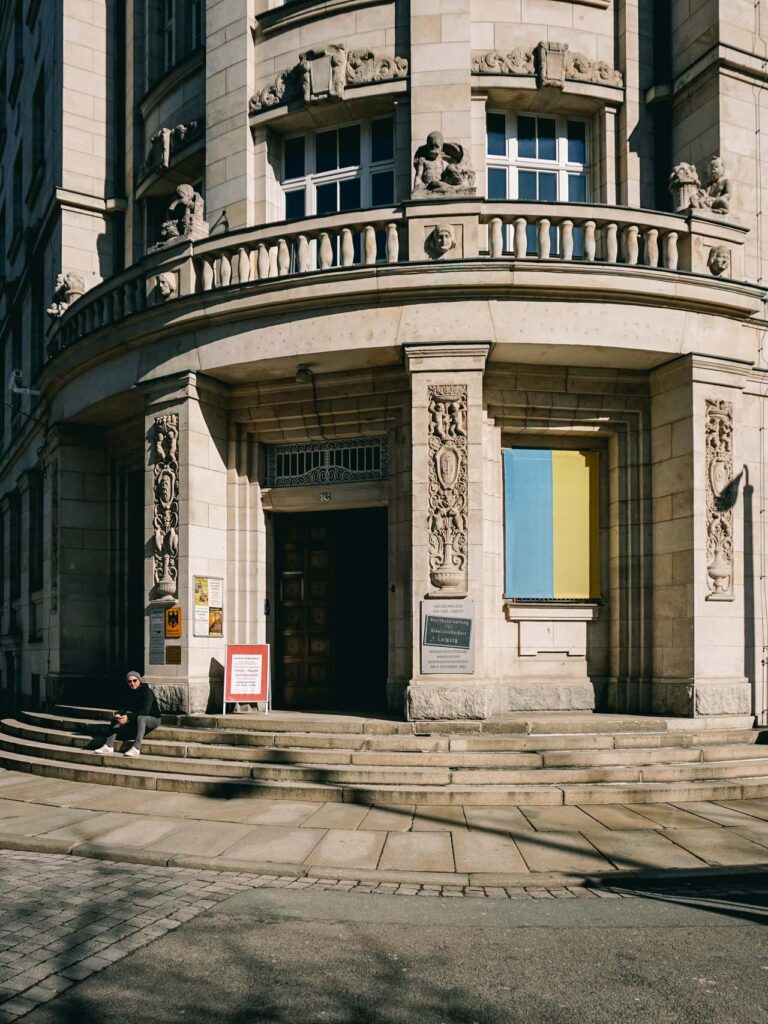
Located at Dittrichring 24, the museum sits on a busy corner of downtown Leipzig. The name “Runde Ecke” comes from the rounded corner of the building, and this appellation reminded me of the Corner House in Riga. It seems that an architectural element could accurately describe the former headquarters and serve as a synonym for an eerie building.
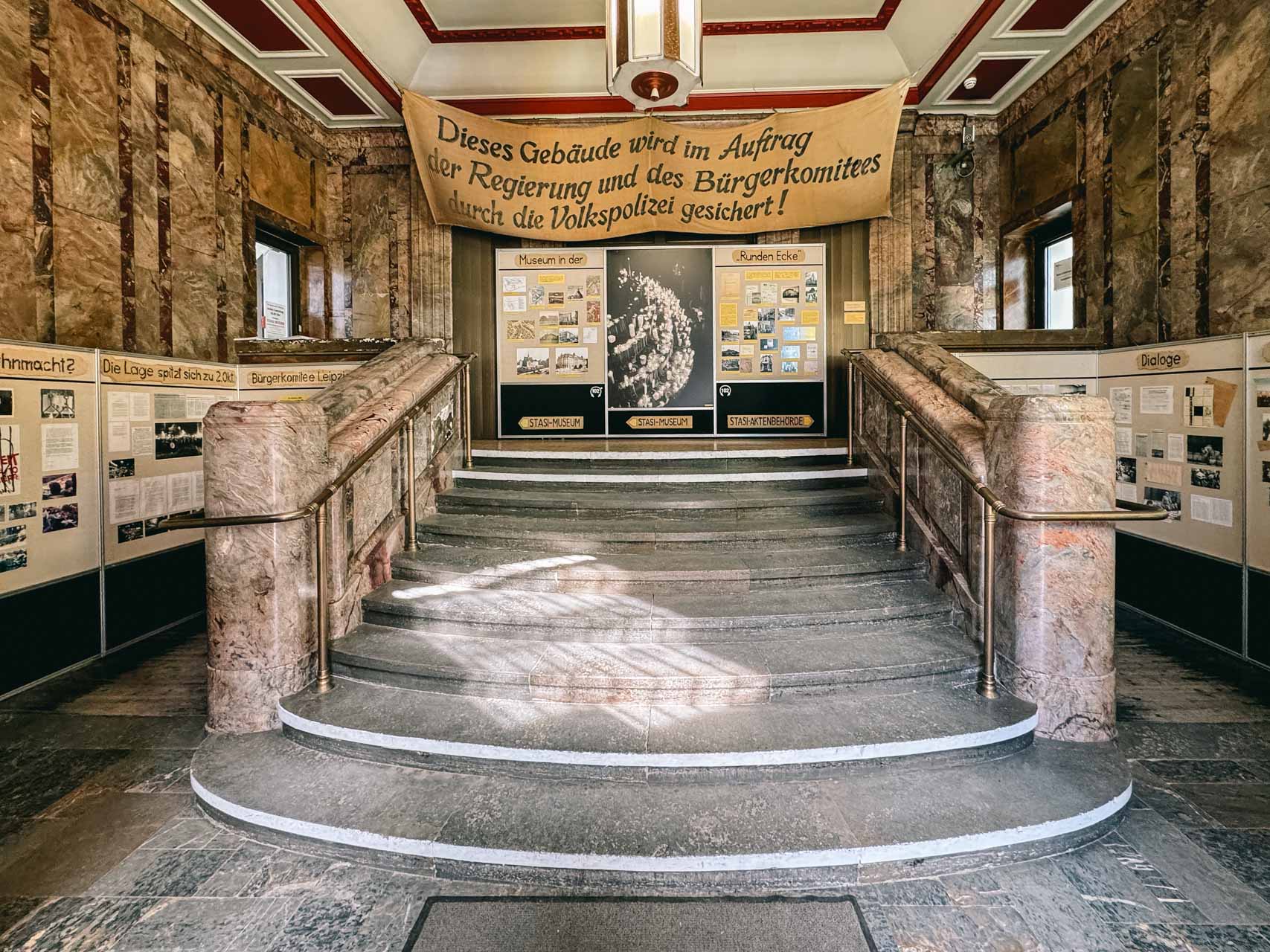
After entering the building, you will see an imposing marble staircase. I could only imagine what it felt like to enter here during the Cold War for an interrogation. While the original details have been preserved, it’s now clear this is a museum, with an introductory display of the former Stasi building in the form of posters on boards.
After taking the stairs, you have to go to the left. That’s the museum entrance, and it’s actually the only floor open to visitors. Although the museum is advertised as free to enter, you must pay 5 euros for an audioguide. Make sure to get one (available in various languages), because without it, you won’t grasp more than 20% of what was really happening at the Runde Ecke.
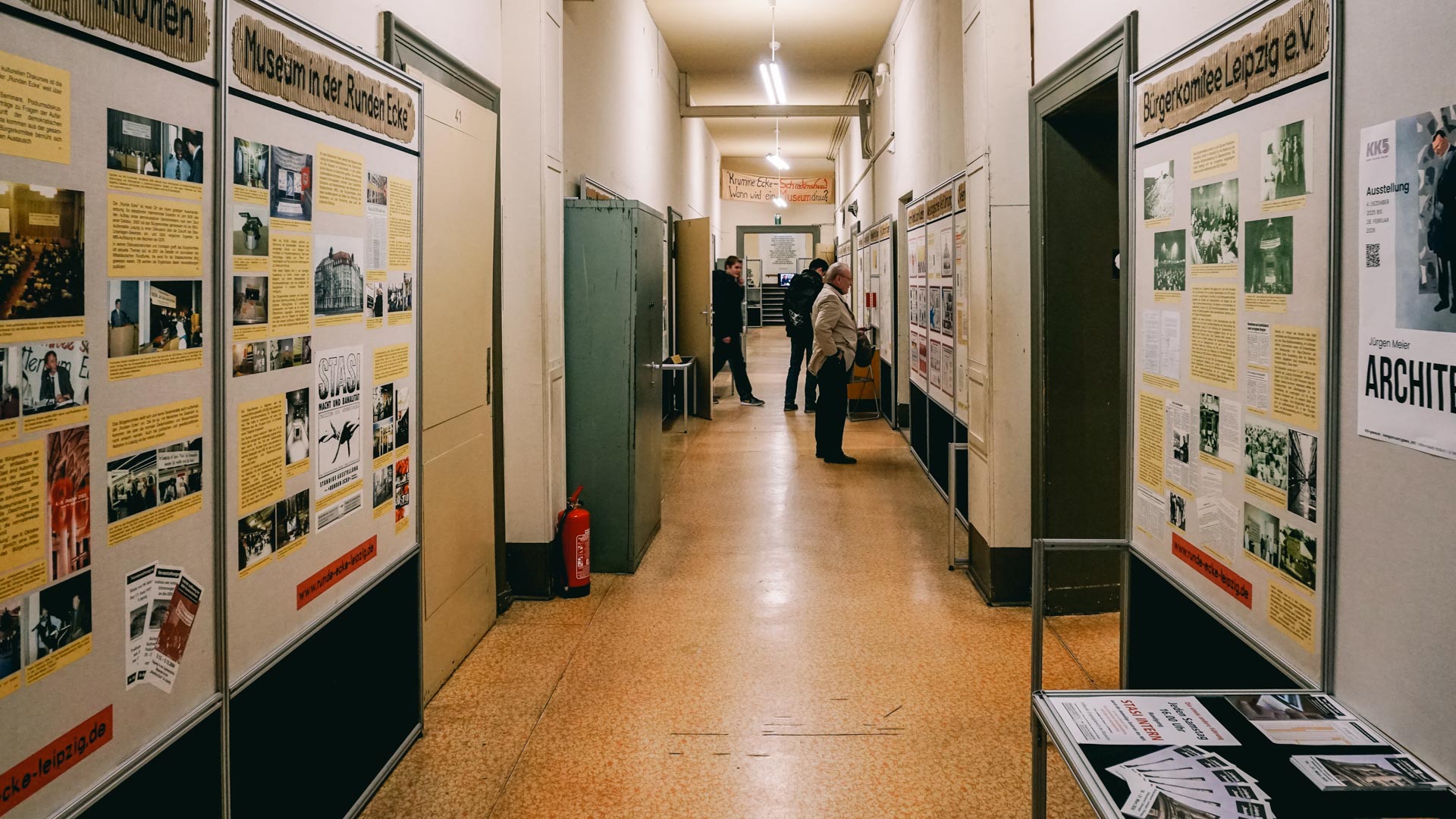
Then you will see a long corridor with various rooms opening to the left and right. And what you will see as you navigate the rooms with your audioguide goes well beyond surveillance. It’s another level of paranoia, which in fact means that you will come across a proper administration structure so neatly organized that it could produce unimaginable levels of intrusion.
How the Stasi intercepted letters
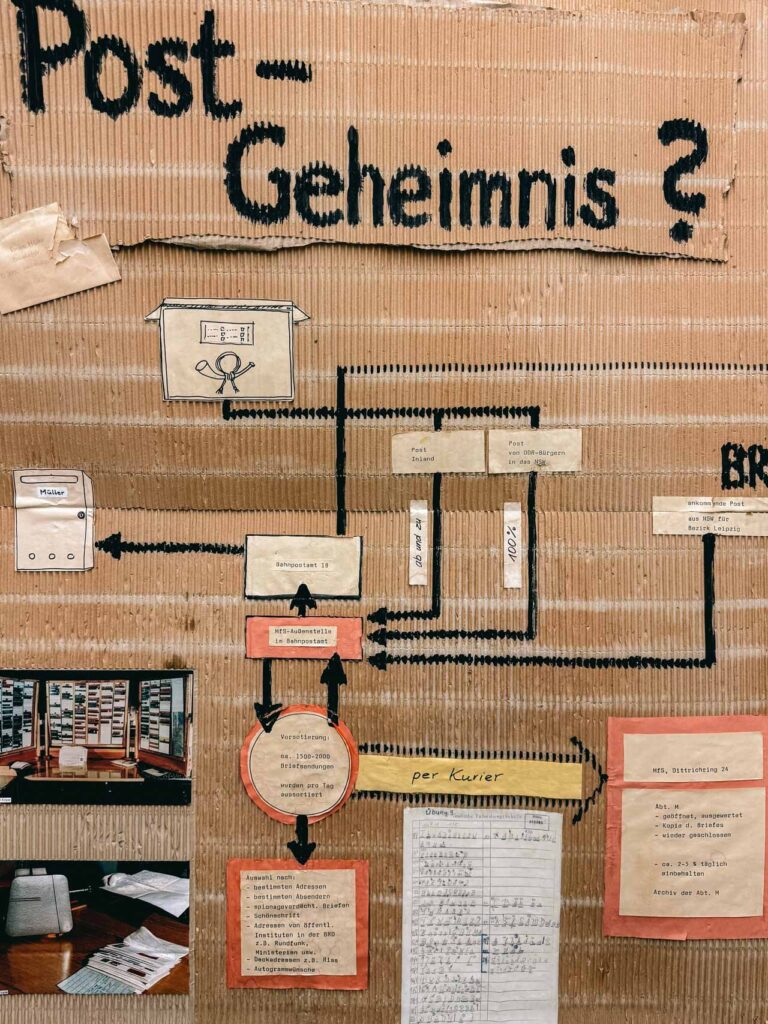
The exhibition contains loads of mind-blowing material. It’s really hard to grasp the insanity of surveillance in Leipzig and East Germany in general. One of the first things that impressed me and showcased how bureaucratic the procedures were was the display of post surveillance.
Within the Stasi, postal control was handled by Department M. As you can see in my photo, the process was far more structured than I initially thought. While only a fraction of the East German post was tracked, every letter to and from the West was monitored. In fact, the letters were pulled from the regular stream, checked, copied, and then delivered. Most of the time, the recipients couldn’t even tell their letters had been opened.
The process followed a strict protocol, as is obvious in the diagram. Selected letters were evaluated by dedicated Stasi staff, who read every single letter from the West. It was Stasi’s way to create extensive maps of contacts, as well as of preferences, habits, and networks. Repetitive work and thorough documentation were actually the way surveillance and control worked. And the letters, in reality, served as file entries for every citizen.
How the Stasi monitored phone calls
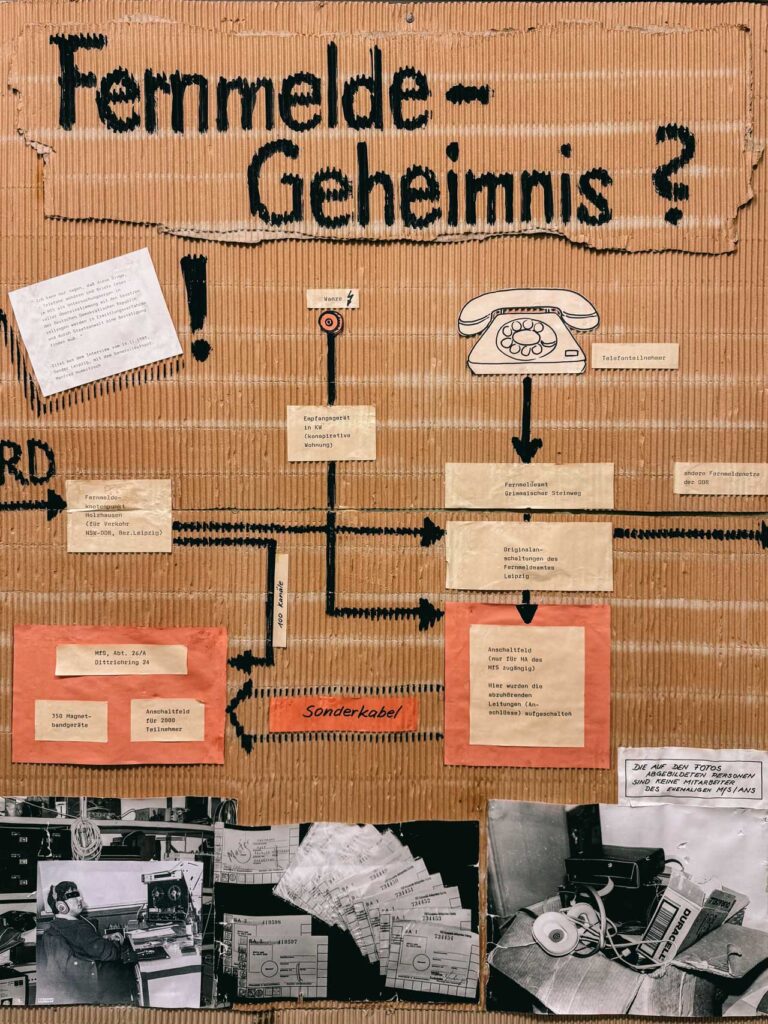
Although the same logic appeared in telephone surveillance, I was actually more impressed by their methods. I often had the image of the Stasi tapping citizens’ telephones and breaking into their apartments. While this might be the case from time to time (and I’ve seen that in movies), the truth is that the process was less cinematic and, once again, more bureaucratic.
Instead of tapping phones, Department 26 of the Stasi in Leipzig took a more infrastructural approach. In fact, the Stasi intercepted traffic at exchanges and network nodes, then fed the information into their monitoring systems. This way, they could track calls without bugs by just getting on the line. Apparently, these calls were always recorded and contributed to the extension of citizens’ files. This was a far more scalable solution, and one that didn’t risk breaking into people’s houses.
That said, instead of recording one telephone at a time, the Stasi could monitor several targets simultaneously by technical routing. The workflow (in which a call enters the system, is routed, and recorded) generated a lot of information. The people of Leipzig probably knew their calls were being tracked, but I believe they didn’t expect the extent of the mechanism.
Geruchskonserven (or how they traced odors)
This was hands down the process that stayed with me the most. It was what I told friends and family after returning from Leipzig, and I must admit that this was the most terrifying part of all. It was terrifying, mainly because of how cruel the workings of the human mind can be.
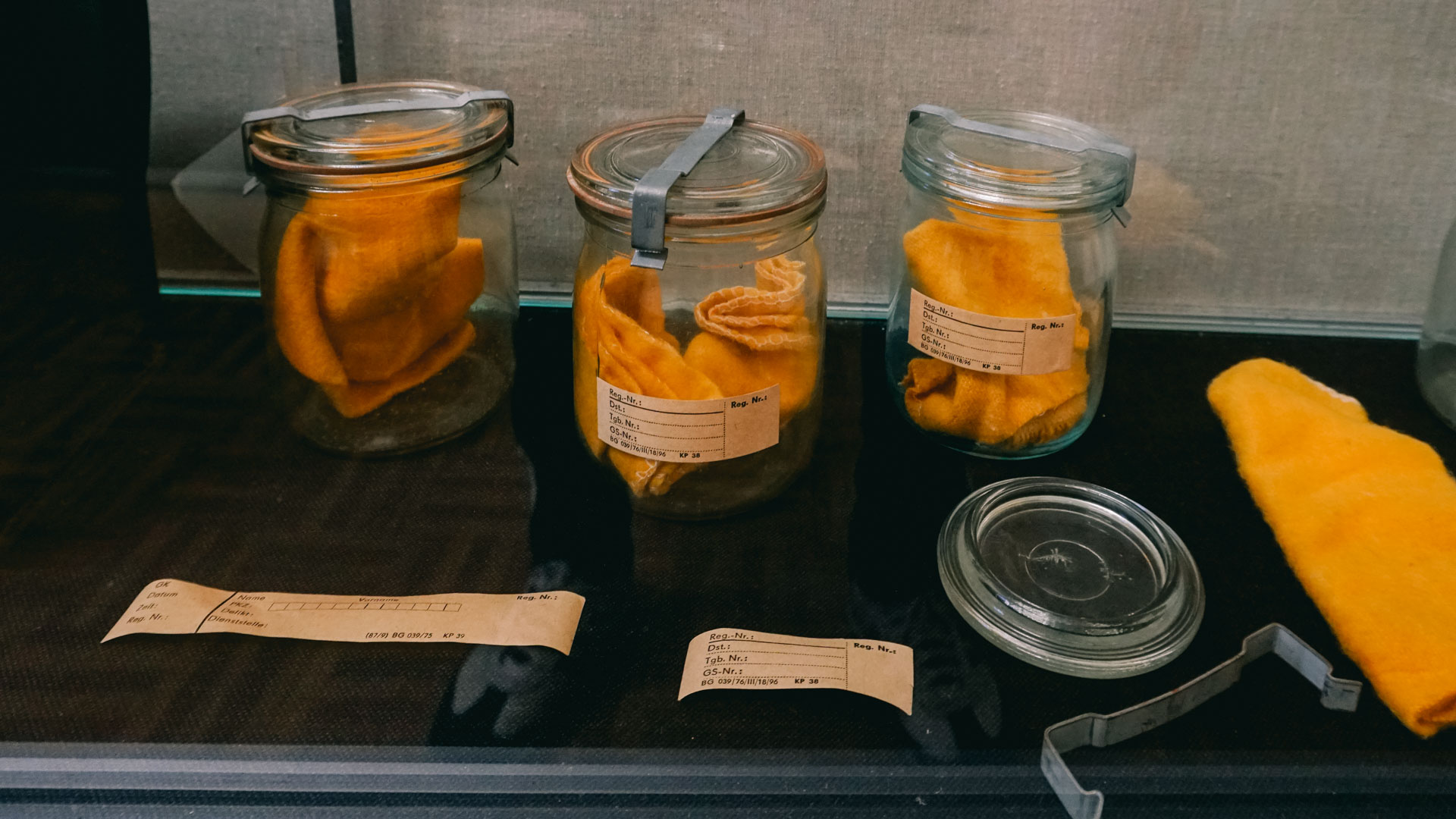
The so-called Geruchskonserven translates to “odor preserves,” or, more simply, “odor jars.” What were these? Well, they served as scent samples, and the Stasi stored them in sealed glass for years. The audioguide (and the exhibition text, which is in German throughout the museum) explains that these samples were another investigative measure. The Stasi assumed the following: each person has an identifiable body odor, and if they could get a sample of it, they could later compare it with traces found on objects or even at locations.
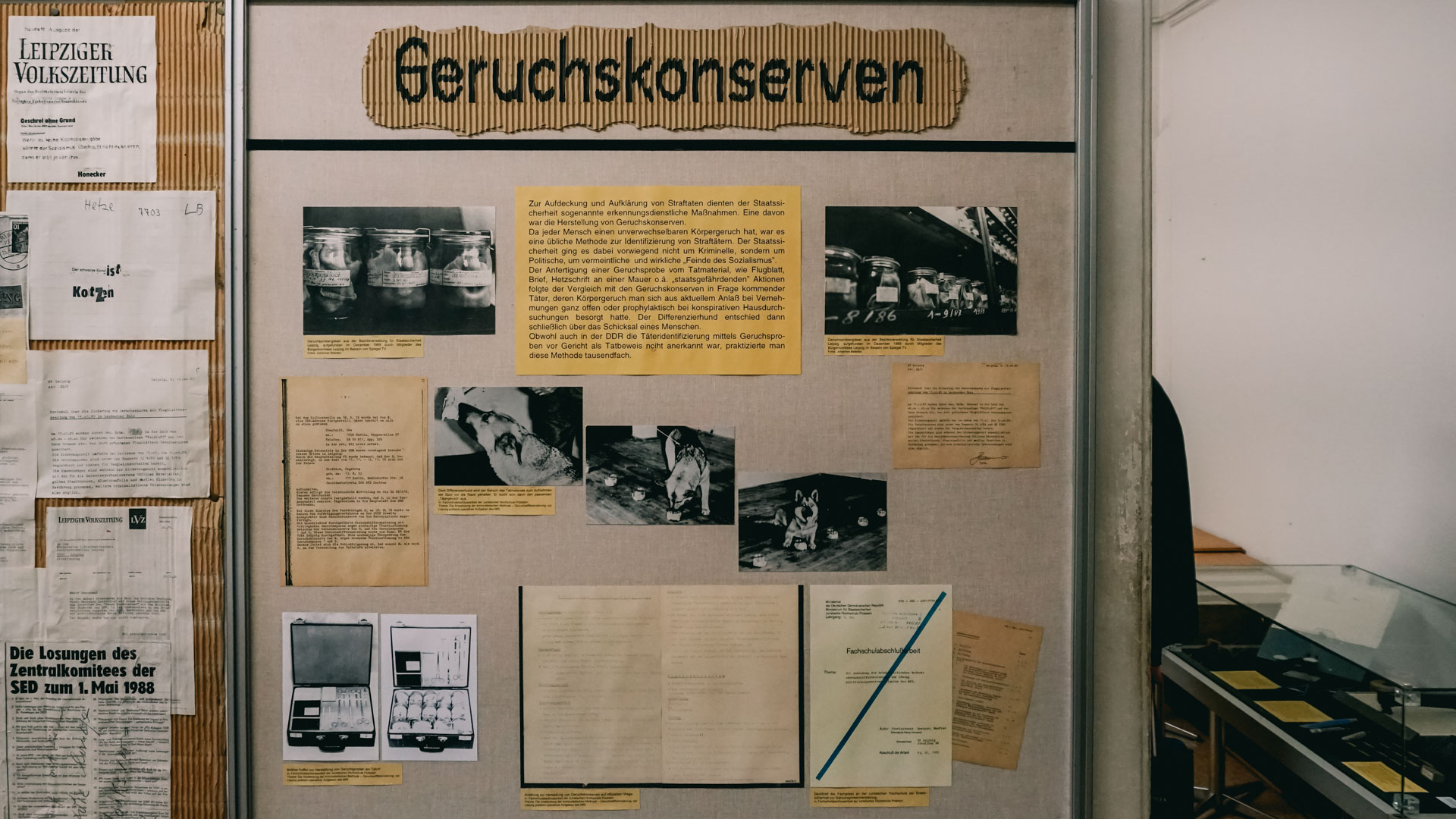
The target was the state’s political enemies. You can see a shelf of jars with clear labels, and inside them are yellow towels. One method (but not the only one) was to place these towels on the chairs of the people being interrogated and have them collect the body odor. One might rightly wonder: how could they use this smell to track down suspects?
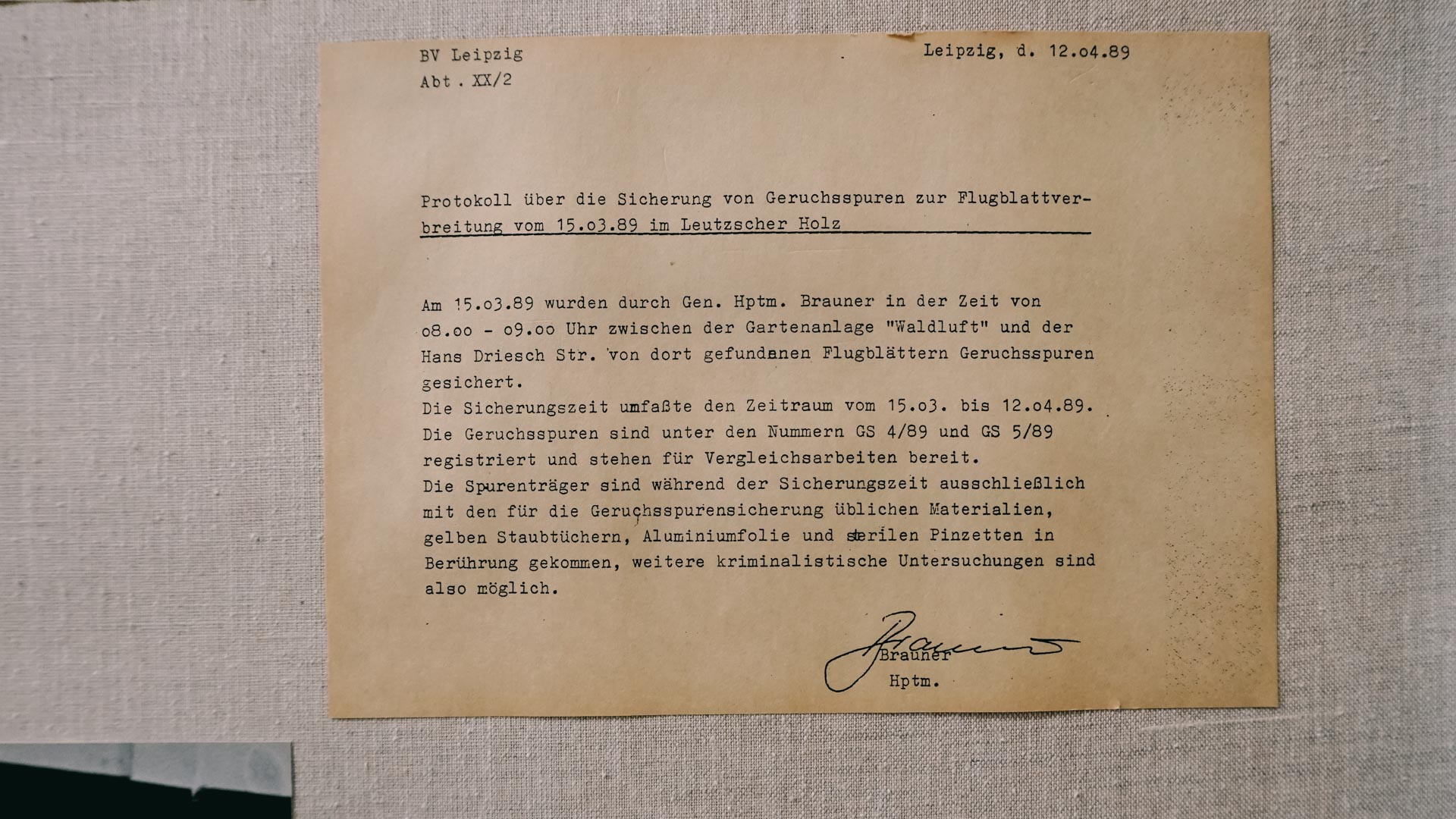
Well, they used trained dogs for this comparison work. In the Stasi Museum in Leipzig, you can clearly see that the method was used during the Peaceful Revolution in 1989, where the Stasi traced the distribution of leaflets.
The Polaroids that caught my attention
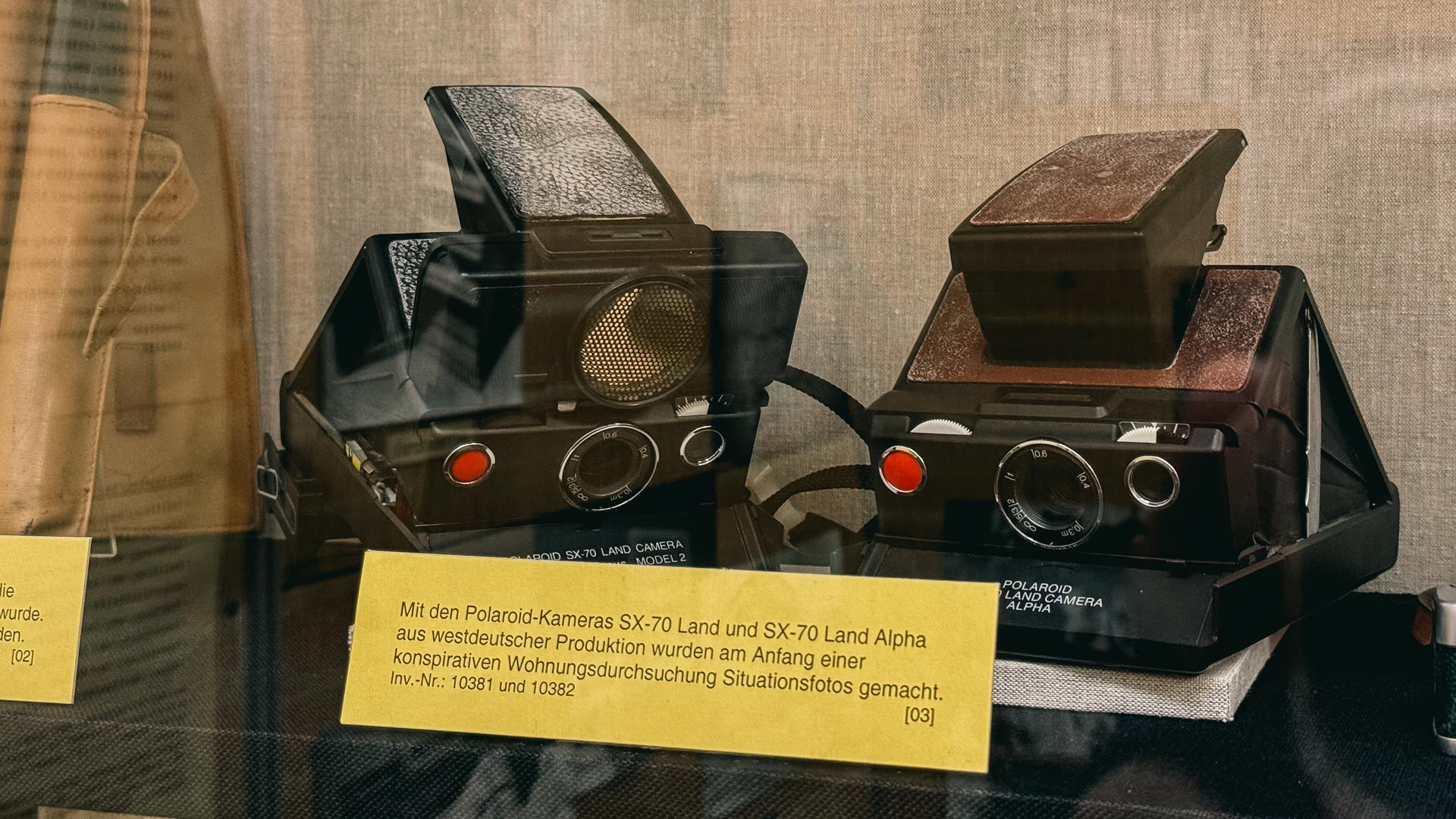
If you are a long-time reader of my blog, you probably know how much I love Polaroid photography. I run my Polaroid Diaries, where I present instant photography from my journeys. Well, in the Stasi Museum in Leipzig, I saw this hobby of mine under a different light.
The Stasi used the beloved Polaroid SX-70 to photograph scenes or even suspects. Two of these SX-70s are exhibited at the Runde Ecke. But here, the instant images turned into documentation. During the Stasi years, instead of an easygoing activity, instant photography became a routine of identification, storage, and file creation. And this reminded me that no medium is inherently innocent: it’s the use that determines whether it is.
Despite not being as impressed as with the Geruchskonverven, the Polaroid cameras are still in my mind. Apart from using them for my travel blog, I could clearly see how everyday objects can serve as the core machinery of power and control.
How the Stasi in Leipzig tried to destroy its own files
It’s impossible to write about every exhibit I saw. But in this part, I want to talk about another aspect that, in another way, seems administrative and bureaucratic.
Archiving material and creating citizens’ files was one thing, but another was destruction. Already from the entrance of the Leipzig Stasi Museum, it becomes clear that the secret police headquarters were occupied by protesters, partly because they wanted to stop the ongoing destruction of records. So, it’s important to understand that the files and records were saved by the people who suffered, and, in my opinion, this gives the entire museum a dramatic tone.
What was fascinating to see was the so-called (take a deep breath) Aktenvernichtungsmaschine Aktema IV. This heavy machine was produced in the GDR and was intended to destroy documents no longer needed. Or, in the light of the 1989 events, to destroy the documents so the citizens won’t have access to them and, therefore, accuse the Stasi of its methods.
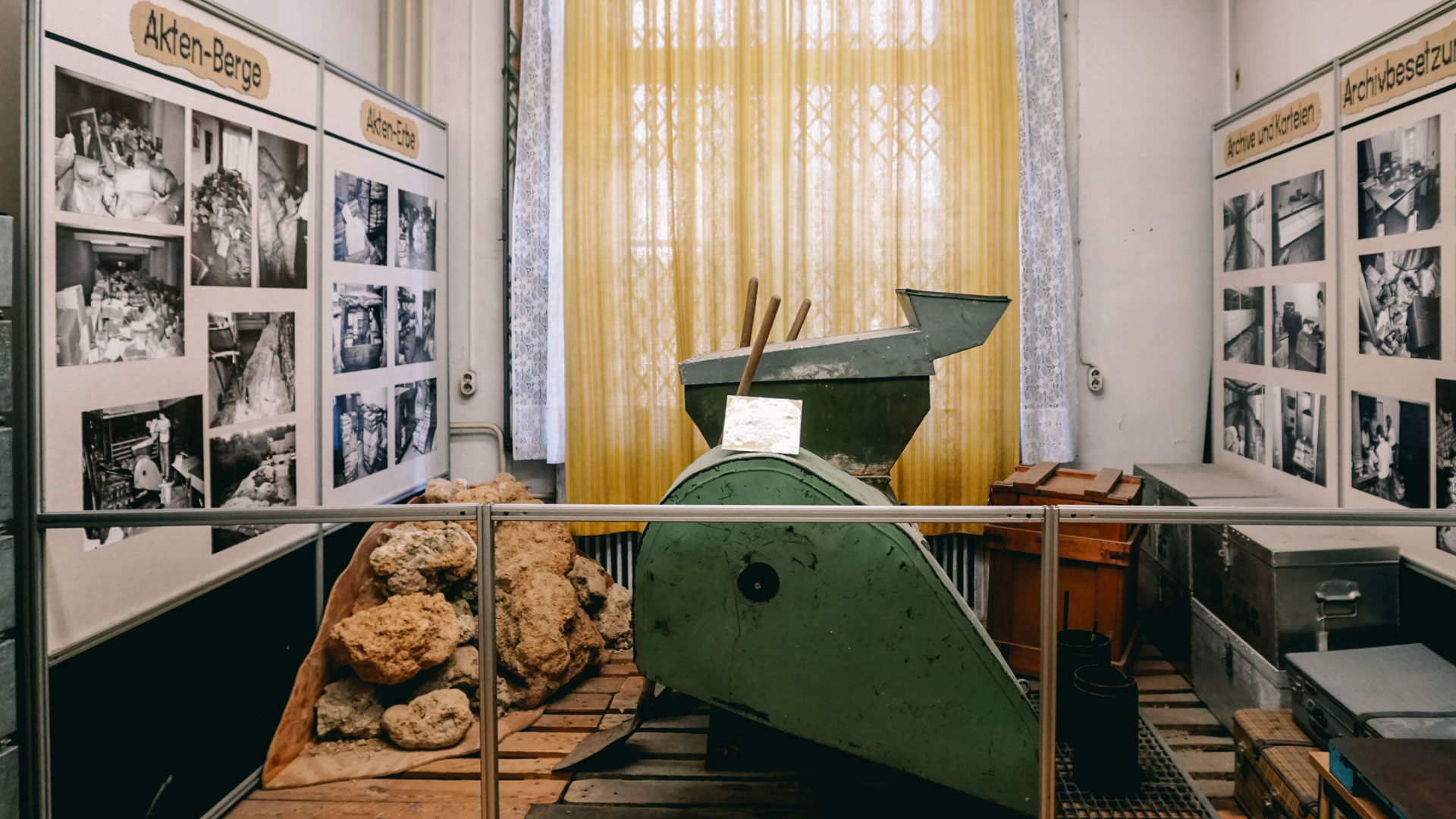
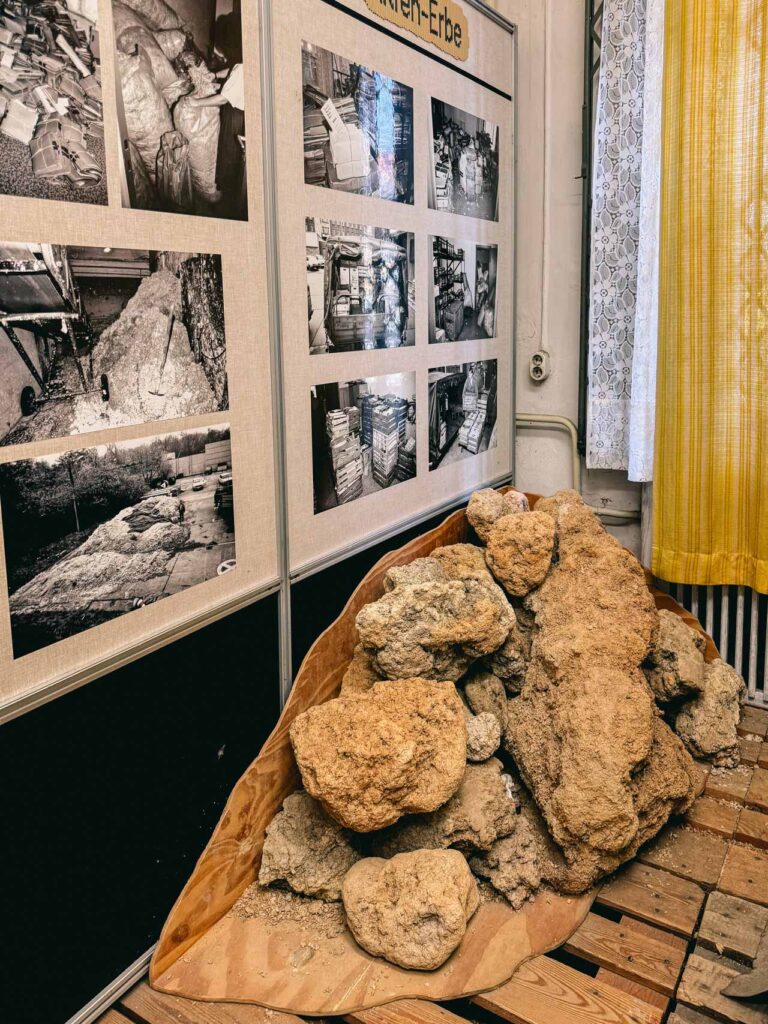
Although the Stasi in Leipzig had the option to destroy the files in the courtyard of the Runde Ecke, they chose not to. Instead, they stored the machine in one of the garages; it was shredding the documents, and by adding water afterward, they turned them into Kollermasse, or coarse pulp. After this processing, the papers resembled muddy stones, and some of them are exhibited in the room.
The detailed process matters a lot in my opinion. They didn’t want to simply tear up the papers; they also wanted to destroy the information completely, leaving no traces or legibility. Once the paper turned into a wet mass, reconstruction was impossible. Names, signatures, relationships, notes, everything that has been built throughout the decades had to be fed into a machine and destroyed.
Practical information for your visit to the Stasi Museum in Leipzig
In this short section, I will share some helpful information for your visit to the Stasi Museum in Leipzig, which is also known as the Runde Ecke. For up-to-date information, please cross-check with the museum.
Admission fees
The entry to the Leipzig Stasi Museum is free. However, there is a 5-euro charge for the audioguide, available in various languages. Make sure to get one, because otherwise you will lose tons of useful information about what you see. I find it a must if you don’t just want to have a look. Plus, you support the museum and its operation.
Opening hours
The museum is open daily between 10 am and 6 pm.
Stasi Museum Tours
The museum offers tours in German at 3 pm every day. For English tours, you should contact the museum. You can find the relevant contact information here.
FAQ about the Stasi Museum in Leipzig
In the final section of this blog post, I will reply to some frequently asked questions about Leipzig’s Runde Ecke. If you have more questions, please leave a comment at the bottom of this article, and I’ll do my best to assist you.
Is the Stasi Museum in Leipzig worth visiting?
Yes. Period. If you are interested in Cold War history and the backbone of surveillance, the Stasi Museum is a must-see in Leipzig. It shows how control and surveillance operated through documents, postal interception, phone monitoring, and everyday bureaucracy and administrative workflows.
How long does a visit to the Stasi Museum in Leipzig take?
If you just want a general impression, you can see everything in well under an hour. It’s a small museum set on the ground floor of a historic building. However, if you’d like to understand what you see, hear the audioguide descriptions, read the texts, and look closely at the objects, I’d recommend at least two hours.
How did the Stasi intercept letters?
Briefly, the Stasi used postal control units and interception points within the mail system. They removed selected East German letters and all the letters coming from the West from the normal flow. They opened them, read them, copied and resealed them to reach the final recipient. The recipients usually didn’t notice that their letters were opened, but, well, they always suspected it.
How did the Stasi tap phone calls?
Briefly again, the surveillance occurred at the level of the telecommunications network, not by bugging devices inside homes. The Stasi in Leipzig routed the calls through nodes and listened to or recorded the conversations.
Why did the Stasi destroy files in 1989?
When the regime began to show signs of collapse, the files became dangerous for the Stasi because of the documents, surveillance networks, and methods they used. They attempted to destroy them to erase evidence that could hold them responsible for their actions in the future.
Can I combine the Stasi Museum with other sights in Leipzig?
Yes. The Runde Ecke is centrally located on the eastern edge of the historical center. Leipzig is a walkable city, and it’s pretty easy to combine with the most important sights. You can read my Leipzig travel guide for more information.
The Stasi Museum in Leipzig: Final Thoughts
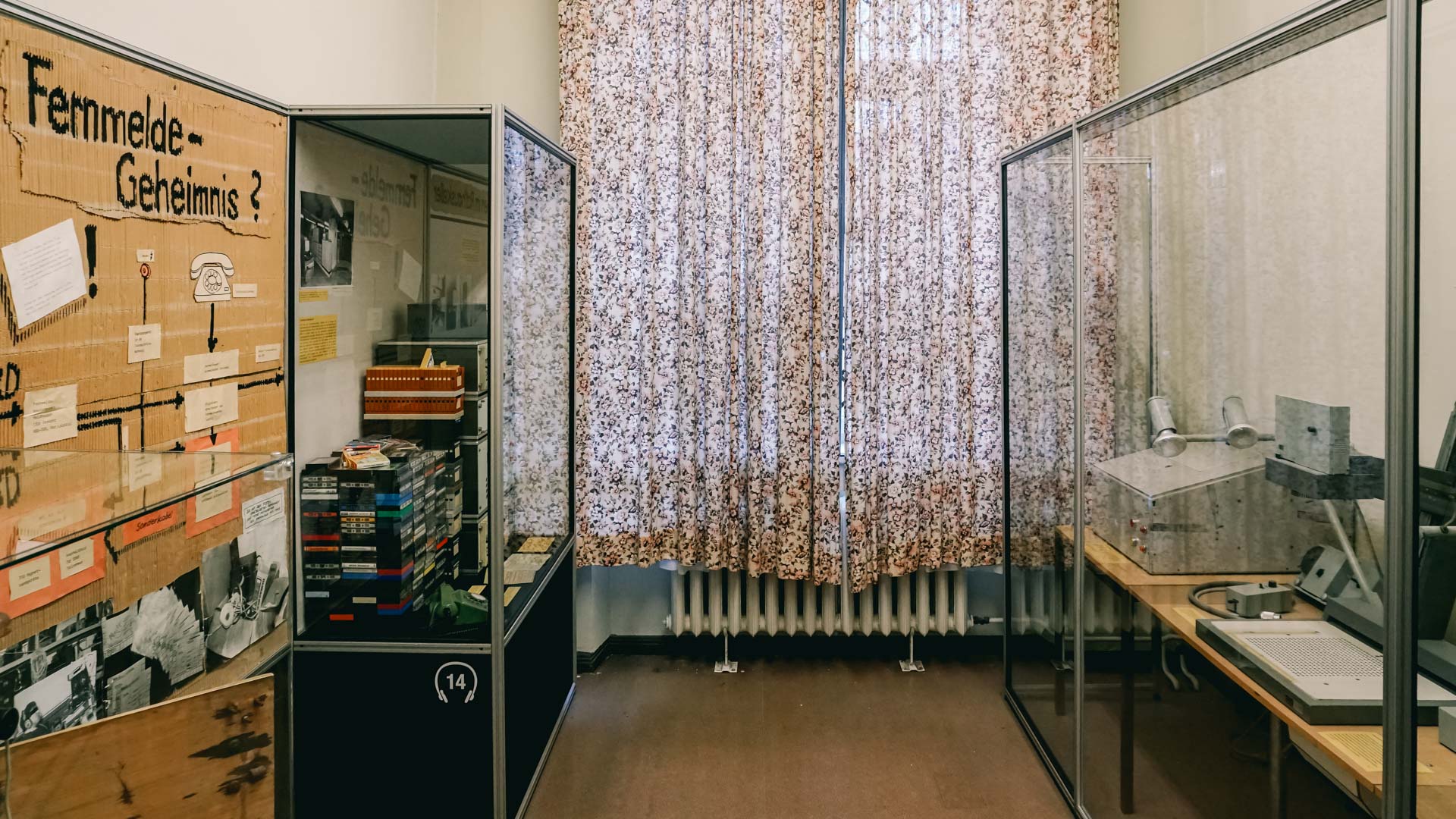
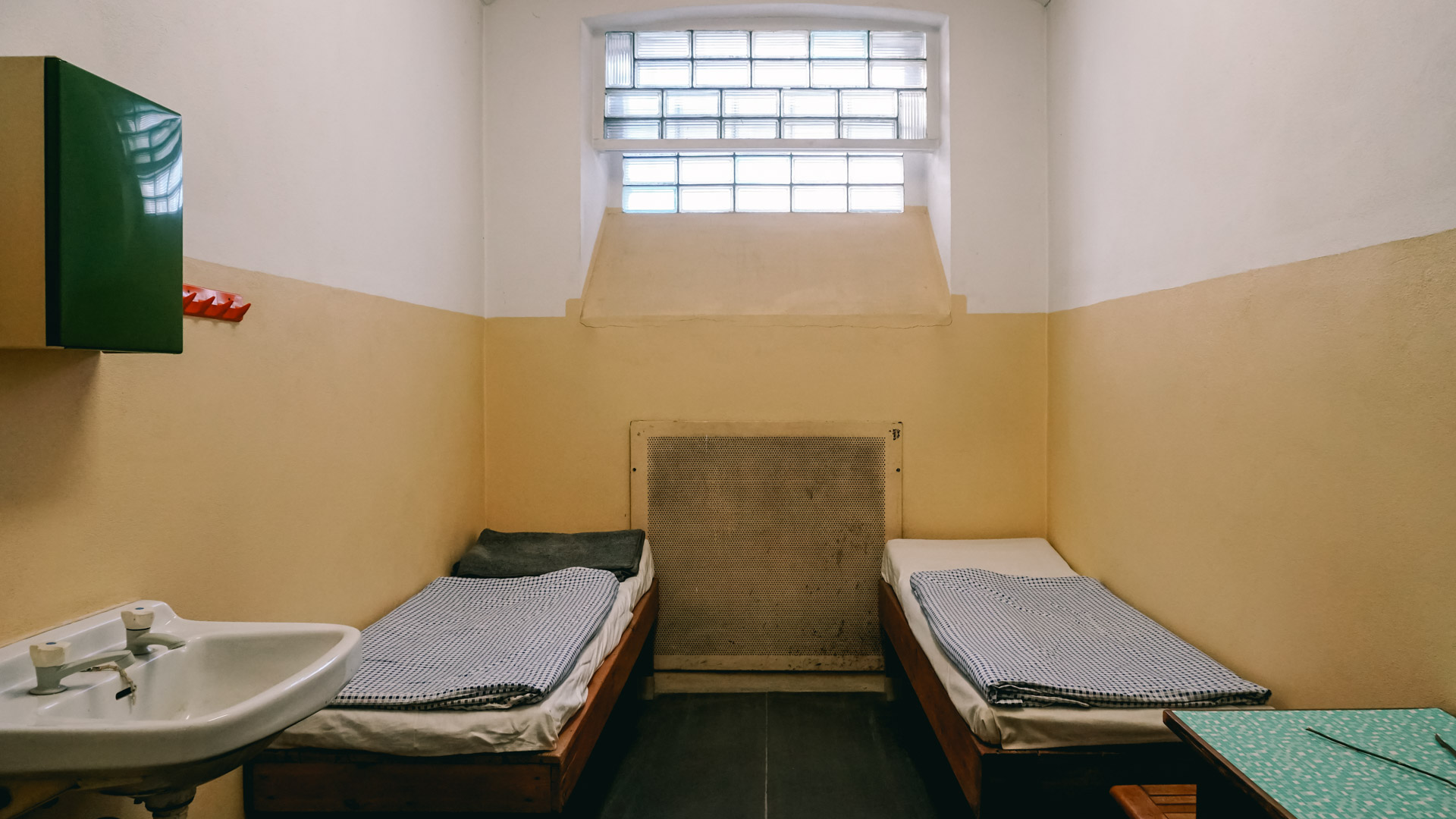
The Stasi Museum in Leipzig is one of those places that I always want to visit when I travel. Apart from dealing with contemporary history, the Runde Ecke offers, in plain sight, the practices of the Stasi, while also helping you be part of the story. I felt that I wasn’t just a visitor to the exhibition but someone who tried to navigate the bureaucratic nightmare that the secret police of East Germany had created in Leipzig, consisting of scent jars, prison cells, archives, surveillance methods, and diagrams.
As more and more details come to light from this dark period, the museum’s importance grows. It is unsettling to see how a regime tracked its citizens, and what you will get straight after entering the museum is how control doesn’t always announce itself. It’s a slow process, or even an administrative workflow. The Runde Ecke is a dark yet memorable political setting, and what I also saw up close was the final days of a regime and its panic to destroy evidence.
For me, these are enough reasons to add a visit to the Stasi Museum in Leipzig to my list of top priorities when in town. Leipzig, the city where the Peaceful Revolution started, shines under a different light after a visit to the Runde Ecke. And therefore, the museum’s purpose succeeds: after two hours in its interiors, it becomes very clear what the citizens of Leipzig were resisting and why they didn’t want the Stasi to destroy the files and just walk away.
More about Leipzig: What to see and do in Leipzig
Pin it for later
Sharing is caring. Share this article about the Runde Ecke in Leipzig with your friends.