

Last Updated on May 10, 2025 by George Pavlopoulos
One of the most iconic temples of the Golden Age of Athens is located at Attica’s southernmost tip. Cape Sounion (Greek: Σούνιο) is home to the world-famous Temple of Poseidon, a landmark that inspired poets and philosophers. Located on an impressive hill and offering breathtaking sea views, the temple is a must-see for your journey. Therefore, if you plan to visit Athens and would like to go on a short excursion out of the city, a day trip to Cape Sounion is one of the best things to do.
In this article, you’ll find 10 interesting facts about the Temple of Poseidon at Cape Sounion and several photos. Moreover, I’ll show you how to reach Cape Sounion, either on your own or as part of a guided tour. Finally, I’ll include a short section at the bottom of the post with the nicest hotels in the area. So, navigate through the article’s sections and learn everything you need to know before visiting Cape Sounion.
Let’s start.
*Some of the links are affiliate links. It means that if you buy something, I might earn a small commission at no additional cost to you.
10 Key Facts about the Temple of Poseidon at Cape Sounion
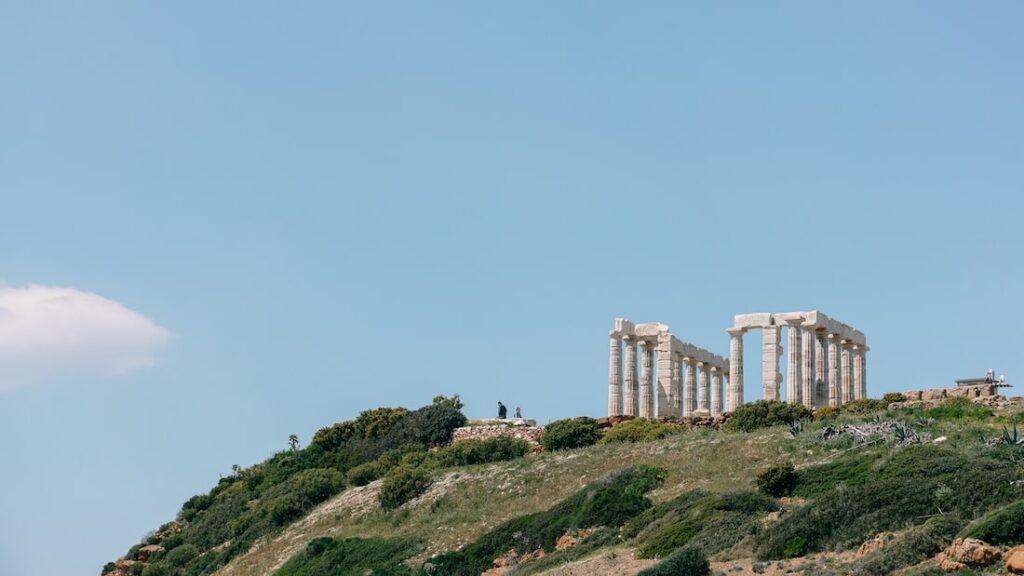
Greece is full of awe-inspiring antiquity landmarks, and Poseidon’s Temple at Cape Sounion is among the most visited ones. So, let’s discover some key facts about the Temple of Poseidon that will give you a better overview of its significance.
Where exactly is Cape Sounion?
Cape Sounion is approximately 70 km (43 miles) away from Athens. It is the southernmost tip of the Attica region, which also includes the Greek capital. It will take approximately one hour to reach Cape Sounion from downtown Athens (but more on that later). You can see the exact location on Google Maps here.
Cape Sounion is also close to Lavrio, an ancient city that still exists today. Lavrio is just 8 km (5 miles) away from Sounio, and during Greek antiquity, it was famous for its silver mines. A fair amount of ancient Greek coins were created from Lavrio’s silver.
When was the Temple of Poseidon at Cape Sounion created?
According to historians and archaeologists, the Temple of Poseidon was constructed between 444 and 440 BC. However, this wasn’t the first temple on-site. In the late archaic period, a monumental temple was under construction at the same spot. Unfortunately, that temple was destroyed during the Persian Wars before its completion. The Temple of Poseidon that we see today was erected at the same location under Pericles.
What’s the order of the Temple of Poseidon at Sounion?
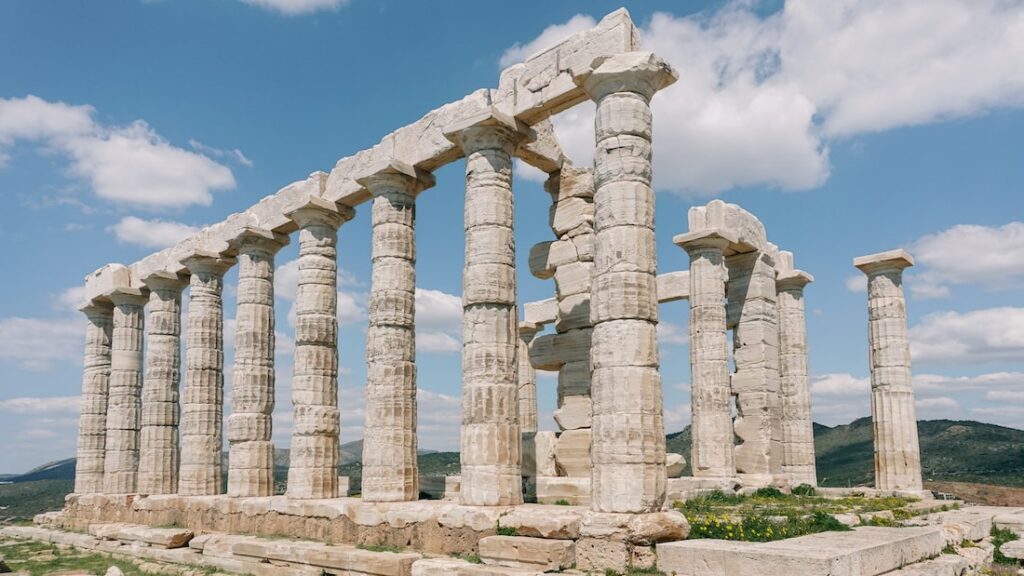
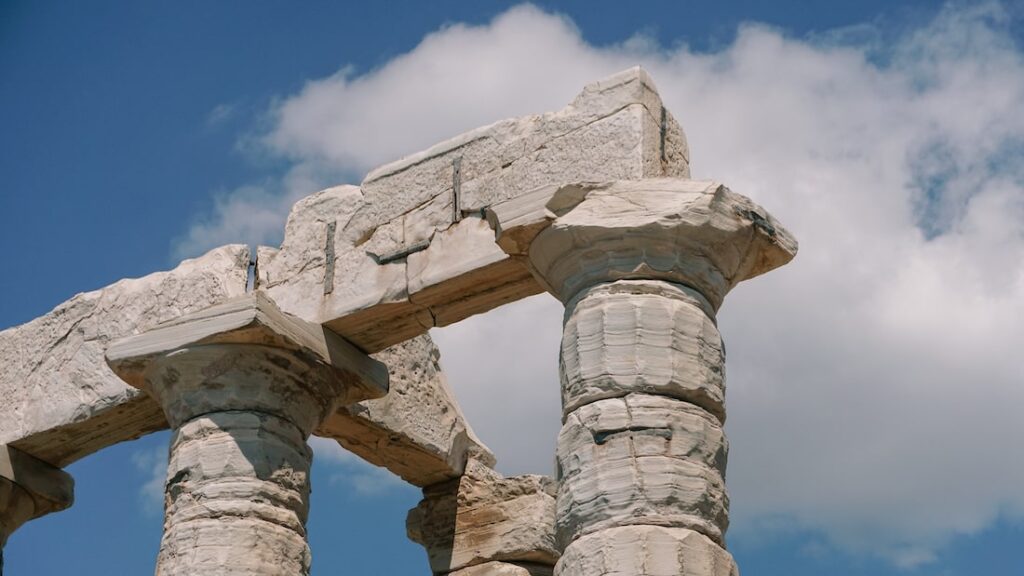
The Temple of Poseidon at Sounion follows the Doric order. Its simplicity is still impressive and, together with the view from the promontory, creates a stunning location. As for the temple’s material, the Athenians used Agrileza marble. Agrileza is an area close to Lavrio, and during ancient times it was famous for its marble quarries. The ancient road of marble transportation and the Agrileza marble quarries are still in good condition.
An interesting fact about the Temple of Poseidon is that it was built on top of an archaic temple. That’s relatively uncommon for ancient Greek temples. However, the old temple’s material was limestone.
What did the Temple of Poseidon look like?
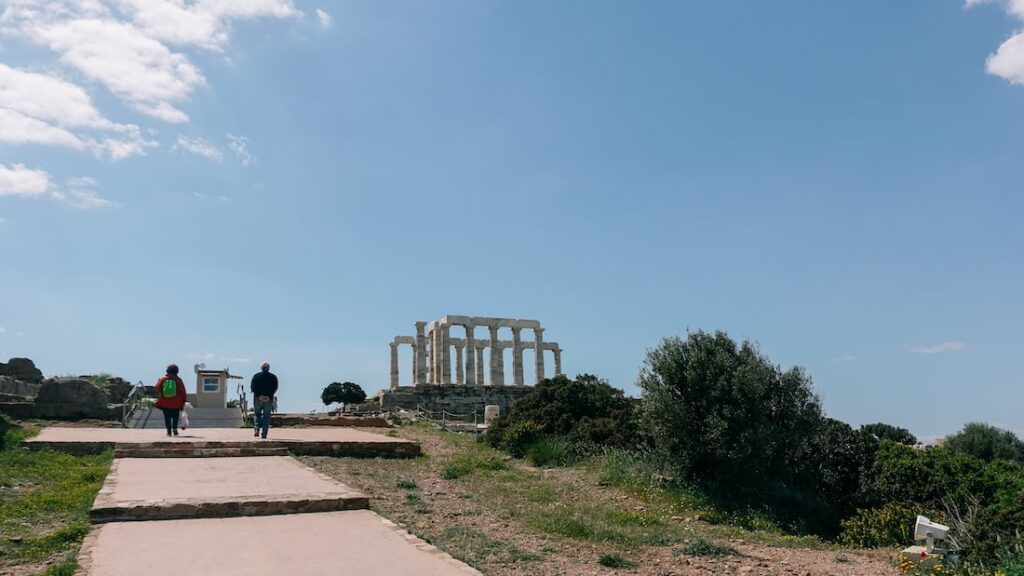
The Temple of Poseidon at Sounio has 6 columns on the short side and 13 columns on the long. Of the 34 columns of the original temple, only 13 survive and are still in place. Inside the temple, there was an impressive statue of Poseidon, the god of the sea. It was probably 6 meters tall (20 ft). Last but not least, the frieze (made of Parian marble) depicted scenes from the legends of Theseus.
What’s the connection between Theseus and Cape Sounion?
That’s one of the most important ancient myths. Theseus was the son of Aegeus, the famous king of Athens. Theseus was sent to Crete to kill the Minotaur, a mythological monster living in Knossos. The agreement between Theseus and Aegeus was that if Theseus killed the Minotaur, he should replace the black sails of his boat with white. So, if Aegeus could see the white sails from Cape Sounion, he would know that the monster was dead and his son alive.
Theseus managed to kill the Minotaur, but he forgot to replace the sails. From Cape Sounion, Aegeus saw the black sails of the boat approaching in the distance. He falsely believed that the Minotaur killed his son in Crete. Unable to cope with the loss, he committed suicide and fell into the sea from Sounion.
Athenians named the sea he suicided after him. And that’s how the Aegean Sea got its name.
Why did the Athenians choose Cape Sounion for the Temple of Poseidon?
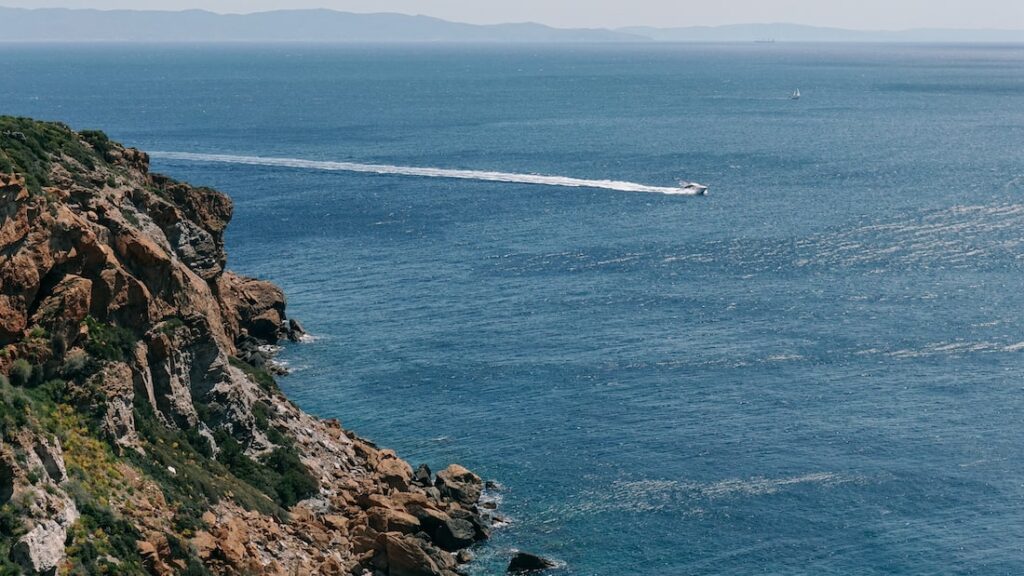
There’s a lot of speculation on that. It’s probably a mixture of political, religious, and sentimental reasons. Cape Sounio was the last piece of land when the Athenians departed by boat and the first to see when they returned. However, there were also more practical reasons that dictated this choice.
The temple’s placement likely had to do with the politics of the time. Cape Sounio was an excellent point of surveillance of the era’s naval traffic. It could be easy to observe potential threats but also the economic activity. The tension with nearby islands like Aegina was a reason for remaining vigilant.
There was also the religious aspect. A famous theory claims that the Temple of Poseidon in Sounion, the Temple of Aphaia in Aegina, and the Hephaisteion in Athens form an isosceles triangle. Supposedly, ancient Greeks observed the movements of celestial bodies and built their sacred places. There are plenty of stories about it, but nothing has been proven yet.
Was there a settlement at Cape Sounion?
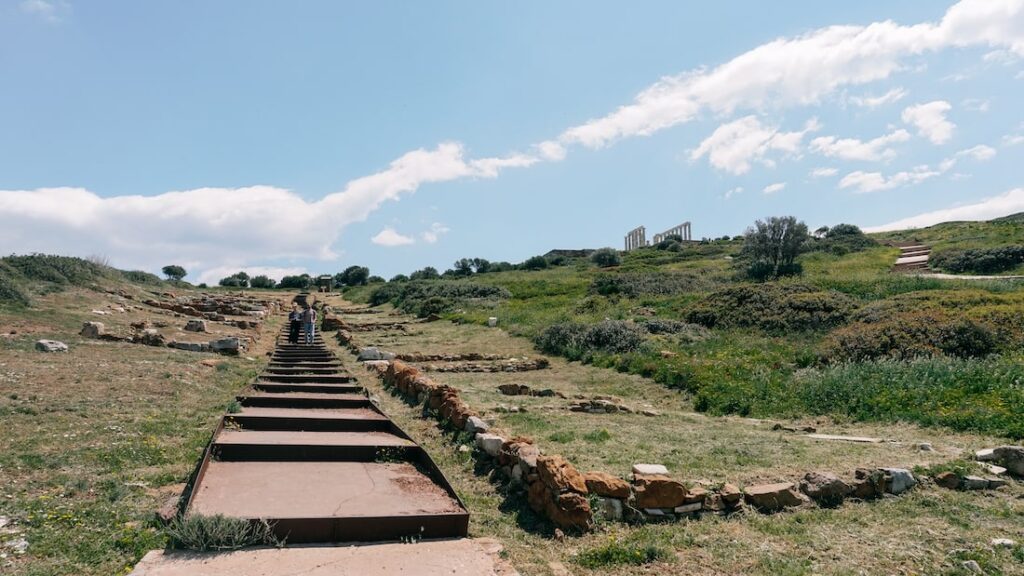
Cape Sounion was fortified, and the walls are still visible today. Inside the walls and close to the Temple of Poseidon, you can still trace a settlement. Even though there’s not much left, you can see a street almost 100 meters long, and on both sides, the ruins of houses are visible. After excavations, archaeologists assume that this was the center of the Sounion deme.
Why are there names engraved on the temple’s columns?
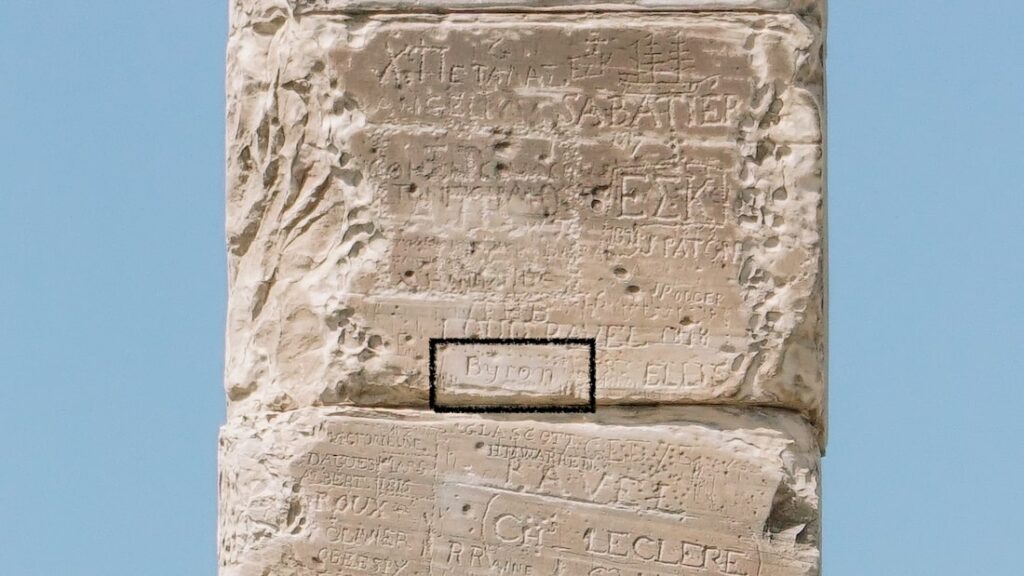
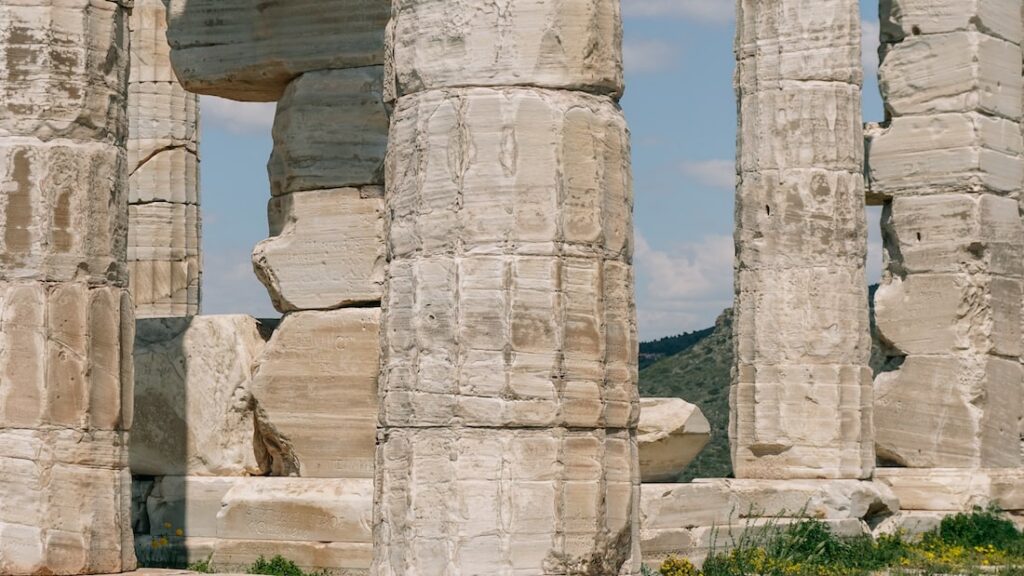
Even though you can’t walk through the Temple of Poseidon, a closer look will surprise you: there are loads of inscriptions on the columns. Specifically, the marbles are carved with names and dates.
It seems that foreign travelers to Greece assumed as exotic the spectacle of an ancient temple in front of the open sea. In order to declare their presence (or vanity?), they engraved their names on the columns. There are plenty of engraved names and among them is also the name of Lord Byron. A prominent figure in the Greek War of Independence, Byron wrote his name on Greek history books -and on the Temple of Poseidon in 1810.
Where is the Temple of Athena Souniados?
Approximately 350 meters away from Poseidon’s Temple and on a much lower hill, there was a temple dedicated to the goddess Athena. Built back in 47o BC and demolished in the 1st century AD, there isn’t much to see from the Temple of Athena nowadays.
What is the earliest literary reference to Sounio?
It doesn’t come as a surprise that the first literary reference to Sounio is in the Odyssey. Homer narrates the Greeks’ return from Troy, and Menelaus, the King of Sparta, stops at Sounio to bury one of his companions. Homer describes it as “Sounion, the sacred cape of Athens.”
Practical info for your visit to the Temple of Poseidon and Cape Sounion
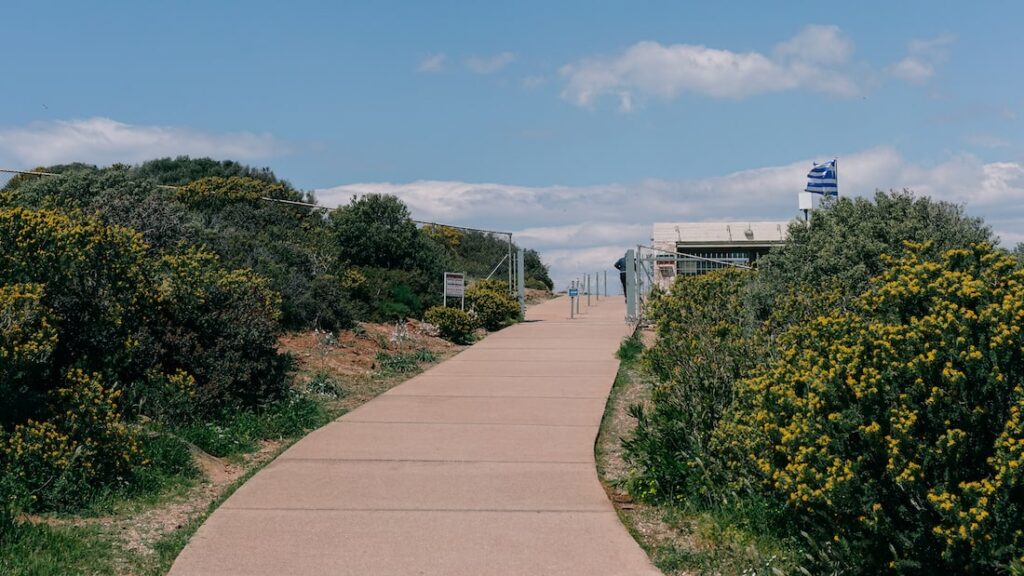
Before continuing to the guided Sounio tours, in this section you can find some practical info for your Temple of Poseidon visit.
Opening hours
The archaeological site of Sounio is open daily between 9:30 and sunset time. Yes, sunset time is closing time, so if you visit in winter, expect shorter opening times. The last admission is 20 minutes before closing/sunset time.
Admission fees
The regular ticket costs 10 euros and the reduced costs 5. However, all visitors pay the reduced ticket between November 1st and March 31st.

Guided tours to Sounion and the Temple of Poseidon
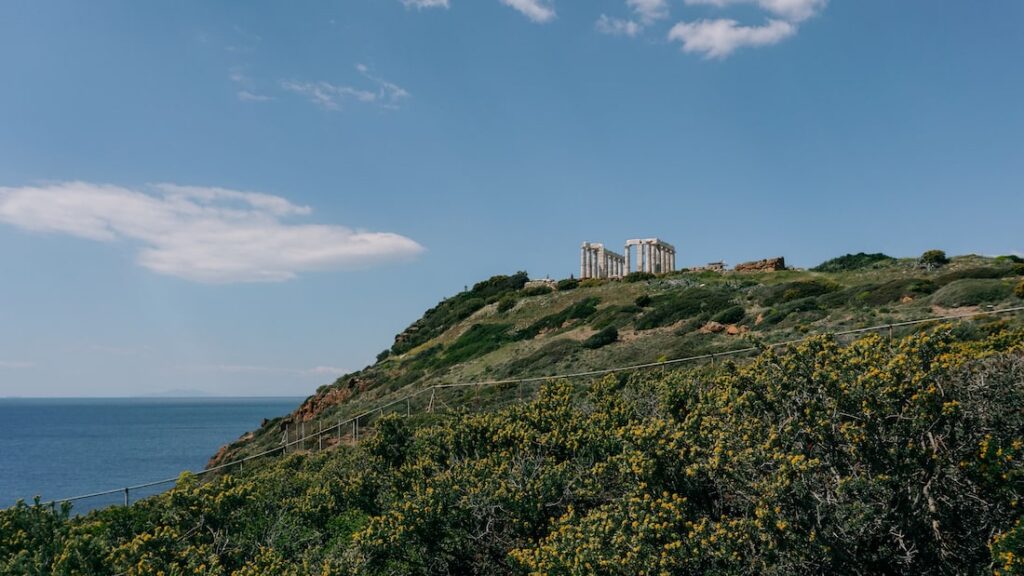
Several tour operators offer a variety of trips to Sounion. Most guided tours are half-day trips, and just a couple are full-day trips. So, in this section, you will find my handpicked selection of guided trips to Sounion and the Temple of Poseidon.
Athens Sunsets Tour to Cape Sounion and the Temple of Poseidon
Greeks claim that the best time to visit Sounion is at sunset. Indeed, the sun sets in the sea, and the colors of the sky are beautiful. Plus, the Temple of Poseidon is still open. On a clear day, you can see all the nearby Greek islands. And the sunset tours to Sounion also have a plus: you can spend the day exploring downtown Athens and then see an incredible sunset.
Most of the sunset tours to Sounion last 4 to 5 hours. Depending on your budget and travel style, here are the best sunset tours to Sounio.
The most affordable sunset tour. It costs 39 euros, but admission fees are not included. The tour departs from Halandri Metro Station.
The small group sunset tour. The small group tour costs 56 euros, but you’ll also have to pay for admission. However, if you prefer smaller groups, that’s a great option: it’s a tour for up to 10 people, and it’ll pick you up from your hotel. Finally, you’ll also have the opportunity to swim on a nearby beach (depending on the season, of course).
The private half-day tour. That’s a great half-day sunset tour to Sounio for groups. The cost is 245 euros per group, and your driver will pick you up from your accommodation in a Mercedes car. Entrance fees are not included.
Regular tours to Sounio and the Temple of Poseidon (with a guide)
Now, while many people prefer to enjoy the sunset time, others would love to have a guide narrate everything about the location. Therefore, in this subsection, you’ll find the best tours to Cape Sounion with a guide.
The best tour for antiquity lovers. This 4-hour tour to Sounio will pick you up from your hotel in Athens and drive you to Cape Sounion. A professional guide will provide lots of info about the Temple of Poseidon and the area. The tour costs 38 euros, and admission fees are included. A true bargain.
Alternatively, make sure to check out also this half-day tour; it offers the same services, but is slightly pricier.
Other tours to Sounio
As always, some pricier tours offer a fuller experience. The tours mentioned in the following lines are full-day trips to Sounio, extending beyond visiting the Temple of Poseidon. If you can afford their prices and you’d like to have a unique experience in Greece, check them out.
Private tour of classical Athens (and Cape Sounion). As its name suggests, this is more than just a trip to Sounio. In fact, this private tour will pick you up from your hotel in Athens and drive you to every Greek antiquity landmark. The places you’ll visit include Hadrian’s Gate, the Acropolis of Athens, the Kallimarmaro Stadium, the Archaeological Museum, etc. Afterward, you’ll drive along the Athens Riviera and reach Cape Sounion. No doubt, that’s a fantastic day trip from Athens. It currently costs 199 euros and admission fees are extra.
Private rib cruise to Poseidon Temple at Cape Sounion. If the weather is fair, it doesn’t get more unique than this. Apart from visiting the Temple of Poseidon, you’ll have the option to visit some of Athens’ uninhabited islands, like Arsida or Patroklos on a private cruise. Swimming, snorkeling, or just relaxing it’s up to you. The price is all-inclusive (fees, transfers, snorkel equipment), and it’s per group. Check it out.
Visit Cape Sounio independently
The guided tours to Sounio are an excellent option for people who are not willing to deal with Athens’s (often chaotic) public transport. A limited number of buses travel between downtown Athens and Sounio, but their accuracy is questionable.
The buses depart from KTEL Attikis at Patission Avenue (see the station on Google Maps) at 10:30 and 14:30 and return from Sounio at 13:30 and 17:30. Please cross-check the itineraries here (you need to check the section Αθήνα-Σούνιο) because they might change at short notice. If you lose the last bus, the only other option is the taxi, which will be pricier than most guided tours.
If you feel comfortable driving abroad, a far better option is to rent a car. This might make more sense if you plan to explore more places in the Attica region, like the Eleusis Archaeological Site. I recommend checking Car’n’Motion: it aggregates the prices of dozens of car rentals and gives you the best prices. You can find the most affordable prices for renting a car in Athens here.
Where to stay at Cape Sounion
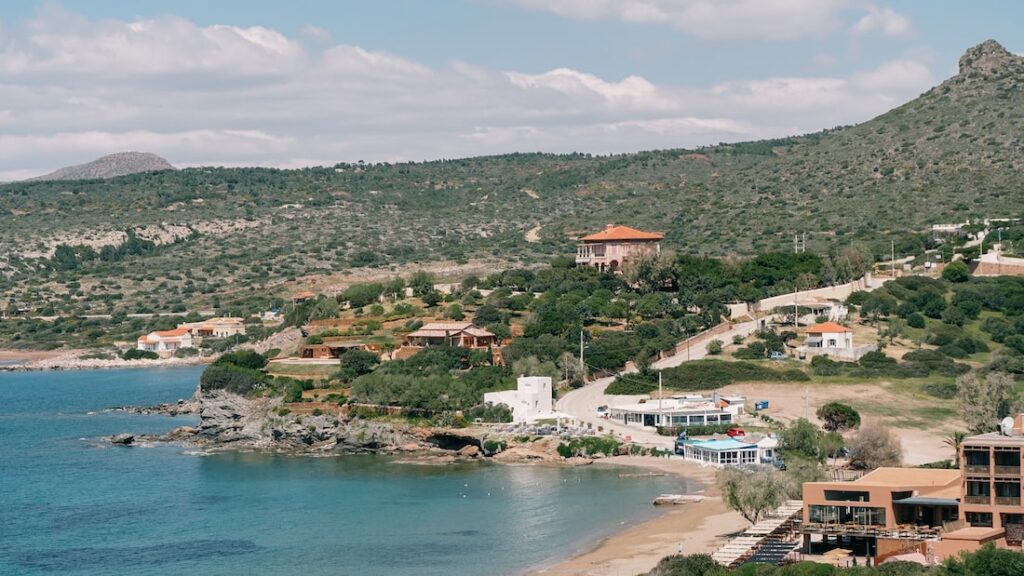
Although it’s rare for travelers to Athens to stay at Cape Sounion, some people prefer it due to its quiet location and the proximity to some majestic beaches. If it’s your first time in Athens, staying downtown is better. However, if you have already visited the archaeological sites and you’d like to swim in the crystal clear water of Kape Beach, then there are a couple of options for you. And there’s a big plus: you can visit the Temple of Poseidon anytime.
So, the best hotels at Cape Sounion are:
Grecotel exclusive resort. That’s the most famous hotel in the area and as its name suggests it’s a resort. The Grecotel at Cape Sounio overlooks the Sounio bay and is next to a pine forest. The Temple of Poseidon is visible from its premises, making it a unique spot. Various restaurants operate at the resort, and the views are breathtaking. See prices and availability for the Grecotel.
Aegeon Beach Hotel. Located straight at the shore, Aegeon is another excellent option for your accommodation at Cape Sounion. The room furniture is handmade, and there’s also an outdoor restaurant with an endless view of the Aegean Sea and Poseidon’s Temple. See prices and availability for Aegeon here.
Final thoughts about Cape Sounion & the Temple of Poseidon
A day trip to Cape Sounion is one of the best things to do in Athens. This is a prime location in the Attica region, not only because of the 5th-century BC Temple of Poseidon but also because of the unique view of the Aegean Sea. Moreover, traveling along the Athens Riviera, you’ll see the landscape of Attica unfolding out of your window. The open sea, the modern settlements, and historic towns like Lavrio are enough reasons to visit Cape Sounion.
Even if you’re on a short journey to Athens, make sure to include a visit to Sounio in your itinerary. It will be one of the best days you will have in the Greek capital -and it’s the best spot to see the sunset in Athens.
More Ancient Greece: Delphi, Mycenae, Ancient Corinth, Acrocorinth, Nemea, Epidaurus, Benaki Islamic Art Museum
Pin it for later
Sharing is caring. Share this travel guide to Cape Sounio with your friends.